
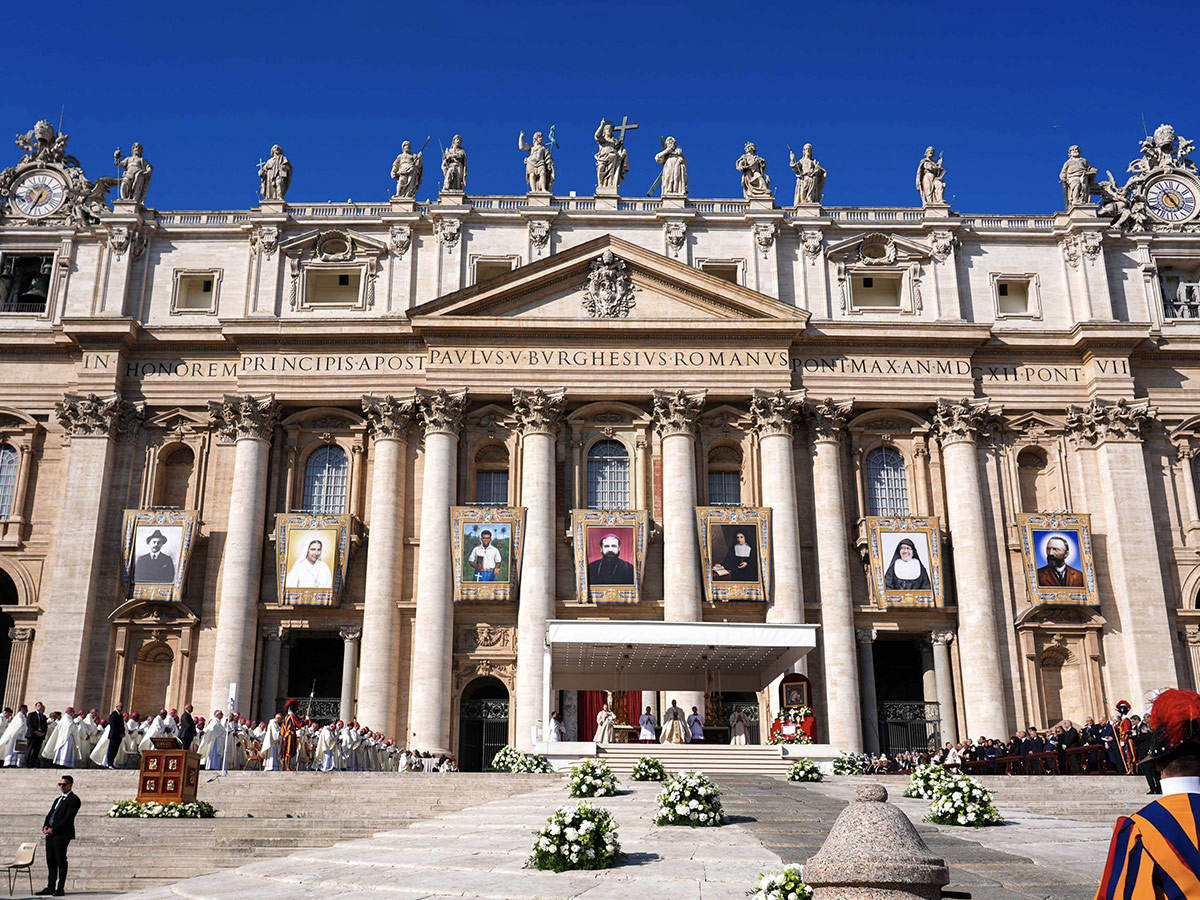
Pope Leo XIV has created seven new saints, including a one-time satanist priest who reconverted to Christianity, at a canonization mass in St Peter’s Square.
Huge portraits of the seven, who included a lay catechist from Papua New Guinea, an archbishop killed in the Armenian genocide, a Venezuelan “doctor of the poor”, and three nuns who dedicated their lives to the poor and the sick, were unfurled from the facade of St Peter’s Basilica at the start of the service.
“Today we have before us seven witnesses, the new saints, who, with God’s grace, kept the lamp of faith burning,” the Pope said.
“Indeed, they themselves became lamps capable of spreading the light of Christ.” In his homily, Pope Leo described the saints as either “martyrs for their faith”, “evangelizers and missionaries”, “charismatic founders” of congregations, or “benefactors of humanity”.
“May their intercession assist us in our trials and their example inspire us in our shared vocation to holiness,” he said. The ceremony, which recognizes that the individuals were examples of exceptional holiness and worthy of universal veneration in the Catholic Church, took place before a crowd of about 70,000 people in bright sunshine.
It was the Pope’s second canonization rite since becoming the first American pontiff on May 8. The most unusual of the new saints was Bartolo Longo, an Italian who went from being a practicing Catholic to taking part in anti-papal demonstrations, becoming an atheist, then a satanist, and eventually being “ordained” to the satanist priesthood.
Longo, who died in 1926, eventually renounced satanism and underwent a profound conversion, dedicating his life to the promotion of the rosary and contributing to the creation of the Shrine of Our Lady of the Rosary of Pompeii, a major pilgrimage site to this day.
The other saints included Peter To Rot, a lay catechist from Papua New Guinea who was killed during the Japanese occupation in the Second World War; the Armenian bishop Ignatius Choukrallah Maloyan, who was killed by Turkish forces in 1915; and Venezuela’s José Gregorio Hernándes, a layman and doctor who died in 1919.
Article written by Philip Willan and originally appeared on TheTimes.com.
 Read Previous Post