
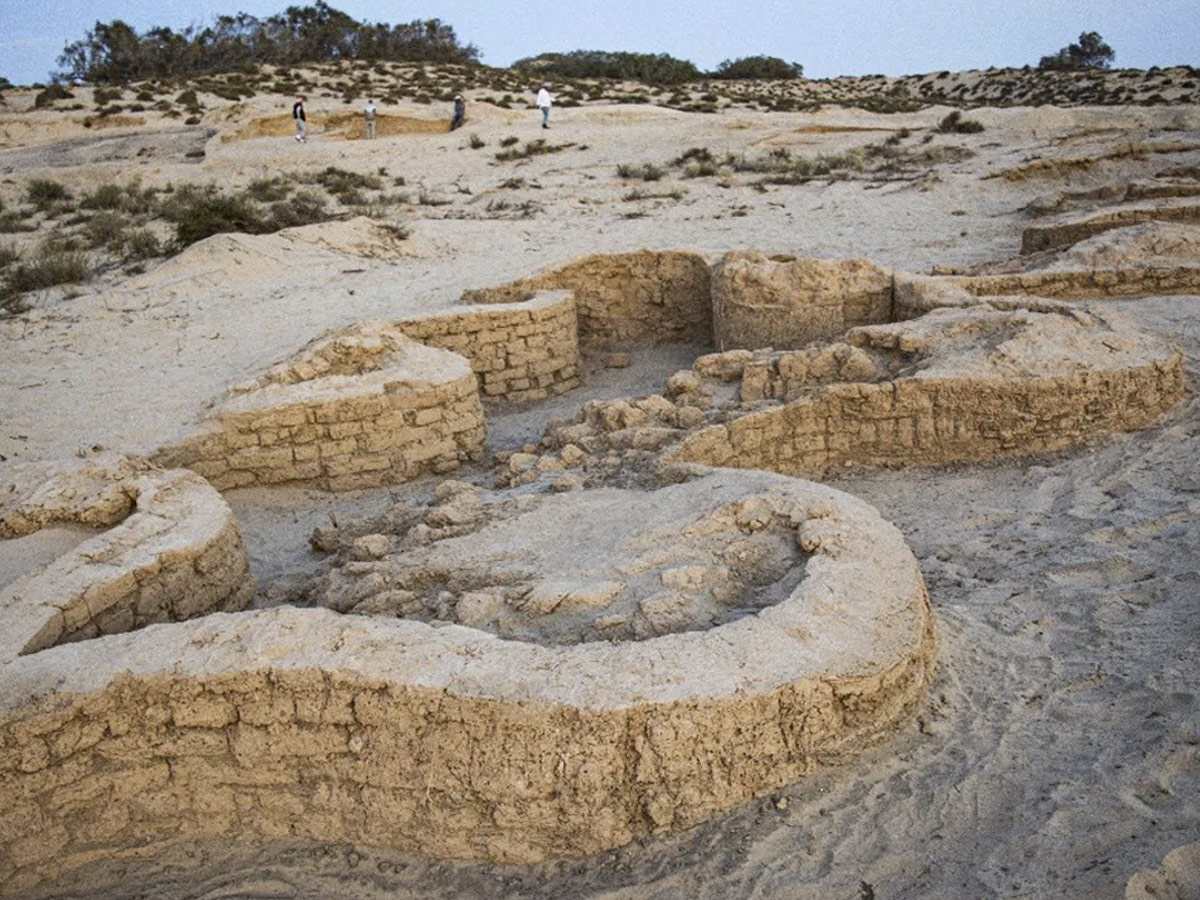
A recently discovered Egyptian fortress could be tied to the biblical account of Moses and the exodus from Egypt. The Egyptian Ministry of Tourism and Antiquities announced the discovery of a military fortress that covers around 86,100 square feet at Tell al-Kharouba in North Sinai. Archaeologists dated the fortress to what is known as Egypt’s New Kingdom era, which lasted from 1550 to 1070 B.C. So far, archaeologists have uncovered eleven defensive towers at the site, a nearly 345-foot southern wall that is over 8 feet thick, and pottery shards. One of the jars discovered had the name of Pharaoh Thutmose I stamped on its handle. Thutmose reigned from 1506 to 1493 BC.
Even more interesting, the fortress was found along what is known as the Horus Military Road, which is referenced in Exodus 13:17: “When Pharaoh let the people go, God did not lead them on the road through the Philistine country, though that was shorter. For God said, ‘If they face war, they might change their minds and return to Egypt.’ So God led the people around by the desert road toward the Red Sea.” The Horus Road is the “shorter” route that leads from Egypt to Canaan. The fortress does date to the time period traditionally attributed to the events of Exodus, further strengthening the Biblical account’s historicity.
In a statement originally in Arabic, Sherif Fathy, Minister of Tourism and Antiquities called the discovery “a tangible embodiment of the genius of the ancient Egyptians in building an integrated defense system to protect the land of Egypt, and tells new chapters of the ancient military history of ancient Egypt, and enhances the status of Sinai as a land that bears unique civilizational evidence throughout the ages.” Secretary-General of the Supreme Council of Antiquities, Mohamed Ismail, noted that the new discovery is “an important step in reconstructing the complete picture of the Egyptian fortification network on the eastern borders during the New Kingdom.” “Every fortress that is discovered adds a new building block to understanding the military and defensive organization of Pharaonic Egypt, and confirms that Egyptian civilization was not limited to temples and tombs only, but was a state of strong institutions capable of protecting its land and borders,” added Ismail. Speaking with Sky New Arabia, Egyptian archaeologist Sherif Shaaban described the Horus Military Road as being built to secure the Egyptian Empire’s expansion into other territories. There was a series of fortresses built along the road with the purpose of gathering and training soldiers. The fortresses were also used as starting points for military campaigns.” This particular fortress “is considered one of the largest and most significant fortresses discovered along the Horus Military Road.”
 Read Previous Post