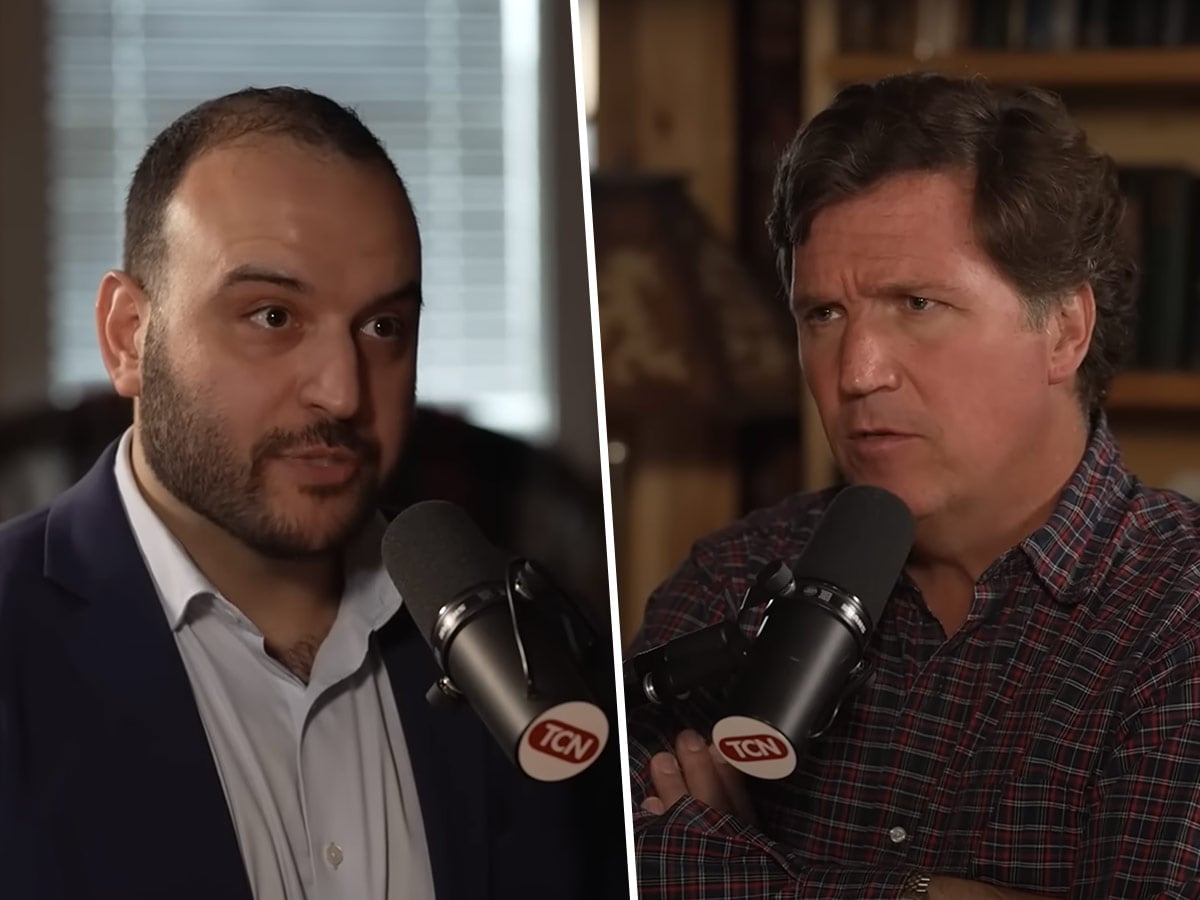
Tucker Carlson is facing strong criticism from Christian leaders after suggesting that the biblical regions of Judea and Samaria are no more real than the fantasy land of Narnia. Carlson claimed during a recent podcast interview with Shahed Ghoreishi, a former U.S. State Department contractor who says he was fired for disputes over language used in statements about Israel.
Carlson’s Controversial Remarks
In the interview, Ghoreishi recounted a clash with David Milstein, senior advisor to Ambassador Mike Huckabee, over whether the U.S. government should refer to the territory as the “West Bank” or “Judea and Samaria.” Milstein preferred the biblical names, while Ghoreishi objected.
Carlson agreed with Ghoreishi, scoffing at the biblical terminology: “Putting Judea and Samaria in an official U.S. government communication, it’s like using the term Narnia or something. It’s not a real place.”
The remark has drawn sharp rebukes from Christians who see Judea and Samaria as central to Scripture and to Israel’s identity.
Christian Leaders Respond
Luke Moon, executive director of The Philos Project, told The Christian Post that Carlson’s comparison shows a lack of biblical understanding.
“Anyone who has read the Bible knows Judea and Samaria are not fairy tales,” Moon said. “These are the same hills where Abraham walked, where David tended sheep, where prophets thundered the Word of God.”
Susan Michael, president of the U.S. branch of the International Christian Embassy Jerusalem (ICEJ), also rejected Carlson’s claim. She emphasized that “Judea and Samaria” are terms that date back thousands of years, while “West Bank” only describes the 19-year Jordanian occupation of the land from 1948 to 1967.
“It is far more accurate to call the region Judea and Samaria, the biblical heartland of Israel,” she stated.
Debate Over Gaza and Journalists
The Carlson–Ghoreishi interview also touched on disputes that Ghoreishi says led to his firing, including a draft statement he wrote opposing the “forced displacement of Palestinians from Gaza” and whether the State Department should publicly mourn journalists killed during the war.
Carlson dismissed Israeli claims that some of those journalists were linked to Hamas, saying the explanation was simply: “They were Hamas. OK, end of conversation.”
Moon countered that the evidence of ties between Hamas and certain journalists is “overwhelming.” He argued, “They held cameras by day and rifles by night. The evidence here is in such abundance that it is impossible to consider the ignorance as anything other than malice.”
The Question of Hamas
Carlson went further, casting doubt on Hamas’ classification as a terrorist organization. “Seems more like a political organization,” he said.
Moon sharply disagreed, calling Carlson “willfully blind” to the group’s atrocities. “When even Hamas calls itself radical Islamist extremists, maybe take them at their word,” he said.
Susan Michael likewise underscored the reality of Hamas’ violence, pointing to its October 7, 2023, massacre in Israel that killed 1,200 people and kidnapped hundreds more. “Hamas is not a political movement but a terrorist organization by its own words and deeds,” she said.
Concern For Christians in the Middle East
Carlson also accused Israel of using U.S. tax dollars to persecute Christians, but Moon pushed back, arguing that the real threat to Christians comes from radical Islamists who seek to erase Christianity from the region.
“Tucker clearly has no clue how religious identity works in the Middle East,” Moon said. “The only true threat to Christians in the region is radical Islamists who want to erase Christians entirely.”
Michael added that Israel has gone to great lengths to protect churches and religious sites, even apologizing after stray munitions tragically hit the Holy Family Catholic Church in Gaza earlier this year.
A Deeper Divide
Carlson’s remarks highlight a growing divide between some political commentators and Christian supporters of Israel. For many believers, Judea and Samaria are not abstract geopolitical terms but sacred places where God revealed Himself to His people.
As Moon put it, “The only people who believe Judea and Samaria to be fictional names are the ones who’ve never opened the Book they claim to believe in.”
For Christians who view the Bible as the ultimate authority, dismissing Judea and Samaria as imaginary is not just inaccurate—it’s offensive. And as the debate over Israel and the Middle East continues, leaders like Moon and Michael insist that Christians cannot afford to be “willfully blind” to the truth written in scripture.
 Read Previous Post