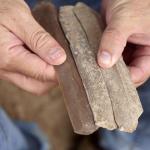

An ancient seal discovered near Jerusalem’s Temple Mount may have ties to the Bible. Archaeologists with the Temple Mount Sifting Project uncovered a seal with the name “Yed[a‛]yah (son of) Asayahu.” Archaeologist Mordechai Ehrlich made the discovery, which was described as a “rare and exceptionally well-preserved clay sealing, impressed by a stamp seal inscribed with ancient Hebrew letters.” Even more impressive, the seal bears a fingerprint, most likely of its former owner. Archaeologists dated the seal to around the 7th or early 6th century B.C. Marks on the back of the seal indicate it might have been used to seal a bag or container.
The date means the seal is from the days of King Josiah, whose servant, Asayahu, is mentioned in the Bible in II Kings 22:12. “Given his prominent role, it is reasonable to assume that his son, Yeda‛yah, may have also served in a high-ranking capacity, either at the same time or shortly thereafter,” the project wrote. “Historically, seals like these were reserved for officials of high rank, and many individuals named in similar discoveries from Jerusalem have been directly identified with biblical-era officials,” project officials said, citing it was “highly plausible” the seal could be connected to the Asayahu mentioned in the Bible.
Archaeologist Zachi Dvira, co-director of the Temple Mount Sifting Project, said the find is especially unique. “This is only the second time since the Temple Mount Sifting Project began over 20 years ago that we’ve uncovered a sealing with such a complete inscription — nearly every letter is clearly legible,” he said. The inscription was so legible that the project decided to announce its find earlier than typical. “However, in this case, the artifact was very recognizable, and Dr. Anat Mendel-Geberovich, who works in our lab, is one of the leading experts in ancient Hebrew script. So we decided to move forward, also because we felt it was very significant that the sealing was found just before Tisha B’Av.”
“Obviously, we are not sure that the Asayahu mentioned on the sealing is the same that appears in the Bible. However, several such artifacts found in the area of the Temple Mount carry biblical names, and it does make sense, because these were not objects used by common people,” said Dvira. He is hopeful that new sifting techniques will help the project with many more discoveries. “Because of their small size, clay sealings are difficult to identify,” he said. “In the past, most of the bullae came from the antiquity market, but as we developed new techniques to sift through massive amounts of dirt, more excavations have started to either employ our sifting services or carry out their own sifting. Now, there are maybe 10 or 20 times more known bullae found during controlled archaeological work than in the past.”
 Read Previous Post