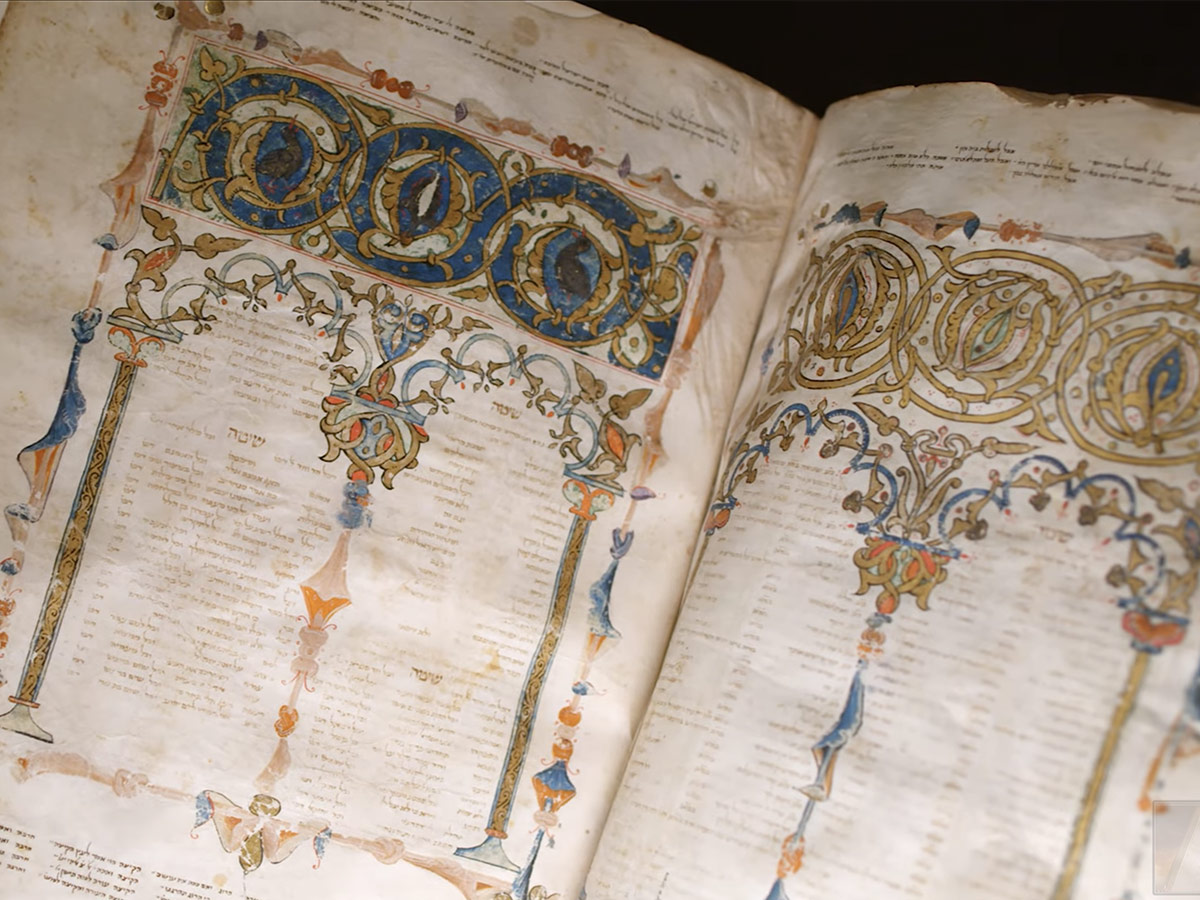
An ancient medieval Bible has made its way back to Israel after a centuries-long absence. Known as the Shem Tov Bible, the medieval Bible dates from the 14th century and was authored by kabbalist Rabbi Shem Tov ben Abraham Ibn Gaon. The Bible was originally written in 1312 in Soria Spain. Ibn Gaon then took the codex with him to the land of Israel after a two-year journey in 1315, where it remained after his death in 1330. It spent the next few centuries in the Middle East before making its way to North Africa. Collector David Solomon Sassoon purchased the codex in the early 20th century before later selling it to European collectors. It was then purchased in 1994 by a Swiss collector Jaqui Safra before being sold at auction at Sotheby’s for $6.9 million to Terri and Andrew Herenstein in 2024. The Herensteins have placed the codex on long-term loan at the National Library of Israel in Jerusalem, bringing about the codex’s return. The family released a statement saying they were “delighted” to bring the book back to Israel. “We are delighted to know that the Shem Tov Bible is incorporated into the Library’s permanent exhibition of its greatest treasures, and equally delighted that the manuscript will be digitized to the highest standard, making it available worldwide, for study, research or to simply enjoy its beauty.”
What is unique about the codex is its hidden meanings and intricate designs. Ibn Gaon was a Jewish mystic who was familiar with the “Jewish faith, Christian Gothic aesthetics and Islamic and Iberian motifs” according to Sotheby’s. Shaul Seidler-Feller, a Senior Specialist of Judaica at Sotheby’s, noted how unique the codex is. “This is the only example of a medieval Hebrew Bible that has letter-forms throughout the Pentateuch section that have been modified to so closely follow an ancient tradition that goes back to the first millennium of the Common Era,” he said. The images in the codex represent Ibn Gaon’s knowledge of the main faiths of medieval Spain, with the illustrations calling up numerous motifs of the Christian, Jewish, and Muslim tradition. “These motifs were inspired by the Islamic and Christian visual languages of the period, adapted to the long-standing Jewish tradition of beautifying ritual objects,” a statement noted.
The National Library celebrated the codex’s return to Israel. “Receiving this manuscript, especially at the time of Shavuot, which celebrates the giving of the Torah, is profoundly significant,” the chairman of the National Library of Israel, Sallai Meridor, said. “Having traveled from Spain to Jerusalem, Baghdad, Tripoli, London and Geneva, the Shem Tov Bible has come full circle and is now back home, returning to the very place where Rabbi Shem Tov ben Abraham Ibn Gaon lived and intended for it to be, in the land of Israel, and now in Jerusalem. We are grateful to the Herenstein family for turning what might otherwise have been a dream into a reality.”
 Read Previous Post