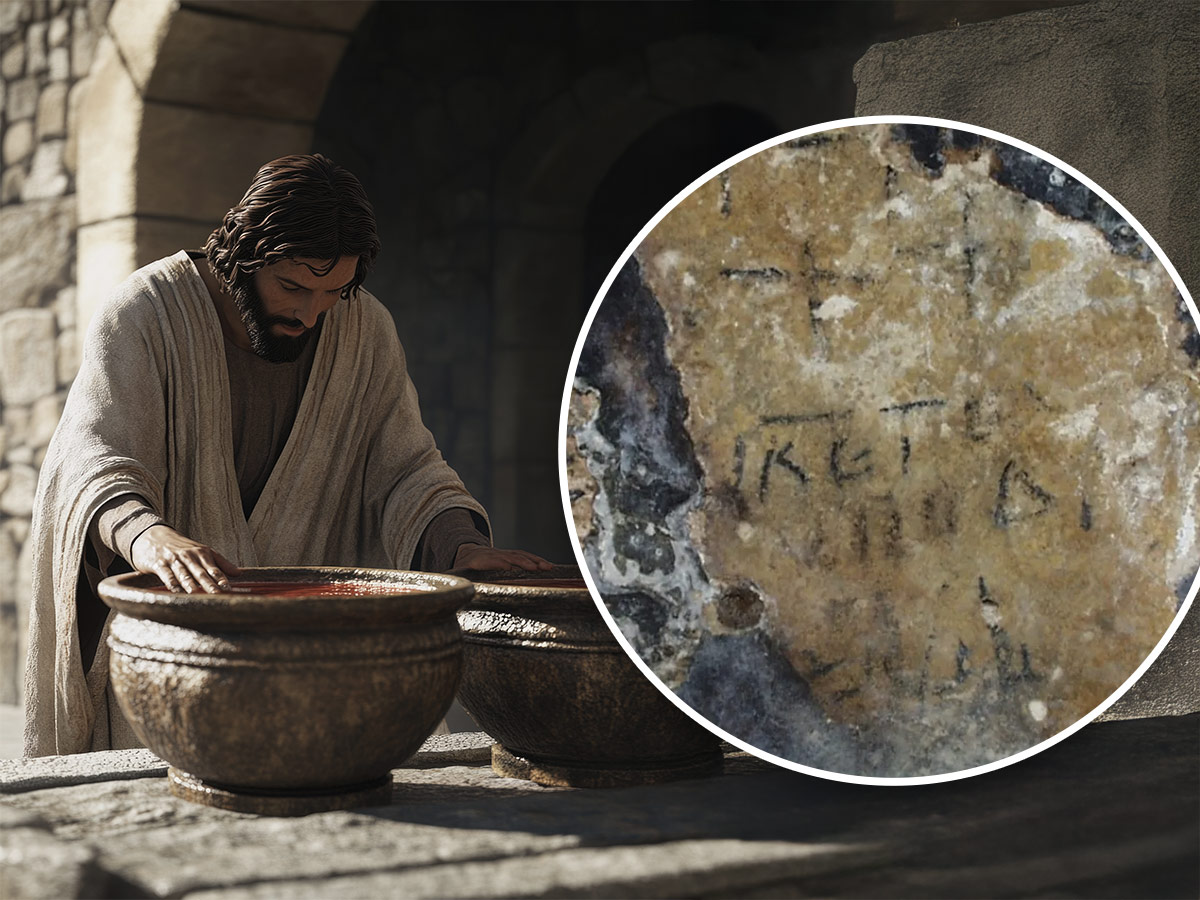
Archaeologists believe they may have discovered the actual site of Jesus’s first miracle, as described in John 2. In John’s account, Jesus and his disciples are attending a wedding at Cana when the wedding feast runs out of wine. Jesus’s mother, Mary, asks him to intervene, to which Jesus responds, “mine hour is not yet come” (vs 4). After which, Jesus instructs the servants to fill six large jars with water. When they are served to the guests, the water has miraculously turned into wine.
Originally, archaeologists had believed this miracle had occurred at a site in Kafr Kanna, located three miles northeast of Nazareth, where Jesus originally made his home. However, an excavation at Khirbet Qana, 7.5 miles northwest of Nazareth, is now believed to be the actual site of Cana. Excavations at the site go as far back as 1998, when archaeologists led by Professor Douglas Edwards uncovered signs of a Jewish village that existed between 323 BC and 324 AD. Dr. Tom McCollough, who now leads the excavations, has now found an underground series of caves containing Christian worship sites. In one site, archaeologists discovered an altar built from a sarcophagus lid. “On the shelf with the two stone jars, there was room for four more. Six stone jars could hold the water that Jesus turned into wine. All this points to the fact that Khirbet Qana was considered the Cana of the New Testament from a very early period,” said Dr. McCollough. The jars could hold 20 to 30 gallons of water, fitting the description in John’s account.
Despite the fact that Kafr Kanna has long been considered the site of the miracle, Dr. McCollough stated that Khirbte Qana offers the most compelling evidence. “[No other village] has the ensemble of evidence that makes such a persuasive case for Khirbet Qana,” he said. There is evidence that shows Christians venerated Khirbte Qana as the site of the miracle long before they began to do so at Kafr Kanna. In fact, no excavations had been able to locate any sign of a Jewish settlement at Kafra Kanna that would have dated during Jesus’s time. Archaeologists also uncovered a Beit Midrash, a Jewish house of study dating from the Roman period as well as coins from the Maccabean revolt. “Our excavations show that this was in fact a thriving Jewish village located in the heart of much of Jesus’ life and ministry,” concluded McCollough. He confirmed his conclusion to Pen News. “The pilgrim texts we have from this period that describe what pilgrims did and saw when they came to Cana of Galilee match very closely what we have exposed as the veneration complex. There is no other village that has the ensemble of evidence that presents such a persuasive case for Khirbet Qana.”
 Read Previous Post