
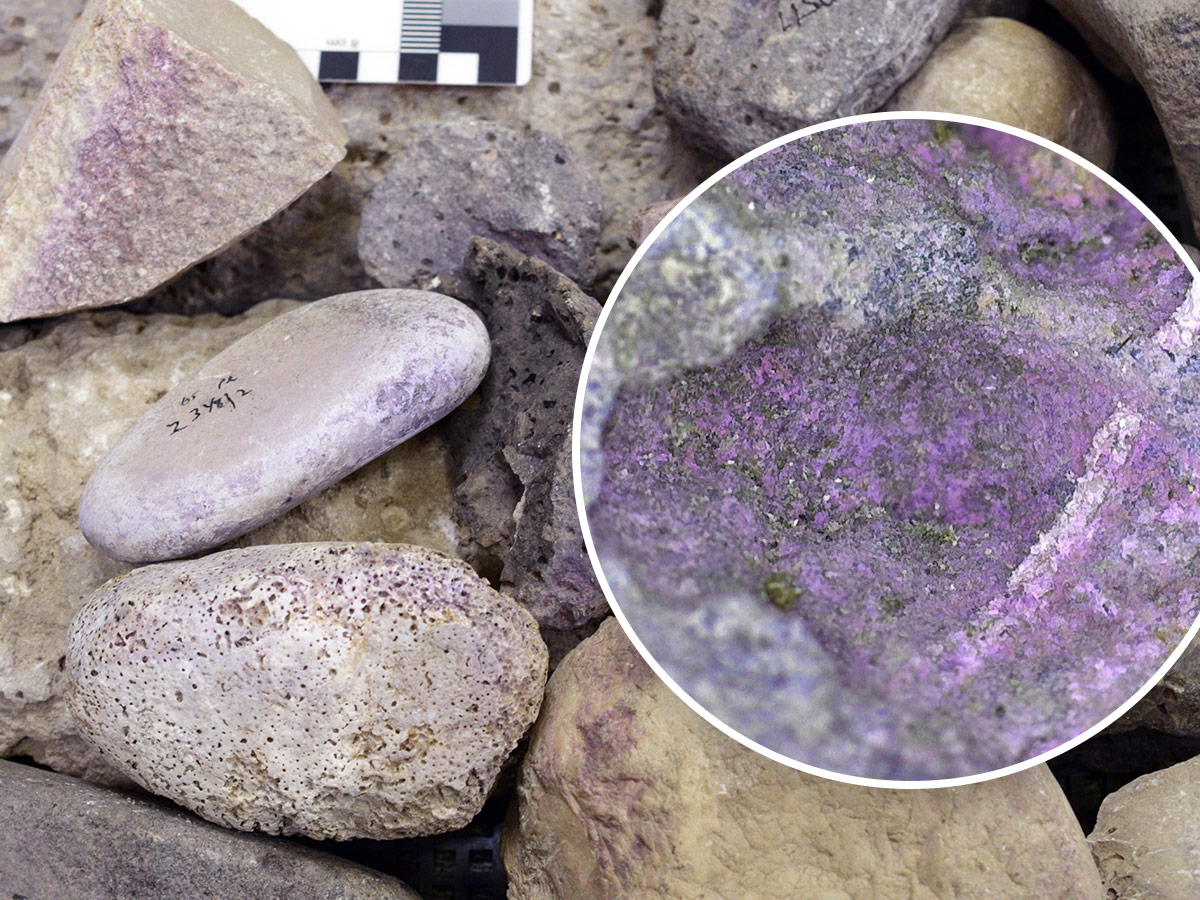
Scientists have announced the discovery of an ancient dye “factor” south of the Israeli city of Haifa. Called Tel Shiqmona, it is a mound on the coast of the Mediterranean Sea which “can unequivocally be identified as a specialized facility for large-scale and long-term production of the lucrative purple dye,” according to researchers. The site is dated to around 1100 BC, predating both reigns of King Solomon and his father, King David. The Hebrew Bible mentions purple dye several times, including God requesting purple linen as an offering.
According to researchers, the site is incredibly unique. “It is the only site in the Near East or around the Mediterranean – indeed, in the entire world – where a sequence of purple-dye workshops has been excavated and which has clear evidence for large-scale, sustained manufacture of purple dye and dyeing in a specialized facility for half a millennium, during the Iron Age,” stated the paper. Purple residue found on vats and tools indicates the site’s purpose. Researchers also discovered 135 purple-stained artifacts at the site. The vats were massive, standing around three feet tall and able to contain around 92 gallons, indicating they were used for dyeing whole garments. “Given their substantial weight when full, it is unlikely that the vats were intended to be moved, nor could they be tilted. Producing the dye in these very large vessels and then transferring it to other containers for dyeing (at Shiqmona or elsewhere) does not seem to be a plausible reconstruction of the process,” said the paper. “For the first time, we have identified a complete production system in which significant quantities of purple dye were produced using specialized tools designed to streamline the process. The scale of the operation confirms that Shiqmona was an extraordinary production center for its time,” said study co-author Ayelet Gilboa.
The scale of the site reveals that Tel Shiqmona would have served as a wide-scale business. Its seaside location also makes it an ideal hub for such an activity, given that purple dye, referred to as Tyrian purple, was harvested from sea snails which secrete “a slightly greenish fluid, which oxidizes upon exposure to air and gradually turns purple,” according to the study’s lead author, Golan Shalvi. To bind the fluid to thread required a process that scientists still don’t currently understand. “I imagine it as a very smelly place—especially to a modern nose—since the production process emitted a terrible odor,” Shalvi suggested. “I picture wool fleeces dyed in various shades drying outside and inside the buildings, which may have given the site a purplish-reddish-blue hue.”
 Read Previous Post