Beliefnet
  
advertisement

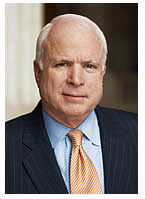
John McCain: Constitution Established a 'Christian Nation'


« Prev Page | Next Page »
Page 1 | 2 | 

Print Page

In a recent interview, President Bush said that in attempting to spread freedom abroad, including in Iraq, he was operating from a “theological perspective.” Did that perspective give him an overconfidence that blinded him to the difficulties of prosecuting the Iraq war?

On the issue of the war in Iraq and the conduct of it and President Bush's public statements about it, let me just go back. We were founded as a nation on Judeo-Christian principles. There's very little debate about that. And I think the noblest words ever written are, "We hold these truths to be self evident that all, all people are created equal and endowed by their Creator."

So if you believe in that fundamental principle, then of course you believe in the desirability and the attractiveness of helping bring to those God-given rights to people all over the earth. What has happened, though, throughout our history is a tension between realpolitik and Wilsonian principles…. [which are] clearly defined in "We are endowed by our Creator." But realpolitik says that if you overstretch, if you go places you shouldn't go, then the penalty you pay is higher than anything you might have hoped to have gained.

So, that's the tension, and it's good that it's there. So, do I believe that Iraq is an object lesson? Not as much as others do because after the initial victory, if we'd have handled it right, everybody would be happy with Iraq today because Saddam Hussein is gone and they have a country that's functioning.

The problem is, we mishandled it terribly. I do agree and most people do - we're a shining city on a hill. Has that shining city been dimmed and tarnished by our reputation in the world today? Of course, of course it has been. But, I still believe we have that role and mission to fulfill in the world.

But the mistakes that the President made in Iraq were not born of “theological perspective” hubris?

There were serious mistakes that were made by—speaking of religions, I think the Greek god hubris played a role in Mr. Rumsfeld's decisions. It was just terribly mishandled. But I don't think it had a lot to do with Christian principle as much as it had to do with terrible mismanagement.

Many prominent pro-life activists have objected to your campaigns even though you have a more staunchly pro-life record than any of the Republican presidential frontrunners: Rudy Giuliani, Mitt Romney, or Fred Thompson.

 I find it a bit ironic. Part of it may have had to do with campaign finance reform…. But I continue to establish relationships with people like [televangelist] John Hagee, Pastor Richard Land [president of the Southern Baptist Convention’s public policy arm], my own Pastor Dan Yeary and others in the evangelical community. There are issues, also, that I'm in agreement with them on such as climate change and support for the state of Israel. I hope that I can continue the dialog.

How much did your losing the GOP nomination in 2000 have to do with you denouncing Christian Right leaders as “agents of intolerance,” which happened shortly before your decisive loss to George W. Bush in the South Carolina primary?

I don't know. I'm sure it probably must have had an effect. But Reverend Falwell came to my office, said he wanted to put our differences behind us. I am so grateful that that happened. Others have come to me, [like] the anti-war activists of the Vietnam War came and [have] said, ‘I believe in redemption and reconciliation.’ That is a fundamental belief of mine and I think it's a Christian principle, as well.

A lot of Republican activists say the separation of church and state is a myth. What do you think?

Our Founding Fathers believed in separation of church and state and they stated it unequivocally. But, they also continued to emphasize the Christian principle. In God We Trust or [all men are] created equal—every statement that they made had to do with the belief in a Divine Creator… They sought guidance from their Creator. So, when some people interpret their desire for separation of church and state as a failure to acknowledge the importance and influence of our Creator, I think that they have a different view of history than I do.

In your new book Hard Call, the chapter dealing most with religion, besides one on Reinhold Niebuhr, is a chapter about Abraham Lincoln. That’s kind of surprising.

The thing that really did impress me is how Lincoln, once he became president, became far more, not only devoted to his religion, but dependent in some ways on his faith in God. And, you know, part of that is really understandable. The carnage of the Civil War, can you imagine how it weighed on him? ….He made a promise to God that he would free the slaves, which was not a popular move in the North, much less in the South. But, still, it was an act that was really because of his religiosity.

We have to rely on our faith sometimes to give us guidance, not to help us make a specific decision, but to help us maintain our moral and spiritual values that then allow us to make the right decision, even if sometimes it's politically expensive.

Some have criticized President Bush for giving his faith to big a role in shaping his decision. In 2004, some criticized John Kerry for saying his faith didn’t inform his positions. Where do you stand?

My faith obviously informs my decisions. It informs my strengths as well as my weaknesses. And it makes me aware of how imperfect a person I am. And it is vital in helping me maintain the principles upon which I conduct my political life, as well as other parts of my life…. when I have taken decisions which were not in keeping with those principles, interestingly enough, I've always paid a heavy price.

Could you give an example?

One where I paid a price was that the Confederate flag was flying over the State Capitol in South Carolina. I talked with my advisor, [who] said it's a state issue and we shouldn't be involved in it. But it was an offensive symbol to so many Americans. I took a hike and I lost [the 2000 South Carolina primary] anyway. I could name you other times that I have been weak and not stuck with those principles and not relied on my faith and on prayer and in a way, maybe it's good that I've paid--I didn't think so at the time--but that I've paid a price.

In Hard Call’s chapter on Reinhold Niehbur, you write about his evolution from sharing a Social Gospel emphasis on human perfectibility to a more fundamentalist Christian emphasis on human sinfulness. As someone raised in a mainline Christian denomination but now attending a Baptist church, have you undergone a similar transformation?

On the subject of Reinhold Niebuhr, I think his realization and appreciation that we have to combat evil even if that means that we violate some of God's commandments was an interesting journey that he took, particularly when at the end he arrived at the conclusion that I agree with—we are not perfect. We are imperfect. And at the end of the day, for our sins, we have to ask for the judgment of a loving God. He had to confront with his conscience this overwhelming evil that he couldn't sit by. But, yet, at the same time, he violated one of his fundamental principles of pacifism.

And yet you write that Niebuhr vociferously opposed “America’s missionary zeal to promote democracy abroad,” viewing it as a “heresy” rooted in human arrogance. It’s impossible to read those words and not think of Iraq.

I have great respect for Niebuhr. It doesn't mean that I always agree with his conclusions. And by the way, I think that Niebuhr would have opposed the Vietnam War, because I believe the only reason why he opposed Nazism and Communism is because he thought it was a transcendent threat to everything that we believe in as Christians or Judeo-Christians.

So I think that when we made the decision to go to war in Iraq, that we believed and so did every other intelligence agency that we faced a transcendent challenge of nuclear weapons, weapons of mass destruction.

Related Features


« Prev Page | Next Page »
Page 1 | 2 | 

Print Page

advertisement
Poll
Whom do you prefer for the Republican nomination?
Sam Brownback
Jim Gilmore
Rudy Giuliani
Mike Huckabee
Duncan Hunter
John McCain
Ron Paul
Mitt Romney
Fred Thompson
Tommy Thompson

vote       View Results
Talk About It

Related Features


Faiths & Practices | Inspiration | Health | Entertainment | Comfort & Support | Family & Home
Relationships | News & Blogs | Audio/Video | Discussions | Ecards | Prayer Circles | Meditations | Quizzes
Copyright © 2008 Beliefnet, Inc. and/or its licensors. All rights reserved.
Use of this site is subject to Terms of Service
and to our Privacy Policy. Constructed by Beliefnet.