To find movies that focus on Islamic issues and Muslim culture, independent films--especially the film festival circuit--is the way to go. The Human Rights Watch International Film Festival, which visited New York in June and will travel around the U.S. in the coming months, is generally a goldmine for these kinds of films. And this year's festival is no exception: It includes several insightful documentaries and dramas about Muslims.
Beliefnet Islam editor Dilshad D. Ali and editorial intern Hala Shah review seven films from the festival, which runs in New York until the end of June:

The Road to Guantánamo
Michael Winterbottom, Mat Whitecross, UK
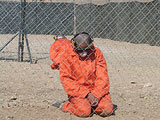 What begins as one man’s trip to Pakistan to meet his future bride becomes an ill-fated journey as four friends out to enjoy the end of bachelorhood travel from Britain to Pakistan, and then to Afghanistan where the most unfortunate of circumstances brings them finally to Guantánamo Bay Prison in Cuba in the gritty docudrama “The Road to Guantánamo.”
Though you expect the re-enactment scenes and the men’s accounts of their motivation will explain how and why such frightful events took place, you still wonder how a group of young British Muslims could become tumble weeds in a desolate, war-ravaged country. In short, the men hear a Friday prayer sermon in Pakistan encouraging them to go to Afghanistan for humanitarian relief work.
Impulsively they decide, almost like tourists, to see what the country is like. However they soon learn that being British does not give them any sort of protection. After one of the men is supposedly killed by a U.S. bombing raid, the remaining three are accidentally rounded up with other supposed Al-Qaeda members, arrested by the Northern Alliance, and eventually flown to Guantánamo Bay Prison in the infamous sack-like, hoods.
The last half-hour of the film paints a grim, disturbing picture of the conditions at Guantánamo. The three British Muslims are tortured physically and emotionally, completely cut-off from their families, denied the right to a fair trial, and deprived of the right to pray. Though the men are eventually released, they return religious and aware that they can never return to their old lives.
The scenes of what they and the remaining Guantánamo prisoners--five hundred the film claims— suffer endure long past the closing credits. The “Road to Guantánamo” only strengthens the prison’s image as a perpetually lawless, corrupt, and inhumane death-sentence.
--Hala Shah
Iraq in Fragments
James Longley, USA
What makes James Longley’s “Iraq in Fragments” so incredibly special is the length of time (2002-05) he took to explore the effects of Saddam Hussein’s regime and the subsequent war waged in Iraq by the United States. For a country that is in the news on a daily basis, very little is known about what its people are truly experiencing at a base level.
This cinema verite-style documentary is the right antidote to the two-dimensional Iraq we usually see. Longley takes his camera into the most intimate and frenzied moments, allowing the viewer to be absorbed into what different Iraqis are living minute to minute. We see the country in three parts and learn that it is an amalgamation of religious sects, different ethnicities, varying poverty levels, and distinctive outlooks on the country’s situation.
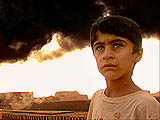
This Sundance award-winning film echoes the way the country has splintered under Saddam’s rule and then the war by telling three stories: Mohammad, a young boy in Baghdad who works as an auto mechanic’s assistant, the volatile Shi’a movement led by Moqtada al-Sadr in Najaf, and two Kurdish brick-laying families in northern Iraq.
Each part flourishes without narration or editorializing by letting the individuals tell the story with examples and comments. From Mohammad’s struggles in school and with his boss to the footage of a brutal military raid against Shi’as in Nasiriyah to the thoughts of Mahmoud, who wants his youngest son to be an imam—each story spells the current situation of Iraqis: A fragmented country searching for something--religious, political, or economic stability--to give them some hope.
--Dilshad D. Ali
Winter in Baghdad
Javier Corcuera, Spain
It started, explained director Javier Corcuera at the Emirates Film Festival in February, from ordinary Spanish people who mobilized before the Iraq war began: Regular people--housewives, professors, nuns, war veterans--traveled to Iraq and acted as human shields at water, oil, and all other types of production plants. The idea was that, with civilians present, perhaps the bombing and war would not commence.
Corcuera took his cameras to follow these people and in turn found the real activists and victims, the Iraqis themselves. And so he discovered four young 14-year-old boys who came to represent the hope, innocence, destruction, and future of Iraq. “Winter in Baghdad” focuses on these boys on the eve of the war in 2003 and extrapolates from their lives to show the simple act of what happens when war is thrust upon a country.
The four boys sit on a wall overlooking the Tigris river at the start. One simply states what they all feel: “I do not want this war to happen. I hope nothing happens.” After that interview Corcuera returns to Spain. And the bombings begin, and Baghdad falls, and the director discovers that that very wall where the boys sat was destroyed by a bomb.
Corcuera returns, determined to find the boys. But with no point of reference and a country in ruins, the search yields countless other tragic stories, until he finally finds them again—selling black-market petrol, shining schools, and searching for bricks. This is not the proverbial “coming full circle.” This is an entire population with varying opinions on the whether the fall of Saddam was a good thing.
But they do seem to agree on one thing: The war, which wages on, has stripped them of hope. Faith in Islam, faith in humanity, faith itself is a lost commodity, says one elderly Iraqi who lost his entire family. Or as the mother of one the four boys sadly says, “His soul is tired.”
--DDA

Shadya
Roy Westler, Israel
To watch “Shadya” is a frustrating lesson in the sustaining power of clichés—how a “typical” Muslim Arab male treats women, what marriage does to a woman’s independence, what befalls brash youngsters who are completely self-motivated. The tragedy is that "Shadya" doesn't force these clichés for cinematic sensationalism. They are truly a way of life for the film’s star.
Shadya Zoabi is a young Israeli-Arab Muslim and the 2003 World Shotokan Karate Champion. She brims with self-confidence and is supported by a doting father in spite of her macho brother’s obvious disapproval for her lifestyle. “I’m different. This is the way I am,” she says at the beginning of the documentary. “But the bottom line is I’m an Arab Muslim, right?”
Being Muslim doesn’t mean much to Shadya, but it does to her judgmental brother. He may justify his thinking with conservative Islamic principles (that she acts immodestly, she doesn’t pray), but he truly outs himself as an Arab male cliché when he says that women must serve men and they must stay at home to cater to the family.
Shadya is confident that this won’t be her life after marrying her fiancé, Morad, who early in the film say he will support her karate. But he also turns into the cliché of a macho married husband when, immediately after their wedding, he forbids Shadya from competing and tells her coach that she must take care of him first.
It’s all extremely exasperating to watch. I know there must be more to the story. How does Morad explain his about-face? How can Shadya so quickly and completely change into a meek housewife? And most disturbing, why does her formerly supportive father cast her off after marriage and start focusing on her younger sister, who also is a karate champion?
There’s no narrative explanation from director Roy Westler; no insight into why Shadya chose to let this happen to her. The large-than-life Shadya is reduced to a shrinking violet, telling the filmmaker to turn the cameras off because her husband’s getting mad. “So that’s it,” she says, smiling hollowly for the camera.
--DDA
Avner Faingulernt and Macabit Abramzon, Israel
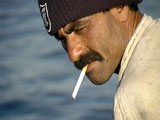
Two Palestinian and two Israeli fisherman battle volatile seas and spend their summers and winters together on an isolated beach wedged between the border of Israel and Gaza, where survival depends on a balance of force and bonding in “Men on the Edge--Fishermen’s Diary.” In telling their story filmmakers Avner Faingulernt and Macabit Abramzon, discover an astonishingly accurate microcosm of the Israel-Palestine conflict.
Amid the overflowing machismo, sexual jokes, and intense feuding, a symbiotic relationship unites the four men to create a fragile brotherhood that is tested during the four years the film covered. The Palestinians are the experts with the boats and fishing gear who teach the inexperienced Israelis ancient fishing techniques. In return the Palestinians are allowed to fish in Israeli waters by virtue of the Israelis’ presence.
Lingering in the men’s consciences is the threat that at any moment, personal or political disputes could beach their boats. Those fears are realized one summer when a knife-fight erupts between a different group of Palestinian and Israeli fisherman. Our four men become weary of returning to the seas. After eventually returning to work, the boats are soon beached again by the Al-Aqsa Intifada. These problems spell a certain death for their brotherhood.
The film’s drawback is the confusing juxtaposition of scenes and the heated debates between the fishermen. But in a post-show discussion, Abramzon explained that “The purpose of the editing was to leave it as natural, rough, and rude as it really happened.”
The fishermen reunited to view the film. Abramzon said that after bickering throughout the film, the men sat silent for ten minutes at its conclusion, “until Suheil [one of the Palestinian fishermen] broke the ice and said ‘The film tore my stomach.’ Then Elli [one of the Israeli fishermen] replied, ‘You see, you see. No one is to blame. We are all victims.’”
--HS
They Call Me Muslim
Diana Ferrero, U.S./Italy
The premise is quite clear, almost too simplistic even. For a government to force a Muslim woman to take off her hijab (headscarf) or to wear one presents two extreme relationships with Islam, neither of which is fair in a world where the right to freedom of religious expression (or lack of it) should be paramount.
Director Diana Ferrero’s two-toned approach to the hijab issue is that clear in her short documentary, “They Call Me Muslim.” The film focuses on two women, Samah in France and Kay X. in Tehran.
Samah, an 18-year-old university student, had felt the brunt of France’s 2004 law banning all forms of religious expression in public school in order to toe a rigid secular line. She was forced to remove her scarf during school hours. Now, as a university student, she is free to wear it. She wonders, what is the big deal? In 2004, 47 girls were expelled because of the law. There were no expulsions related to Christian crosses or Jewish skullcaps, according to the film.
In Tehran, 33-year-old Kay X. adheres to her country’s 1979 law that all women must observe the hijab by lightly covering her hair, or wearing a hat in the wintertime. Her sanctuary is her home, where she comfortably appears in front of the camera in a camisole and shorts: “They call me Muslim, because my mom was Muslim, my dad was Muslim. But do you see me as a Muslim? What you have in your mind for a Muslim person?” she says.
Ferrero’s point is quite clear: Both extremes are insulting to women the world over. It’s an admirable viewpoint, especially for the moderate Muslims who take Islam’s credo to heart--that there is should be no compulsion in religion.
--DDA
Smiling in a War Zone
Simone Aaberg Kaern and Magnus Bejmar, Denmark/Sweden/Germany/Finland
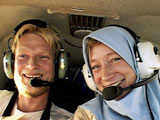
The story of a journey is a well-worn cinematic tool used by countless filmmakers. And yet we continue to flock to that story, to learn as the characters learn; to travel as they travel. And so when artist and pilot Simone Kaern embarks on a flight from Denmark to Kabul to make an Afghani girl’s wish come true, she inexplicably draws us in.
Kaern’s “Smiling in a War Zone” is her own story of fighting for free skies. Kaern, who draws inspiration from female pilots of the past, reads an article one morning about Farial, an Afghani girl in Kabul who wants to fly, to become a fighter pilot. That’s all it takes. Kaern buys a 40-year old Piper-cup model of a teeny-tiny airplane that runs on super unleaded car gasoline, and along with her boyfriend Magnus takes off.
What motivates her wild decision? “If Farial gets to fly where women are even forbidden to ride a bike, that will be my personal contribution to freeing the sky,” Kaern says. Her plane can only travel three hours at a time, and she doesn’t have visas and permission for most of the places she is to travel through (Sarajevo, Turkey, Iran, and Afghanistan), but she is determined.
The journey is riveting, but the film suffers from poor quality and strange half-animated interludes. But all that aside, her fight for free skies makes a for a compelling film. She finally makes it to Kabul and takes Farial up in the skies. But Kaern butts up against an Afghani patriarchal society that still invokes conservative Islamic and Taliban-esque rules for women. You can make the journey, but you can’t always win the fight.
--DDA