 |
|
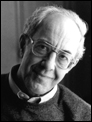
| Henri Nouwen. Photo by Kevin Dwyer |
The resistance to praying is like the resistance of tightly clenched fists. This image shows a tension, a desire to cling tightly to yourself, a greediness which betrays fear. A story about an elderly woman brought to a psychiatric center exemplifies this attitude. She was wild, swinging at everything in sight, and frightening everyone so much that the doctors had to take everything away from her. But there was one small coin which she gripped in her fist and would not give up. In fact, it took two people to pry open that clenched hand. It was as though she would lose her very self along with the coin. If they deprived her of that last possession, she would have nothing more and be nothing more. That was her fear.

When you are invited to pray, you are asked to open your tightly clenched fist and give up your last coin. But who wants to do that? A first prayer, therefore, is often a painful prayer because you discover you don’t want to let go. You hold fast to what is familiar, even if you aren’t proud of it. You find yourself saying: "That’s just how it is with me. I would like it to be different, but it can’t be now. That’s just the way it is and this is the way I’ll have to leave it." Once you talk like that, you’ve already given up believing that your life might be otherwise. You’ve already let the hope for a new life float by. Since you wouldn’t dare to put a question mark after a bit of your own experience with all its attachments, you have wrapped yourself up in the destiny of facts. You feel it is safer to cling to a sorry past than to trust in a new future. So you fill your hands with small, clammy coins which you don’t want to surrender.
You still feel bitter because people weren’t grateful for something you gave them: you still feel jealous of those who are better paid than you are; you still want to take revenge on someone who didn’t respect you; you are still disappointed that you’ve received no letter, still angry because someone didn’t smile when you walked by. You live through it, you live along with it as though it doesn’t really bother you...until the moment when you want to pray. Then everything returns: the bitterness, the hate, the jealousy, the disappointment, and the desire for revenge. But these feelings are not just there; you clutch them in your hands as if they were treasures you don’t want to let go. You sit wallowing in all that old sourness as if you couldn’t do without them, as if, in giving them up, you would lose your very self.
Detachment is often understood as letting loose of what is attractive. But it sometimes also requires letting go of what is repulsive. You can indeed become attached to dark forces such as resentment and hatred. As long as you seek retaliation, you cling to your own past. Sometimes it seems as though you might lose yourself along with your revenge and hate—so you stand there with balled-up fists, closed to the other who wants to heal you.
Often you will catch yourself wanting to receive your loving God by putting on a semblance of beauty, by holding back everything dirty and spoiled, by clearing just a little path that looks proper. But that is a fearful response—forced and artificial. Such a response exhausts you and turns your prayer into torment.
Each time you dare to let go and to surrender one of those many fears, your hand opens a little and your palms spread out in a gesture of receiving. You must be patient, of course, very patient until your hands are completely open.
It is a long spiritual journey of trust, for behind each fist another one is hiding, and sometimes the process seems endless. Much has happened in your life to make all those fists and at any hour of the day or night you might find yourself clenching your fists again out of fear.
Maybe someone will say to you, "You have to forgive yourself." But that isn’t possible. What is possible is to open your hands without fear, so that the One who loves you can blow your sins away. Then the coins you considered indispensable for your life prove to be little more than light dust which a soft breeze will whirl away, leaving only a grin or a chuckle behind. Then you feel a bit of new freedom and praying becomes a joy, a spontaneous reaction to the world and the people around you. Praying then becomes effortless, inspired and lively, or peaceful and quiet. When you recognize the festive and the still moments as moments of prayer, then you gradually realize that to pray is to live.
Dear God,
I am so afraid to open my clenched fists!
Who will I be when I have nothing left to hold on to?
Who will I be when I stand before you with empty hands?
Please help me to gradually open my hands
and to discover that I am not what I own,
but what you want to give me.
And what you want to give me is love—
unconditional, everlasting love.
Amen.