Today we stand at the threshold of Beltane, the Celtic festival of summer, when the entire green world is charged with new life beneath the growing sun. In Ireland, Beltane (celebrated May 1st) was known as one of the three "spirit nights" of the year—along with Midsummer's Eve and Halloween—a time when the faeries rode out of their dwellings in the Hollow Hills within the Earth into the human world.
Until the 20th century, many people had encounters with faeries and lived side by side with them in quite a natural way. Some of these faery-seers descended from generations of country-dwellers who kept the old beliefs intact; others were visionaries, poets, and artists who refused to be influenced by the modern, materialistic worldview that, in William Blake's words, can only "see with, not thru, the eye."
The Nature of Faeries
But what are faeries and do they still exist today? Many people still think of them as the delightful, gauzy-winged creatures of children’s books—but this was not always so. Those faeries were a product of Victorian literature. Before that, there was a strong recognition throughout Europe of a host of sentient beings who are mostly non-physical entities, although they can be seen with the inner eye. What’s more, they knew that faeries do not dwell in a far-off realm, but live within the subtle dimension of our world, co-existing with us in the cracks of our everyday reality.

A Guided Faery Medition With Mara Freeman
Faeries range from tall, beautiful, noble creatures to diminutive imps called "little people," with many shapes and sizes in between. There are solitary faeries, like the household brownie who looks like a small stocky man with a gray beard; leathery gnomes who dwell in forests and caves; "trooping faeries" who dance, sing, and feast together in the faery hills; and tribes of Cornish piskies, with red hair, pointed ears, and turned-up noses. One of the best explanations of what faeries are comes from an unlikely source, a 17th-century minister of the Church of Scotland: The Reverend Robert Kirk called them "a middle nature betwixt man and angel." They are creatures of light and energy, of "force" rather than "form," who can shift their shape as they please, unbound by laws of the physical world.
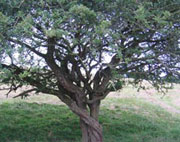
The Hawthorn tree, a common faery dwelling. Photo by Susa Morgan-Black
All faeries are deeply connected to the living Earth. The Faery Queen spoken of in so many ballads and stories is a Celtic aspect of Gaia, the Earth Goddess. The faeries sometimes called "nature spirits" are involved with the processes of nature—birth, growth, decay, and the changing of the seasons—while "elementals" are responsible for cycles of water, earth, air, and fire. Other faery tribes interact more with the human world, bestowing gifts such as healing, music, and seership upon their favorite mortals.
A Faery Encounter, Read by Mara Freeman
The Faeries’ Return
Today, a new awareness of faeries is returning as people are awakening to the reality of worlds not normally apparent. It seems that, with the current crises on Earth, we are being called to reconnect with those beings of light with whom we once consciously shared our planet home. When we pollute, degrade, and destroy the land, sea, and skies, we are destroying their world, too; we tear apart the exquisitely woven tapestry of all creation. And so faeries are bringing messages from the Earth, urging us to change our ways from living in separateness to an awareness of our interconnectedness with all beings, visible and invisible.
A Faery Encounter, Read by Mara Freeman
How to Meditate With Faeries
Connecting with faeries is not as difficult as you may think—you don't need special psychic powers to do so, just a willingness to open your mind and, especially, your heart, as a child might. "You have to be content to know that you love that tree, and you want to love it more," said Ella Young, a poet and storyteller who communed with faeries in western Ireland, "and you know it's alive and you want to come closer to it."

Here is a simple way to connect with the faery kingdom:
This Beltane season, take a faery walk in nature, preferably where there are trees and plants. Find a place to sit and begin taking some deep breaths:
1) Inhale and imagine a wave of green light rising from the land beneath you, rising up your body to connect you with the earth below. Exhale and sense a wave of golden light flowing down from the heavens through your body, connecting you with the sun and stars. Do this several times until you feel relaxed and charged with the energy of earth and sky.
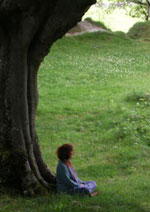
Mara Freeman sitting in a faery fort in Ireland. Photo by Susa Morgan-Black.
2) Notice three natural things around you and send a line of light from your heart to connect with each one.
3) Now extend this connection to everything around you. Rest and be at peace in this feeling of oneness.
4) Ask for a message from the faery realm and open to receive impressions that may come to you. The response may come through feeling a light, sparkling, joyful energy, or it may come as words or images in your mind’s eye. Watch out also for signs of animal or bird movements or calls that may carry a message for you--one that brings you home to your true self. Don’t forget to send a blessing to the faeries before you leave.