 "To be nobody-but-yourself," poet e.e cummings once wrote, "in a world which is doing its best, night and day, to make you everybody else--means to fight the hardest battle which any human being can fight and never stop fighting."
 In the early stages of his spiritual awakening, to be "nobody-but-himself" for George Harrison meant fulfilling a duty to broadcast India's devotional teachings. "If I don't take this chance," he told a fellow yoga student in the mid-sixties, "then I've waste my life, haven't I?"
At first, from 1966 through 1973, his efforts met with some success. Sanskrit mantras for peace, the exotic aura of mystic India, and songs about journeying to eternal worlds beyond the material sky could not have been better timed for an era fueled by anti-materialist sentiment, visual spectacle, and spiritual quests.
And in the early 1970s, after the dissolution of the Beatles, George's solo career did bring India's devotional teachings to the attention of the world. His first album, "All Things Must Pass," and first single, "My Sweet Lord," both reached the number one slot in the United States and Britain. In 1971, his second solo album, "Living in the Material World," also rose to the top of the pop charts.
Counterculture idealism still lingered in those days, and George's message of "getting liberated from the material world" struck a chord with post-modern mystics and political refugees. Even greater acclaim followed his 1973 Concert for Bangladesh, history's first pop charity extravaganza, which raised millions of dollars to aid victims of the Pakistan-Bangladesh civil war. For the moment, it seemed George Harrison could do no wrong.
But by 1974, the mood in America had shifted. That year, U.S. troops withdrew from Vietnam, a depressed economy sent spiritual seekers back into the world to find work, and it was entertainment that fans wanted, not evangelism. For the first time in his life, George was facing something less than adulation. The negativity sent him into seclusion at his home, Friar Park, 35 miles west of London. Despite his love of performing, it was 20 years before he would again play before a live audience.
During this period of retreat, George's commitment to God evolved from external missionary fervor to concentration on personal communion. "The best thing anyone can give to humanity is God consciousness," he told a friend in 1974, "but first you have to concentrate on your own spiritual advancement. So in a sense, we have to become selfish to become selfless."
"A man with a truly big heart"
Read more on page 2 >>
| _Related Features | |
|
|
|
 |
But the last two decades of his life were marked less by worldly affairs and more by an appreciation for God in the simple miracles of nature.
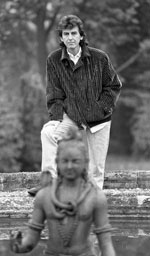 |
| George Harrison poses behind a statue of demigod Shiva at the Harrison home Friar Park west of London. Photo c Rex Features |
Every so often, he drove to a nearby nursery to purchase trees and plants. The owner, Konrad Engbers, remembered the first time George came in. "How are things going?" George asked.
"A little slow," Engbers said.
"I'll give it a little push for you," George replied, and then bought almost every tree Engbers had in stock.
From time to time, George walked down the hill from Friar Park to the market where Engbers had a stall. He would wait in the queue and take his turn, not expecting any preferential treatment. Seeing his friend, Engbers would take a break and the two would sit in a nearby coffee shop in their dirty overalls and talk about herbs and plants.
"Such a kind man," Engbers recalled, "with no airs and graces--a man with a truly big heart."
From the beginning of his spiritual journey, George knew that his frame of mind at death would determine where his soul would be reborn. "Whatever state of being one remembers when quitting the body," he read in the Bhagavad-gita, "that state one will attain without fail." From that time on, he was rarely without the holy names of God on his lips. "Om Hari Om," he prayed walking down the street. "Govinda jaya jaya, Gopala jaya jaya," he sang driving in his car. "Hare Krishna, Hare Krishna," he chanted on beads when traveling by plane or sitting in his garden.
Because thinking about God was his life, George never needed to make separate arrangements for death. Liberation was not some place he would go later, but a way of being now. To stop judging, to stop racing, to stop wishing for something grander than this moment--to manifest divinity at every second: that was the real yogi life. Living this life and living the next had become one and the same for him. There was no fear of leaving his body, no concern for what would happen next, only selfless love and the anticipation of going on with selfless love in some other place.
Having recognized the immortal, indestructible nature of his soul, he had transcended death's tragic dimension. He needn't have been concerned about giving up the missionary stage of his spiritual journey. Throughout his life, George Harrison conveyed spirituality as effectively by example as by precept.
| _Related Features | |
|
|
|
|
|