 or, alternatively, the phenomenon of atheism. Based on a book by Harvard psychiatrist Dr. Armand M. Nicholi Jr., the show presents an imagined debate between the militantly atheist founder of psychoanalysis, Sigmund Freud, and "Mere Christianity" author C.S. Lewis. Paralleling their fictional faceoff with a roundtable discussion with a group of believers and doubters, the show examines what it means to believe, and what both faith and unbelief presumes about suffering, morality and death. We talked with Dr. Nicholi recently about his book and the two men in whose literary company he's spent the last 35 years.
You're a practicing psychiatrist. How do you think Freud's and Lewis's psyche affected how they approached faith?
Many things Freud theorized have now been discredited, but certain theories have held up. One is that early life experiences influence how we think and feel as adults. One way early life experiences influence us is that we have a tendency to transfer feelings about our early adult authority figures onto present authority figures. Both Freud and Lewis had a lot of conflict with their fathers. That probably influenced their feelings toward an ultimate authority.
As the show makes clear, both seem unhappy in youth.
They both become very critical of people. Freud says, "Most human beings in my mind are trash." Lewis kind of shares that. He's turned inward, he avoids close relationships with women, probably because he doesn't want to get close and then get hurt like he was when his mother died.
How do you view Lewis's conversion, professionally?
Something extraordinary happened. This man, an adult male about 30 years old, a professor at probably the most prestigious university in the world, has this radical life-changing experience, where he goes from a militant atheist to a very strong believer. In a matter of a couple of years, his life is just transformed. His temperament changes. His attitude toward people changes. His relationships change. He sees every human being as a thousand times more significant because that human being is going to live forever. As a psychologist I'm very interested in what brings about that kind of change.
He's not the first person one thinks of when one thinks of Freud, yet the key to your book was putting these two men together. How did that come about?
When I finished my medical training, I was asked to teach a course on Freud at Harvard. Since I hadn't read his philosophical works, I thought I'd teach
a 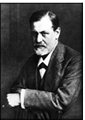 course on those, so I would be forced to read them. The course was very interesting. It dealt with the basic life issues, but it was a sustained attack on the spiritual worldview. Freud's position was, "No intelligent person could ever accept the absurdities of the religious worldview." So the students said, "It's all very interesting but it's unbalanced. Why can't we have a counterpoint to Freud?"
Ten years before, when I was a surgical intern, I had come across real suffering for the first time--little children with fatal illnesses. Why, I wondered, would anyone in heaven or on earth who could prevent this not do so? I came across a little book in the hospital library called "The Problem of Pain" by C.S Lewis. So--fast-forward ten years--when trying to come up with a counterpoint to Freud, I thought of Lewis. So I started reading Lewis seriously for the first time.
I noticed this astounding parallelism. Freud raises an argument, Lewis attempts to answer it, as if they're standing at a podium arguing back and forth. Freud was the father of the new literary criticism. He provided Lewis and the literary critics with new tools for understanding human behavior as expressed in the great literature. So Lewis not only knew Freud's work, but was an atheist for the first half of his life. He had used Freud's arguments to defend his atheism. So after his change to a spiritual worldview, when he begins to define and defend it, whose arguments does he answer but Freud's.
And these are the same questions we're addressing today.
Human beings are the same throughout history. We focus on the differences but we're much more alike than we are different and that's been true over time.
He might be surprised that a nation as educated as we are would have 80 percent of people saying they have a personal relationship with God. He predicted that as a society became more educated they would give up these absurdities.
Darwin is often blamed for the loss of faith in modern society, yet the First World War for Lewis and Freud was as significant.
Out of the war, Freud developed his theory of the death instinct. There is something very destructive in our makeup. Freud and Lewis would agree that it's not because God created that in us. He gave us free will and we've used it to do evil. They just gave it different names.
Is there much else these guys would agree on?
I think they'd agree that human beings need alteration, that they're defective. Freud thought they could be altered by self-examination, through psychoanalysis--though he also noticed that analysis didn't make his colleagues better people. That puzzled him. Lewis would agree that people need alteration but he would say that the alteration is brought about through their establishing a relationship with the person who made them.
In all his defense of faith, Lewis never offers a proof for God.
He has counter arguments. Freud says, "This is all wishful thinking, the idea of a superman in the sky who kind of looks after you." He says, "That's so patently infantile." Lewis counters by saying that the biblical story is not something one would wish for, because it begins with the realization that you're in deep trouble, that there is a moral law, that you've disobeyed that law and that you need atonement.
Lewis also uses the argument of the complexity of the universe. If he were living today he'd probably say, "Look through a telescope and you see more 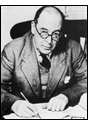 stars than all the grains of sand in all the seashores of the world. Astronomers can't even begin to comprehend borders to the universe. If you look in the other direction, through a microscope, in a thread of DNA, you are programmed for how tall you are, for how intelligent you are, how many times your heart beats, how long you live. That is enormously complex, Lewis would say. Which takes more credibility--to believe that that just happened or that there was some kind of intelligence behind it? So that's the kind of argument that Lewis uses.
For Lewis, it's not a question of proving God exists, but explaining how He doesn't. Lewis says of his conversion, "I felt like I had been holding something at bay and I let it go."
And you wonder, is this true with everyone? Is there a part of us like Freud-so defiant that we don't want to take the barrier down? Is there a desire we all have, some kind of reaching out to us that we just defend ourselves against? Lewis realized that he can close the door, keep his mind shut, or open the door, and he decides to open it.
The closest Lewis gets to a proof is something like, "If there is a God, we would expect him to put something inside of us--
Making us feel guilty...
And sure enough, he says, that's just how we feel. Isn't that a little easy?
He's trying to say that there is a universal sense of right and wrong in all cultures that transcends time and culture. He made a very intense study of this, and found that indeed, although there were differences among cultures, they were minor differences. There is a basic moral agreement.
Both men died too early to be exposed to evolutionary psychology, but what would they say to this idea that innate moral laws are evolutionary strategies that may be found in our DNA?
Lewis said the philosophy that you bring to the evidence influences how you interpret that experience. Since Freud and Lewis bring different philosophies to this new knowledge, you would probably find they would interpret it differently.
You've read and taught and mulled the question of God for years. Is there any way to come to a conclusion?
Well, let's assume that there is a God and let's assume that the Bible, as so many believe in this country, is inspired word. In it, he says, "If you seek me with all your heart, you can find me." So when Lewis decided to open his mind, he began to seek. So I would say, from a spiritual point of view, yes, there is a way you can answer it, and that is just to seek with all of your heart. Whatever that means.