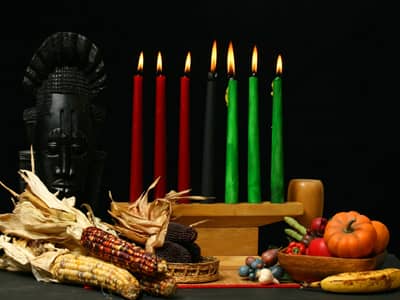
Beliefnet: Why celebrate Kwanzaa in December among the religious holidays that are celebrated in the same month? Do you feel it might add to the misconception that Kwanzaa should be celebrated in place of Christmas or other December holidays?
Maulana Karenga: The first reason for the choice of date of Kwanzaa was for cultural authenticity. A central model for Kwanzaa is umkhosi or the Zulu first-fruit celebration which is seven days and is celebrated about this time. Other first-fruit celebrations were celebrated at the end of the old year and the beginning of the New Year such as Pert-em-Min of ancient Egypt. So Kwanzaa's model is older than Christmas and Hanukkah and thus does not borrow from them or seek to imitate them in the or manner.
People may celebrate either or all of the year-end holidays. And it makes little sense to attribute Kwanzaa's date of celebration to misconceptions about its replacing Christmas or Hanukkah when it is simply following a pre-established season for African first-fruit celebrations which precede both Hanukkah and Christmas. Moreover, Kwanzaa is a cultural holiday not a religious one. And it builds on African commonality, not on the religious, political and other choices we make which often separate us and cause us to focus on difference rather than similarity. In the final analysis, it all depends on personal choice; people choose holidays to celebrate, religions to practice and philosophies to follow. We do not show proper respect for diversity if we blame personal choice and change on one holiday or another.
Beliefnet: While many of us know that Kwanzaa is drawn from ancient African culture and tradition, how much of it comes from African religions? Lately it has been connected more closely to religion by many observers.
Maulana Karenga: Kwanzaa does not come from African religions, it comes from African culture. But no serious student of African culture - ancient or modern, continental or diasporan - can deny that African spirituality pervades African life.
Also, as a celebration of family, community and culture, Kwanzaa is a time of ingathering of the people to reaffirm the bonds between them; a time of special reverence for the Creator, in thanks and respect for the blessings, bountifulness and beauty of creation; a time of commemoration of the past in pursuit of its lessons and in honor of its models of excellence, our ancestors; a time of recommitment to our highest cultural ideals in our ongoing efforts to be the best of what it means to be both African and human in the fullest sense; and a time for the celebration of the Good, the good of life and indeed, of existence, the good of the awesome and the ordinary, in a word, the good of the divine, the social and the natural. Who would find fault with these ethical practices?
Finally, Kwanzaa brings a cultural message which speaks to the best of what it means to be both African and human in its stress on four pillars of African ethics: the dignity and rights of the human person, the well-being and flourishing of family and community, the integrity and value of the environment, and the reciprocal solidarity and cooperation for mutual benefit of humanity. All these above emphases are ethical and at one level spiritual, but belong to no particular religion. And it is their inclusive character that allows people of good will to embrace them as essential elements of common ground for the common good.
Maulana Karenga: Kwanzaa must and will remain essentially a cultural holiday which celebrates family, community and culture, stresses the producing, harvesting and sharing good in the world and invites us to meditate seriously on the wonder, good and awesome responsibility of being African in the world.
Beliefnet: What are some things that Kwanzaa observers can do to avoid commercialization and strive towards Ujamaa (Cooperative Economics)?
Maulana Karenga: See FAQs on the web site, www.OfficialKwanzaaWebsite.org or pp. 119-121 in my book, Kwanzaa, A Celebration of Family, Community and Culture, Los Angeles: University of Sankore Press.
Beliefnet: The nature and structure of the family has changed quite a bit since Kwanzaa was first created. Many young African-American adults of this day and age do not have the cultural background and foundation of the Civil Rights Era. Because of this, many don't necessarily have the impetus to celebrate with their families. How can parents and elders remedy this and effectively encourage their children to observe Kwanzaa?
Maulana Karenga: Kwanzaa is celebrated by over 28 million people throughout the world African community on every continent in the world. I am very pleased with how many people, parents and children have embraced it as an essential cultural and value orientation which expands and enriches their lives. Of all the good which came out of the Black Freedom Movement, both its Civil Rights and Black Power phases, Kwanzaa stands as a unique heritage and cultural institution. It is this institution as a definitive and enduring carrier of culture which has kept the 60's struggles and achievements as a living tradition. But it also brings forth the whole of African history and culture as a valuable, ancient and enduring model of human excellence and achievement and uses this culture as a rich resource for addressing modern moral and social issues. It is in celebrating Kwanzaa and practicing its Nguzo Saba, the Seven Principles, that our families and community are reaffirmed and reinforced and our lives enriched and expanded.
Maulana Karenga: Kwanzaa is extremely successful. It has 28 million celebrants on every continent in the world throughout the world African community. I know of no other holiday that has established itself, grown so quickly and captured the public imagination and respect in such a worldwide way without aid of media favor or discussion of its philosophy, legislative acts or governmental support. Indeed, I give honor to African people who as a beautiful act of self-determination, wove this holiday out of the rich and rare fabric of their own culture, spoke this special cultural truth to the world, used it to enrich and expand their lives and are passing it on to generation after generation as a legacy worthy of the name African.
Beliefnet: Across the African-American diaspora today, which of the Kwanzaa principles are most apparent? Which principles do you think that African-Americans need to work on as a collective?
Maulana Karenga: All the Seven Principles must be practiced and are being practiced. They are Umoja (Unity); Kujichagulia (Self-Determination); Ujima (Collective Work and Responsibility); Ujamaa (Cooperative Economics); Nia (Purpose); Kuumba (Creativity); and Imani (Faith). And they are all dedicated to honoring the teachings of our ancestors in the Odu Ifa, that the fundamental mission and meaning of human life is "to bring good into the world and not let any good be lost." Umoja is put first because without unity we cannot even seriously begin the project. And Imani is placed last because without faith we can't sustain it. But without practice of all the principles, we cannot really accomplish it.
Finally, it is important to note that the Nguzo Saba are used as value orientation and cultural grounding in a vast number of programs throughout the world African community. These range from independent schools, rites of passage programs, youth development and support programs, public school educational programs, and religious institutional cultural programs to various economic and political initiatives and structures. Thus, I'm confident that African people will continue to see their value, embrace their practice and pass on these values and the culture in which they are rooted as a legacy which expresses and encourages the best of what it means to be African and human in the fullest sense.