 |
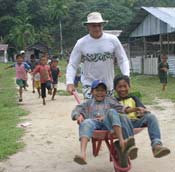
| Volunteer Sam George with Sumatran kids. c Tony Litwak |
Everywhere you turn are visions of overwhelming suffering and loss: a young father whose wife and newborn were swept away moments after the birth; families whose homes and possessions were destroyed, leaving them with no food, water, or livelihood; young children stricken with malaria, tuberculosis, and myriad post-tsunami ailments, caused by poor sanitation; traumatic memories of hundreds of bodies floating offshore.
Since last January, these battered islands, initially overlooked by the major rescue operations, have become the focus of a most unusual collection of healers and volunteers who are helping to rebuild homes, medical facilities, schools--and lives.
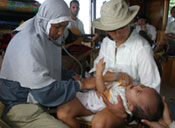 |
| Dr. Ulya Fasrini and actress Nia Peeples help a young patient. c Tony Litwak |
The voyage of the Mikumba was spearheaded by an unlikely field commander--Matt George, a 46-year-old San Francisco journalist and contributing editor for Surfer Magazine. George had known of these islands from previous surfing trips. Surfers are always seeking the perfect wave, and in Simeulue, Indonesia, he had found it.
Last December 26, George recalls, "I woke up to the horrific TV reports. I realized the second the tsunami hit that, as a surfer, I had suddenly become an expert at something. I knew those islands, and I realized that if I didn't head out there to help, I could never forgive myself. I've always been bothered that I couldn't do more to help after 9/11."
George headed out to Indonesia in January and later recruited some of his surfing buddies, Tony Litwak, 35, Peer Court Program Director for The California Community Disputes Services, and David Lupo, 36, an organizer for Carpenter's Union Local 22 in San Francisco, as a SWAT team to deliver supplies to these remote locales. Their rescue efforts were officially dubbed "Surfzone Relief Operation." Back home in San Francisco, the trio are volunteers who teach surfing to the young (and the young at heart) through a group they call The North Beach Surfers' Union.
Last January, George walked into the University of Putra in Padang and asked university administrators for the names of medical students who might be interested in volunteering for the trip. Two young female doctors, Ulya Fasrini and Wati Aziz, as well as biologist Patra Dewi, answered the call and joined the Mikumba. The small team moved in swiftly--the first aid to reach the shores.
Then, in March, George brought along his surfing buddies, his brother Sam (also a Surfer magazine editor), and Sam's wife Nia Peeples, an actress who has appeared in the TV show Fame, among other programs.
The surfer guys wore bandanas and shades. The women wore hijab (head scarves) and the modest clothing of their Muslim faith. But on this adventure, cultural and religious differences did not create barriers. They worked together as a team.
For two-and-a-half weeks, the Mikumba team traveled from island to island, delivering 70 tons of food, water, and the other desperately needed supplies and medical services to the more than 4,000 isolated survivors. Also stacked on board were more than 60 dugout canoes, carved by Indonesian from one of the other islands.
This time, the surfers weren't hoping for offshore winds and nice-size swells to lift their boards. Instead, they were praying for smooth sailing to the hardest-hit islands of Nias, Simeulue, and the Mentawais, where the Sumatran villagers needed the fishing canoes just to survive.
"The biggest part of the problem is everyone is still so afraid..."
Read more >>
| _Related Features | |
|
|
 |
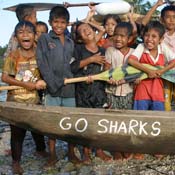 |
| Children welcome dugout canoe delivered by the Mikumba. c Tony Litwak |
"When the canoes showed up all painted, and it was explained what they meant and who they came from, everyone was just so thrilled," says Nia Peeples, who left her two children at home for the three-week trip. "The kids jumped up and down, stood on them, and everyone was so thankful. For the parents, they represent a way to make a living. For the kids, they just wanted to go race in them. It is amazing how something this simple can have such a profound effect on the people in these villages.
"It's amazing to go to a place where the women describe poverty and hunger that kill their babies before they can crawl," she adds. The infant mortality rate is 50 percent, she said. The tsunami disaster had also taken a disproportionate toll on women and children-survivors were three-to-one male adults.
Throughout the trip, the Mikumba crew had to make difficult choices. On one of the first days, after traveling about ten hours north, they were ready to drop off the buckets of food for stranded residents. But after arriving at the first island, they found an eight-month-old boy with tuberculosis was fighting for his life. The baby would die if he weren't brought to a hospital.
"We had to make a quick decision to deliver and distribute the goods or to turn around and head back south ten hours to the hospital," recalls Matt George.
They made the choice to take the baby, his mother, and grandmother on board and head back to where they had come from. Throughout the night, the doctors on board administered CPR four times.
They made it to the hospital. But despite all the efforts, the little boy couldn't hold onto life. "I will never forget the look in the grandmother's eyes," says Peeples. In spite of her great loss, "she showed gratitude. In her whole life she had probably never seen complete strangers care like that for her family." On his third trip to Indonesia in August, Tony Litwak rejoined the Muslim doctors to help the residents of Padang set up a permanent emergency evacuation plan. In June they held a mock evacuation with 5,000 residents participating.
"The biggest part of the problem is everyone is still so afraid," says Litwak. "[We went] door-to-door to answer their questions and help get rid of that fear and empower them."
Back at home in San Francisco and hoping to get back to Padang, David Lupo reflected on the spirituality of surfing and the mission that transplanted himself and his close friends across the world.
"Sometimes people have this impression that surfers are just guys fighting for waves," says Lupo. "But my friends and I are really trying to do something meaningful with our lives--whether it's fighting for workers' rights, or helping teens, or taking an opportunity like this. There we were, on a boat with a guy who doesn't know if his family will still be alive when we get him to the island, or helping set up these medical clinics and seeing all these kids who needed them so badly. It's hard to be back here and not be thinking that there are so many people suffering-we want to go back and help."
On Sept. 2, Hurricane Katrina brought the Surfzone Relief Operation back into action closer to home. Matt George and a different group of surfing buddies he rallied went to a drowning New Orleans with jet skis to rescue residents stranded in their homes and to deliver water and food. There, they spent two weeks, body-deep in the muck and mud, skiing into the most devastated parts of the city to help get folks off rooftops.
Since November, Matt George has been in Pakistan, in the area of Himalayas devastated by an earthquake last October. There he is helping people build new structures to live in. This time the California surfer is working in freezing conditions, knee-deep in snow. George uses much of his own money, but he is also funded through the surfers' organization and personal and business contributions.
"We're here to empower people to get on with their lives," he says. "We will go wherever in the world we are needed."
| _Related Features | |
|
|
|
|