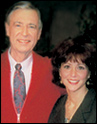
 Author Amy Hollingsworth "met" Fred Rogers on television while watching "Mister Rogers' Neighborhood" on public television with her 2-year-old son. Then she had the chance to meet him in person for a rare interview about his faith. Rogers, an ordained Presbyterian minister who died in 2003, shared insights and life lessons with Hollingsworth during their ensuing friendship. She, in turn, talked to Beliefnet about what Mister Rogers did when he got angry, how he endured cultural criticism and cynicism, and why he felt the space between the TV set and the viewer is "holy ground."
How did you come to know Mister Rogers on such a deep friendship level?
He didn't give very many interviews, and he'd never talked about his faith before on television. When I asked him for both of those things, I didn't realize at the time how unusual those requests were, or that I was asking a lot. There was a 3 or 4 week period after I had asked for the interview where I was waiting. I was going through my Virginia Beach newspaper, and there was an opinion piece by Don Feder called "It's a Psychobabble Day in the Neighborhood." I was so offended by it, not so much by the argument, because I really think there are people who believe empty praise is the way to raise a child's self-esteem, but the fact that Don Feder had lumped Mister Rogers in with that group. So I wrote a nasty letter saying, "Shame on you for criticizing somebody who is trying to do something positive for my kids." And when I sent that op-ed piece and the letter to Mister Rogers' people just as an FYI, I never realized at the time that that was the thing that would make him realize I was sincere enough to be trusted. I think that sort of laid the groundwork of trust. That started something, and we never disconnected after that point, we always wrote each other every 2 or 3 months religiously for the next 9 years until he passed away.
The book is called "The Simple Faith of Mister Rogers." How was Mister Rogers' faith simple?
Sometimes the word "simple" is confused with the word "simplistic," and it wasn't. His philosophy of life is not simplistic, but it's simple in that there are some basic tenets to it that seem simple but are so profound and so hard to live out on a daily basis. Probably the central tenet of his faith and the theme of the Neighborhood is just the idea of loving your neighbor. When I asked him who is your neighbor, he said, whoever you happen to be with at the moment. So right there, there's no loophole-that means we have to love everybody.
He said, once you realize that everybody's your neighbor, you have a choice. You can either be an advocate or an accuser. An accuser is somebody who only sees what's awful about themselves so they look through those eyes and look for what's awful about their neighbor. An advocate is somebody who looks through the eyes of God at their neighbor and sees what's good about that person because they're created in God's likeness. That's a very simple, basic truth, but to live that out in our daily lives is tremendously difficult.
Do you think today's world is too cynical to learn those lessons Mister Rogers was trying to teach?
One of the things that shows the cynicism is all the urban legends about Mister Rogers that are out there-everywhere I go somebody asks me was he really a sniper in the military, did he really have upper-body tattoos. We're cynical because how can somebody be that good as Mister Rogers. But I found that even if people on the outside seemed jaded and cynical about Mister Rogers, on the inside they really respond to it. I've done a lot of radio interviews, and even the male interviewers, they'll be reading an excerpt from the book or just be talking about them, and they'll just break down and start crying. As much as we are cynical, we all want to believe in that kind of goodness. And I think people do, I think people, even if on the outside they seem a little critical or jaded about Mister Rogers, they absolutely want to believe in the goodness that he espoused.
Where did that goodness come from for him? How did he remain so steady over all of those years?
He was really sensitive as a child, and that doesn't always translate into goodness. He was bullied when he was 8 years old, and had an awful experience where he was chased by boys who called him "Fat Freddy." You hear so many stories these days about that happening to children, and it turns them into bullies, or worse. He was sensitive but he made the right choices in response to that. When he was angry or upset about something, instead of hurting people, he would go to the piano and he would play. Or he would play with puppets and he would express negative emotions and maybe aspects of himself that he was a little shy of, through the puppets. I think having a lonely childhood, being so sensitive, I think those things all sort of worked together to make this man who decided really early on that he was never going to look on the outsides of people, he would always look below the surface and see what was essential about them. And I think that was really the core of his goodness, his ability to see past outsides and look for what's good in people.
One time he was telling me about early on in his career. We were just chit-chatting, walking around the studio. This was the first time I'd met him, and he was telling me about how some of his songs had been stolen, he hadn't gotten some of his early songs copyrighted, and they had been stolen. And you know how you respond to something, and nonchalantly go, oh, that's terrible. And he stopped at me and said, "it was terrible!" I asked his staff if he ever got angry, and they said that he did, but he would walk off the set and go play the piano until he had worked it out, and then he would very calmly resume.
You and Mister Rogers come from different Christian backgrounds. How did he affect your spiritual life?
I really thought, in my narrow-minded way, when I first met him, that I was going to impact his spirituality. In my circle at the time, he didn't use the right words, he didn't use the right vocabulary. He didn't use the phrase "born again" or "saved." Whereas in my circle people might call God "Father God," he called God "the Eternal." I really thought, I'm going to get him to be bolder about using some of this terminology, and isn't that always the way-I meet this gentle man, and he's the one who ends up transforming my life. I think I thought I had my faith all figured out, and he reintroduced mystery. Using a term like "the Eternal" instead of "Father God" shows that sense of awe and mystery that I think I had lost. So he did very gently nudge me in a different direction. I think he made me less narrow-minded, more tolerant, and more in awe of what's mysterious about our faith.
Are there any incidents that stand out to you about the effect that Mister Rogers had on people, or how his faith helped a particular person?
They are legions. I think I'm more dramatically impacted by the adults whose lives have been transformed. A woman in her mid-50s told me that about 10 years ago she and her husband had divorced, and she was feeling just horrible about herself. She was flipping through the channels, and Fred was on, and he said, I like you exactly the way you are. People can accept you exactly the way you are. She just started crying, because that was not her experience with her husband. The other story that's pretty dramatic was Lauren Tewes, who played Julie, the Love Boat cruise director, who credits Mister Rogers with helping her overcome her cocaine addiction. She watched him, and she was convinced that she was special because Mister Rogers said she was. It was the thing that propelled her down a road that led to her recovery.
He did tell me that he considered the space between the television set and the viewer holy ground, and that whatever he said or did on the show could be translated by the Holy Spirit into what the person needed to see and hear.
And there are so many stories of people who have called him or written him and said, you know when you said such and such or did such and such, it really made a difference. And he'd say that he'd go back and look at the script, and he hadn't said that at all. But there was this translation because he offered it so sincerely and with faith, that he knew that could be translated into what the viewer needed to see and hear. There's another story in the book. This young man had been abused by his parents, and he was watching the Neighborhood, and it gave him hope because he said if people treat each other with such kindness in Mister Roger's neighborhood, then maybe that's a potential in my own life. Eventually he called an abuse hotline, and was adopted by the couple who ran the hotline. But here's someone whose only background was abuse, and distrust from the very people who were supposed to love and care for him, and who watched Mister Rogers and was convinced that had to be a reality someplace in this world.
To me it's amazing-here's a kid's show with a trolley and puppets with mouths that don't move, and a speedy delivery guy, and yet these powerful stories of cocaine deliverance and getting out of abusive situations, or divorced women who get their esteem back.
I think that he would probably feel that that was a parent's responsibility. He's the one who said that the television set is the only electrical appliance that's more useful when it's turned off. He had this experience when he was watching cartoons with his grandson. Some avenging hero was picking off the bad guys, and Fred was saying to his grandson how scary that was for him, even as an adult, and his grandson said, but Granddaddy, those are the bad guys! Fred was like, there's a better way to treat bad guys than killing them. His response was to make a public service announcement geared toward parents and their children to empower children to turn off the television. My guess is that he would have felt that that would have been a parent's job, giving the children permission to turn off the television when it frightens them.
Do you think Mister Rogers was an anomaly, or do you think that in today's culture there could be a national icon who stands for values that are similar to his?
I think he was an anomaly, I really do. It's so funny to me that he got into television in the `50s because he thought it was demeaning-that was his word, demeaning. And I thought, over the course of the last 50 years, it's just gotten worse. I think he was born at the right time. There was a character on Mister Rogers' Neighborhood, his name was Chuck Aber. They called him "Neighbor Aber." When I watched the show with my kids, I always thought in the back of my mind that he was going to be Mister Rogers' successor because he was very gentle and very much like Fred. I met Neighbor Aber at Fred's memorial and I asked him, and he said there would be no replacement for Fred Rogers, there was never ever any discussion about that because he just knew that you couldn't have another Fred Rogers.
I really don't know of anybody who could have endured the criticism and the mockery that he did. One of the things that always stood out in writing this book was how strong he was in being true to who he was. He was the best Fred Rogers that he could have possibly been, and he never wavered from that, he never wavered from just being himself. I think that's probably one of the most important lessons that I've personally learned from him.
Did Mister Rogers believe in heaven, and do you think that he, on some level, is still helping people from heaven?
He absolutely did believe in heaven, and he absolutely believed that's where he was headed. When he was initially diagnosed with cancer, his first response was that he couldn't wait to go to heaven. And of course his family was like, please don't be so eager. It was part of his theology to believe that people in heaven helped those of us on earth. He really believed that. He believed that his parents, and the people he loved like Henri Nouwen and Johnny Costa his piano player, he certainly believed that those people inspired him and helped him. That was part of his thinking, so I'm sure he does help people. I don't think that his goodness and his love for people is limited by where he is in his new neighborhood.