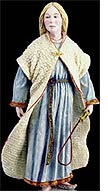
Want to know who really decides who's naughty or nice? Try Holda, the Teutonic goddess of winter. She's the beautiful blonde wearing a shimmering gown and red or white goosedown cape who flies through the night sky on December 24 bringing gifts and spreading joy.
In Pagan religions, goddesses are an important part of our celebrations because they help tie us to ancient traditions and the seasons of the year. Holda is one of my favorites. Stories about her are found in old folktales of Germany, Switzerland, Austria, Holland, Denmark, Norway, and other parts of Europe. Her name means " kind" and "merciful."
 I first discovered Holda many years ago while researching the Pagan
origins of Santa Claus. In addition to
learning that the Teutonic Gods Odin and Thor were part of Santa's mix, I
found that in some parts of old
Europe, it was Holda--not Santa--who brought gifts to children and
determined who was "naughty or nice." I
also encountered lore depicting her as dressed in red and going down
chimneys to bring gifts to children. An
old Germanic tradition included leaving an offering of food and milk for
Holda on December 24, known as Mother
Night.
I first discovered Holda many years ago while researching the Pagan
origins of Santa Claus. In addition to
learning that the Teutonic Gods Odin and Thor were part of Santa's mix, I
found that in some parts of old
Europe, it was Holda--not Santa--who brought gifts to children and
determined who was "naughty or nice." I
also encountered lore depicting her as dressed in red and going down
chimneys to bring gifts to children. An
old Germanic tradition included leaving an offering of food and milk for
Holda on December 24, known as Mother
Night.
I decided to learn more about Holda, and connecting with her and her lore has been part of my Winter Solstice celebrations ever since. I invoke her in rituals, and keep a picture of her on my household altar. She is even among the Yuletide characters that appear in the public Winter Solstice pageant that I direct each year in Madison, Wisconsin.
As with many ancient goddesses, Holda is complex. Also called Hulde and Frau Holle, she goes by a variety of names and takes different forms, depending on locale and culture. In her form as a beneficent and noble White Lady, Holda is beautiful and stately, with long, flowing golden hair, which shines with sunlight as she combs it. She wears a white gown covered with a magical white goose down cape. At Yuletide, she travels the world in a carriage and bestows good health, good fortune, and other gifts to humans that honor her. She not only is connected with Winter Solstice itself, but also with the holiday season that continues many of its customs, the 12 days of Christmas--from December 25 through January 6.
In other early lore, Holda was a sky goddess riding on the wind. She is thought to be an older form of Frigg, wife of the Father God Odin; in some tales, Holda and Odin ride the sky together. Holda also has been honored as a goddess of the moon, and sometimes her name has been used as a term for a lunar priestess. Another of her forms is that of a night-riding witch leading a spirit host in a fierce ride, known as the Wild Hunt, through the sky and across the land.
During persecution times in Europe, some of those suspected of witchcraft were said to "ride with Holda." Her Pagan origins are evident in folk tales in which she is described as accompanied by a grand and furious procession of souls of the dead, mostly unchristened babies and children. It was said that as Holda and her entourage passed through the fields, they blessed the land with abundance and caused a double harvest in the growing season that followed.
In many places, Holda is closely associated with Perchta (Berchta), her tatters-clad shadow twin sister, also identified with the Wild Hunt and Yuletide. On Perchta's Day, January 6, ancient Europeans left offerings of cakes and milk on house roofs to bring good luck for the coming year. Holda and Perchta probably emerged as local variants of the same goddess-turned-folk character, since both sometimes appear in tales as hunched-backed crones and bogey figures, punishing or blessing adults as well as children for bad or good behaviors, at Yuletide and at other times of the year. As crone goddesses, they also preside over destiny and the cycle of birth, death, and rebirth.
Geese are sacred to Holda, and some say she is the source of the storybook character Mother Goose. As the Lady of Beasts, Holda has many creatures associated with her, including hounds, wolves, pigs, horses, goats, bears, and birds of prey. In some tales, she lives in the woods and is the ancient half-tree, half-woman who gave birth to humankind. Apples and flax are among the plants sacred to her.
Holda also is associated with lakes, streams, and wells. In the Grimm's fairy tale, "Mother Holle," she is visited by two half-sisters at her home at the bottom of a well, where she rewards the industrious one with gold but covers the lazy one with pitch. Holda as goddess of hearth and home presided over spinning and domestic arts. She also symbolized virtue, wisdom, and womanhood.
Today, across the United States, Europe, and other parts of the world, Holda is remembered, not only by folklorists, but by Pagans of many paths, who invoke her, give her offerings, and share her stories and traditions in Winter Solstice rituals and celebrations. As Holda takes her Yuletide ride this year, may she bring the world her blessings of peace, prosperity, and well-being.
Bates, James Allan, Doris Duncan, & Countess Von Staufer. History of Santa. Fullerton, California: Duncan Royale, 1987.
Farrar, Janet & Stewart. The Witches' Goddess. Custer, Washington: Phoenix Publishing, 1987. p. 230, 260.
Fox, Selena. "Frau Holda: Yuletide Goddess" in CIRCLE Magazine, Winter 2000, issue 78, p. 19.
Guiley, Rosemary Ellen. "Holda" in The Encyclopedia of Witches & Witchcraft, second edition. New York: Checkmark Books, Facts on File. p. 160-161.
Hilton, Edward. "Winter Goddess" http://des.users.netlink.co.uk/winter.htm, summary of "The Winter Goddess: Percht, Holda, and Related Figures" in Folklore Vol. 95: 11, 1984.
Karas, Sheryl Ann. The Solstice Evergreen. Fairfield, Connecticut, 1998. p. 51-53.
Leach, Maria & Jerome Fried, editors. Standard Dictionary of Folklore, Mythology, and Legend. New York: Funk & Wagnalls, 1972. p. 500.
Monaghan, Patricia. The New Book of Goddesses & Heroines. St. Paul, Minnesota:Llewellyn Publications, 1997. p. 127, 252.
Thorn, Thorskegga. "Holda" at http://www.thorshof.org/holda.htm.