
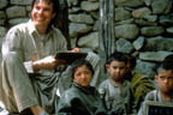
 In 1993, mountain-climber Greg Mortenson nearly lost his life trying to climb one of the world’s highest mountains, K2 in northern Pakistan. Reeling from his failed attempt, Mortenson stumbled into the village of Korphe in Pakistan’s Karakoram Himalaya region.
There he saw children huddled in the cold wind, scratching out lessons with sticks in the hard ground. He was inspired and impetuously made a promise to the village’s leader, Haji Ali: I will build you a school. That promise took him to rock bottom and back again as he despaired while living in his car to save money for the school until a generous benefactor set him on his way. His remarkable odyssesy reflects the astounding humanitarian reach that one person can generate.
 Greg Mortenson Talks About:
The Need for Girls' Education
The Cost of Global Illiteracy
The Worst Threats He Ever Got
Why the Children Are the Heroes
Greg Mortenson Talks About:
Mortenson has traveled the seemingly impenetrable paths of rural Pakistan, fighting the elements, poverty, fatwas against him from corrupt mullahs, death threats from Americans who consider him a traitor for helping Muslim children, separation from his family, and a terrifying kidnapping to make true on his promise.
Mortenson’s book, “Three Cups of Tea,” is the inspiring story of his journey from the completion of that first school to his position as the director of the Central Asia Institute, which has since built 55 schools serving Pakistan and Afghanistan’s poor children, especially girls.
I think I was fortunate that I had my childhood in Tanzania, East Africa. It was a very rich, pluralistic, diverse environment, where I went to school with children of all faiths and backgrounds, and for me that was a normal way to live. When I came back to the States at the end of high school, I was exposed for the first time to bigotry and racism and intolerance.
I saw 84 children sitting in the dirt writing with sticks in the sand, and [was struck by] their sincerity and their fierce determination to have an education--their teacher wasn’t in the village that day because they couldn’t afford his daily one-dollar salary. And so I made a promise that day. It took me three years and many mistakes.
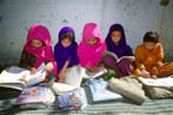 And we’ve also been able to [build schools] in some of the more difficult areas of Pakistan and Afghanistan [in spite of] some despotic mullahs who are in the minority. I’ve had two fatwas against me.
And I think the faith of Islam is [more] about tolerance, and it’s about justice. But more then that, it’s that we live in a global community, and we should have compassion and respect for all people. And I see that there’s been a few extremists who hijacked that somewhat.
And when you grow up in that environment, you become more in tune with your faith, and you have to rely on that--your inner voice. That consciousness is very strong. Often I ask the children, or the elderly, “Why are you doing this?” They’ll say, “This is what Allah wants,” or “This is what is right.”
I don’t think I’m a hero. My heroes are the children going to school. My daughter, Amira, she wrote a song [with her music teacher] called “Three Cups of Tea.” It talks of the heroes writing with “sticks in the sand.” And it talks about how the real heroes are the children. There’s one thing that makes me feel so incredibly proud and joyous--it’s watching that first girl going down the trail into the school. [Mortenson’s schools are for boys and girls, but girls’ education is more emphasized.]
Behind that girl comes dozens more girls, eventually hundreds and thousands. And when that girl becomes a mother, her values are instilled in the community. So I don’t think of myself as a hero. I think if this as just--I’m a dedicated person. To me, my real heroes are every child that I can watch reading and writing for the first time. It’s such a joyous thing to watch.
It’s been more than 10 years since you first started your project to build a school in the Pakistani village of Korphe. Are you satisfied with what has been accomplished so far?
The more I do this, I feel I’m very blessed. And I feel my life is very rich, because I can go between two different cultures [the U.S. and Pakistan] and people of different backgrounds. And everywhere I go I find there are good people. We fail to appreciate the fact that we can be optimists. We’re very pessimistic now.
Americans need to form bridges and have relationships with the moderate Muslim majority who are our greatest allies there. And I also hear Christian, Jewish, and Muslim leaders all saying, “God is on our side.” Actually, God is on the side of the widow and the orphan and the refugee. But most of all we need to take care and have compassion and love those who need that the most.
What is it that makes you different from all the Americans who have been to Pakistan, who make promises--diplomats and humanitarians and climbers--and they don’t keep them?
 |
The Need for Girls' Education |
I joined the military, actually, because we didn’t have any money to go to college. And it was very difficult for me to make that transition. And I think today we are less bilingual. People stress in schools less geography, less social studies, and that’s imperative to living in a global society today. Because we’re so connected.
But you kept your promises when a lot of other people don’t.
Well, that’s true. I went to Pakistan [1993] to climb K2, the world’s second-highest mountain, because I had a sister named Christa who had severe epilepsy. In 1992 she died in her sleep. And she had a little amber necklace that I wanted to take to the top of the mountain in her memory. I worked hard, but I didn’t quite get to the top, and then coming down I stumbled into this village [Korphe].
| |
The Cost of Global Illiteracy |
[In Pakistan] I was the “big Angrezi (white man)” trying to help the people. I was determined; I was going to make it happen. And one day the village chief, Haji Ali, who was a very devout man, took me by the wayside and said, “We’re grateful to Allah Almighty that you’ve come to help us build a school. You’ve made your promise, and you’re keeping it. But you need to do one thing. You need to be quiet, sit down, and let us do the work. And Allah Almighty will guide us.”
And then he took all my receipts and records--he had a little key around his neck--and he locked them up in his little drawer along with his prayer beads and his ibex meat. And then he said, “There now, Inshallah everything will be ok.”
And it was?
And of course in six weeks the school was done. And I had to let go, and it was an important lesson. I had to let the community and their faith become the driving force of their school. And that’s what we [Central Asia Institute] do now. We provide skilled labor and the teacher training. But the villagers provide the sweat equity and resources and land. So it’s kind of a 50-50 thing.
And we’ve also been able to [build schools] in some of the more difficult areas of Pakistan and Afghanistan [in spite of] some despotic mullahs who are in the minority. I’ve had two fatwas against me.The first one was from a Shiite imam who said I was an infidel working in their midst. And that one went to Iran to the council of ayatollahs. And about eight months later a letter came back in a red velvet box. And they summoned me to the mosque. I thought, “This is it. I’m getting booted out of Pakistan.”
Instead, they opened this box, and it was an ornate letter written in Farsi, and it said, “Dear compassionate of the poor, we have reviewed your case, and in our holy Qur’an education is encouraged for all children. And furthermore what you are doing to help our people is in the highest principles of Islam. We give you our permission and our blessings and support. And nobody should interfere with your work.”
Of course, after that we got dozens of [requests to build] schools.
You speak in the book of lessons you’ve learned from those you’ve met and worked with along the way. What were the lasting lessons?
I think the first lesson is that it’s about the relationships. I say it takes three cups of tea to do business there. The first cup you’re a stranger; the second cup, a friend; the third cup you’re family. But the process takes several years. And here in America we have 12-second sound bites and two-minute football drills and 30-minute power lunches, but we really don’t appreciate the strength of relationships. We are in a transient society. People don’t often know their neighbors, or they haven’t seen or talked to their siblings or parents.
| |
The Worst Threats I Ever Got |
But on the other hand there’s even more ignorance here in America. And that ignorance is caused by fear. And that fear brings hatred. And until we overcome our fears and our unwillingness to reach out, then all of this is in vain.
I don’t do this to fight terror. I do this to promote peace and fight ignorance and illiteracy.
Do you think you can balance the religious with the secular education for these children?
I think so. There’s a big struggle going on now in Pakistan, in that the government curriculum standards for Islamic studies are [based] in Sunni doctrine. And the Shi’as who are in the north have rioted about it. It’s caused a significant number of fatalities in the past three years.
So what we’ve done in our schools, especially in the areas where there are both Sunnis and Shi’as, is that we have both of their elders who come in and teach the students about their different backgrounds. And it does work very well. It creates more dialogue rather than fighting.
The media in the U.S. have spread some very big misperceptions. Most madrassas--I’d probably say 99 percent of madrassas--are good madrassas. And they teach the kids about their faith and Islam and about hygiene and other subjects. Unfortunately there are a few extremist madrassas that have been set up in the last 20-25 years that are more radical.
But we have the same thing here in the states. Very recently we’ve had some of the very conservative Christian leaders say very negative things about Islam or about other faiths.
How do you balance your spirituality with the difficulties you--and all the children in the northern Pakistan and in Afghanistan--face?
In our technological society, [everything] we do is controlled in our microcosm. We turn an alarm clock off, we switch a light on, or we turn a heater or an air conditioner on. Everything is controlled. And in an impoverished area, it’s the other way around. You’re at the mercy of your environment and your lack of financial resources and opportunity.
And when you grow up in that environment, you become more in tune with your faith, and you have to rely on that--your inner voice. That consciousness is very strong. Often I ask the children, or the elderly, “Why are you doing this?” They’ll say, “This is what Allah wants,” or “This is what is right.”
Over here if you ask that question to somebody, they’ll say, “Well, I’m doing this because if I do that, then this will happen and it will lead me here.” It’s very linear. Over there they rely on their faith and consciousness I guess you could say--thinking from your heart.
Has that become stronger for you also?
Well, certainly. The more I do this, I rely on my conscious and my faith. It often drives people here a little bit crazy. But I realized that things can work, especially when you have a dedication to something, and you’re driven by your heart and your compassion for something
You are often referred to as hero. Do you think you are a hero?
| |
The Children Are the Heroes |
That first brave girl, I know what’s it’s taken to get on that path. It’s dealing with the elders, some cultural bias, or the mullahs. But most often she does have the support of the community. Watching that first girl is like watching man taking his first step on the moon--one giant leap for mankind.

