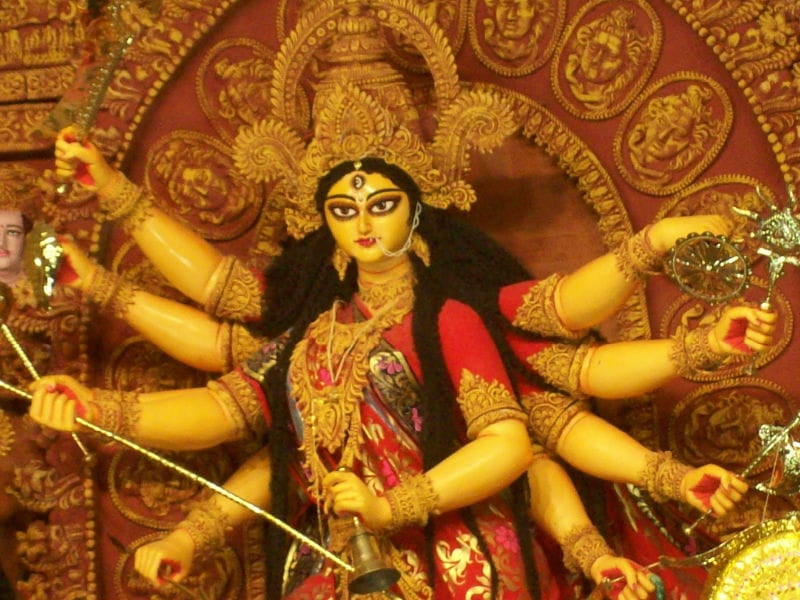
In the Bhagavad Gita, God tells the soldier Arjuna to fight a battle even though Arjuna feels guilty about the war and uncertain about whether it is right. God (in the form of Krishna) says fighting is Arjuna's dharma, duty. How should we apply the Gita's wisdom to the current situation in Iraq?
Qualified violence is an unavoidable reality of this world, even when we view the world from a religious perspective. Everyone embraces the principle of qualified violence on some level. Any sensitive person can feel, however subtle, the spirit of violence behind even the peace protestor's outrage as they chant for peace or denounce those in favor of war. We live in the human drama at the cost of others. One living being is food for another. In this plane we must kill in order to live, however politely. To do so politely only when absolutely necessary is the religious course of action. Beyond this, the spiritual path leads to the land of the soul proper and absolute nonviolence. Those noble souls who seek complete nonviolence must look beyond the material world, and even the religious world, to this realm of the soul to realize their ideal. In the Gita, Krishna instructs Arjuna on these two levels: the religious and the spiritual, with the former leading to the latter. From the religious point of view, in which one sees oneself as a member of a world belonging to God under whose guidance one should live, Krishna tells Arjuna that there is a place for violence when diplomacy fails. Krishna also says that there should be a class of men and women who at such times engage in the unsavory task of dealing with inappropriate aggression. Arjuna was a member of this military class. Thus it was his duty to stand up militarily against aggression and tyranny.
From the spiritual point of view, in which one sees oneself as categorically different from matter--a particle of consciousness and thus not identified with any particular class, nation, religion, etc.--Krishna tells Arjuna to declare war on his material ego, his identification with matter. Only by following this instruction of Krishna will Arjuna realize absolute nonviolence, transcending all varieties of exploitation.
Ultimately, the task that the Gita lays before us is to slay our attachments and extinguish the material desire that generates the human drama. It asks us to die an ego death if we are to live without struggle--to be free from violence and all forms of exploitation. Our identification with matter, our material ego, must die if our soul is to have a life of its own. This is what Krishna asks of Arjuna: to slay his material ego. Arjuna, due to his material attachments, first hears Krishna asking him to fight against his own relatives. But ultimately he understands that Krishna is asking him to slay his attachments and thus free his soul from the material sense of reality, in which violence is unavoidable. If indeed Iraq has weapons and its people are suffering from horrendous violations of human rights under Saddam's reign, it seems justifiable--based on the teachings of the Gita--to take steps to rid the country of weapons and to free Iraqis. The Gita opines that, should diplomacy fail, violent means are justifiable.The Gita, however, speaks only in principle about qualified violence. The current world crisis is far too complex to expect the Gita to provide a specific answer on how to proceed, militarily or otherwise. Scripture does not provide pat answers for every human circumstance. It provides revealed knowledge--as to the nature of God, the self, and its material predicament--that can help individuals make decisions about every aspect of human existence by considering the nature of ultimate reality.
The Gita teaches that a warrior who fights for a just cause is acting religiously, and he or she will benefit spiritually by such fighting. It suggests that there must be rules of war, especially with regard to innocent civilians. If what we hear is true with regard to the cruelty of Saddam Hussein's regime towards its own dependents, and the regime has lied to the U.N. and in fact possesses weapons of mass destruction that it intends to eventually use in acts of aggression, those coalition forces fighting to free innocent people from this regime's reign of terror are on the side of dharma. In this scenario, the best thing the Iraqi solders can do is to join the coalition forces and revolt against Saddam Hussein.
If, on the other hand, as some media sources report, the coalition forces are motivated primarily by the desire to rule Iraq and its oil and Iraq has no weapons of mass destruction or intention to acquire them for terrorist purposes, the coalition forces are not on the side of dharma and would do best to desist from their military campaign, while Iraqi soldiers now dying in battle are martyrs. What spiritual solace can the Gita offer us in the midst of this particular war?
The Gita offers the greatest solace to all of us in its advocacy of absolute nonviolence and its explanation as to how to attain this noble ideal. The present world crisis should serve as negative impetus to pursue this ideal at any cost. My article target="_new">The Play of Violence explains the concept of absolute nonviolence in considerable detail and the Gita's advocacy of this purely spiritual concept.