Making, using, and wearing prayer beads creates a tactile communication, linking our senses to universal prayer energy.
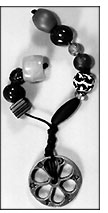 The first beads were grooved pebbles, bones, and teeth -- made over 40,000 years ago -- and had talismanic and symbolic connotations from the beginning. For instance, wearing an animal bone or tooth affirmed success in the hunt for food. Beads at this time also served as status symbols. Later in the evolution of human civilization, beads were used as currency. A fossilized shell and bone necklace that is thirty thousand years old, on display at a museum in the Czech Republic, demonstrates that earliest humankind used beads for some of the same reasons people still use them today -- for personal adornment, which distinguished oneself from others through unique ornamentation.
Spiritual associations began with the ancient Egyptians, whose use of beads goes back to 3200 B.C. Calling beads sha sha strongly implies the beads' talismanic significance, since "sha" is the Egyptian word for luck. Beads officially sanctioned as instruments of prayer have been an important fixture of most spiritual traditions for centuries. And most of the world's inhabitants -- nearly two-thirds of the planet's population -- pray with beads. Some scholars have theorized that counting prayers naturally evolved from the abacus, the Chinese counting instrument that also used beads. Other have noted that records of the third century Desert Mothers and Fathers indicate that they carried in their pockets a specified number of pebbles, which they dropped one by one on the ground as they said each of their prayers.
Traditionally, prayer beads have consisted of strings of similarly sized beads, seeds, knots, or even rose petals and beads made from crushed roses, from which we get the word "rosary." The Sanskrit term japa-mala means "muttering chaplet," which refers to prayer beads' function as a means of recording the number of prayers muttered. Since counting prayers was initially so important, each religion embracing the use of prayer beads developed its own symbolic structure to follow.
In addition to helping keep one's place in structured prayers, prayer beads also symbolize the commitment to spiritual life. With their circular form, a string represents the interconnectedness of all who pray. Each bead counted is an individual prayer or mantra, and the rote repetition of prayers and mantras is meant to facilitate a sole focus on the prayer or mantra itself.
Most scholars believe that the use of prayer beads originated in ancient India with the Hindus. In India, sandstone representations dating from 185 B.C. show people holding prayer beads, and this practice apparently became widespread by the eighth century B.C. The strand of Hindu prayer beads, called a mala, was designed for wear around the neck, and consisted of 108 beads for repeating mantras or counting one's breath, a practice later adopted by Buddhists. (The word mala means "rose" or "garland" in Sanskrit.) The earliest known mala -- strung from seeds that still exist -- is around two thousand years old.
The 108 beads represented the cosmos, in which people multiplied the sum of the twelve astrological signs by the nine planets. Hindu malas are usually made of natural materials. Beads made from rudraksha (called "Shiva's eyes") are used by those in the Hindu cult of Shiva, while devotees of Vishnu usually use beads made from the tulsi (sacred basil) plant.
Buddhism
Around 500 B.C., India saw the birth of Buddhism, which adopted the Hindu practice of using a mala for repeating mantras or counting breaths. As Buddhism spread to Tibet, China, and Japan, so did mala use. Like the Hindu mala, Buddhist malas are usually composed of 108 beads -- or divisions of that number, 54 or 27 beads. While Burmese Buddhist monks prefer strings of black lacquered beads, malas are also made of sandalwood, seeds, stones, or inlaid animal bone. Twenty-seven-bead smaller wrist malas were created to prevent the prayer beads from touching the ground during prostrations.
In Tibet, malas of inlaid bone originally included the skeleton parts of holy men, to remind their users to live lives worthy of the next level of enlightenment. Today's bone malas are made of yak bone, which is sometimes inlaid with turquoise and coral. Buddhists also used their prayer beads as divination tools as well as for prayer.
The 108 beads represent the number of worldly desires or negative emotions that must be overcome before attaining nirvana. Buddhists believe that saying a prayer for each fleshly failing will purify the supplicant.
Christianity
Christian prayer beads, most recognizable as the Catholic rosary, are usually made of colored glass or plastic beads, or sometimes beads crafted of olive wood. Although, as noted earlier, there are roots in the prayer practices of the Desert Mothers and Fathers in the third century, their use was more widely developed in the sixth century. Then, Saint Benedict of Nursia asked his disciples to pray the 150 Psalms of the Bible at least once a week. Since this was a large assignment for the memory, a substitution of 150 Paters ("Our Fathers") was allowed. The faithful used beads to count the paters, and this string of 150 beads became known as a paternoster. It might surprise some who associate Lady Godiva only with unusual horsemanship, but the first recorded mention of Christian prayer beads occurs in her will. She bequeathed her paternoster beads of precious gemstones to the convent she founded in 1057.
In the Eastern Orthodox tradition, both knots and beads are used. Shorter knotted ropes are worn on the wrist. Often made of wool, the Greek prayer ropes -- called kombologion -- have 33, 50, or 100 knots. Russian chotki have 33, 100, or 500 knots. Sometimes the faithful use bead strands resembling a ladder (each end of a bead touching two parallel strands), which signifies the soul making its ascent to heaven.
Christian prayer beads probably once had relationships to the folklore surrounding stones and talismans. Coral, for example, was thought to guard against illness, so in many portraits of Jesus Christ as a child, he is depicted with coral beads. Later, as a result of such association, clergy were not allowed to use rosaries with beads made of amber, quartz, or coral.
Christian prayer beads have been associated primarily with Roman Catholicism or with the Greek and Russian Orthodox tradition, because John Calvin discouraged their use by Protestant believers. He rejected materialism and ritual, feeling that the faithful should read and analyze spiritual texts in direct relationship with God, rather than simply memorize set prayers.
However, in the late 1980s, an Episcopal priest created an Anglican rosary of 33 beads, which represent the years of Jesus' earthy life. There's also a nondenominational variation known as the "Earth Rosary." Consisting of four sets of 13 beads, which indicate the 13 weeks in each of the four seasons, the Earth Rosary has a total of 52 beads, representing each week of the year.
Like their secular counterpart "worry beads," prayer beads offer a kinesthetic comfort -- they are a means in a material world to remember one's place in the spiritual world. As M. Basil Pennington reminds us in "Praying by Hand: Rediscovering the Rosary as a Way of Prayer," prayer beads simply are a method or instrument "to help us pray, to enter into communion and union with God. Therefore, we should feel free to use it or pray it in any way that helps us to enter into that union."
Prayer beads are also used by Muslims. No one knows exactly when or how prayer beads entered this faith tradition, although scholars believe that prayer-bead use in Islam was adopted from Buddhism. Muslims use strings of 33 or 99 beads with one "leader" bead, which represent the 99 names of Allah found in the Koran and the one essential name. Called masbaha or subha -- from the Arabic word meaning "to praise" -- Muslim prayer beads include markers after the 33rd and 66th beads. Often subha are made of wood, or from date pits produced in the Islamic holy city of Mecca.
Judaism
In Judaism, prayer beads have been considered a form of paganism. However, because the Jewish prayer shawl known as the tallit includes a specified number of knots, we can perhaps intuit that numbers are as spiritually significant to the tallit in Judaism as they are to prayer beads in other traditions.
Made of blue and white silk and featuring fringe, five knots, and four tassels, the tallit indicates obedience to a passage in Numbers 15:37-41. In it, Moses asks that the tallit be made and looked at, specifically noting the number of tassels to include "so you will remember all the commandments of the Lord."
Native American
Beads have always had a spiritual significance to Native Americans; neck medallions as early as A.D. 800 served as talismans against threat. Certain items of jewelry and other ornamentation using beads were often integral to their healing ceremonies. For instance, Native American first used seashells and quills for their beadwork. Europeans introduced glass beads, which Native people incorporated into their beautiful and colorful work. These tiny beads were called "little spirit seeds" by some tribes, who felt that they were a gift from the gods.
Vestiges of Christian missionaries appear in the rosaries of the Yaqui tribe of Arizone, who have been Christians since the early 1600s. Their culture blends the symbolism of Christianity with their traditional Native beliefs.
Native Americans bring a spiritual philosophy to their beadwork, believing that the time it takes to make items beautiful honors the spirit world. In "A Primer: The Art of Native American Beadwork," author Z. Susanne Aikman, who is of Eastern Cherokee descent, counsels using a "Spirit bead," or a bead that stands apart from the rest of the pattern, when creating beads of one's own: "Each piece should contain an intentional mistake or Spirit bead," she writes. "The reason for this is that we are but human and cannot achieve perfection; if we attempt perfection in a piece it could be bad luck. So always remember your Spirit bead."
African
African cultures have long prized beads, though their earliest use served as indicators of power and wealth. Africans also used beads to communicate. The "love letters" of the Zulu tribe manipulated the colors and patterns of beaded offerings to one's suitor in order to convey secret messages. In Rhodesia, Matabele chiefs gave beads to witch doctors as tribute to their god. These beads were known as "ambassador beads," since they were used to elicit the goodwill of the Divine. For the Yoruba, beads represent the qualities of spiritual wisdom, the power of the gods, and the gods themselves. The Yoruba believe that using beads in ritual or on ritual objects will enhance their power. Diviners wear special bead necklaces that identify them as spiritual leaders and enhance their power. The Masai find beads so meaningful to their culture that their language includes more than 40 words for different kinds of beadwork.
Given both the religious and cultural significance that beads have held around the world, we can trust the significant precedent their spiritual power holds for our own lives.
(Click here for ideas on how to pray with prayer beads.)