Prayer is the most universal expression of the presence of God. We express devotion, rage, submission, and many other emotions in prayer. We often plead in prayer. In fact, when the professed nonbeliever pleads in prayer at a time of crisis, we may say that she is not really a nonbeliever after all.
We most often think of prayer as something spoken, but it can also be expressed in other ways. What we say, what we do, and how we do it all express God's presence, when we are prayerful....
Consider for a moment the statement of the Jewish mystic and theologian Abraham Joshua Heschel, who said of his experience marching with Dr. Martin Luther King, Jr., in Alabama, "My feet were praying." The meaning in our heads can become the meaning in our bodies. When we use our bodies with spiritual intent, both our bodies and the occasion become sacred. Sometimes these bodily actions accompany spoken prayers; sometimes they are prayers in and of themselves.
What Is Embodied Prayer?
In saying "My feet were praying," Heschel meant that our bodies can embody prayer, or be places where prayer is actively happening. Our actions and movements can be expressions of prayer to God. We don't--or shouldn't--just think our prayers. We can embody the feelings and emotions usually expressed only as spoken or mental prayers in our actions. Prayer can involve our bodies as much as our minds, as we communicate with God, bless, honor, and petition God, rage in the presence of God, and show our devotion. We can show and express with our bodies what we say and express with our minds. This is prayer in motion--and it takes practice. If you try, you can see that prayer can take many forms, and simple actions can have profound meaning in your spiritual life.
We need to realize that God is in us and is part of us. We need to stop talking to God as if we were not intimately one. Embodied prayer is a spiritual practice in which you are able to see your will and actions intermingled with the Divine, engaged together with the world. When you practice embodied prayer, the very motions of your body create meaning for your words like sound creates meaning in poetry....
For many of us, practicing embodied prayer involves a shift in perspective. We begin to imagine our spiritual lives differently, with a more holistic vision. New ways for celebrating and practicing the sacredness of life will open up for you as you begin on this path. You will see how everyday actions can be prayerful expressions to God. You will also see how religious ritual is rich with prayer of the body, and how expressive just your hands can become.
Imagine the many emotions your hands already express: They can invite or beckon, repel or reject, hide or reveal, console or protect; they can embrace. When we pray with our hands we are enfleshing the sacred--not just talking to God, or focusing our minds. In our hands, prayer becomes visible....
We Are Divine Agents in the World
Resisting Evil
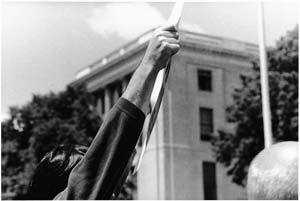
Wherever there is evil in the world, there is the potential for good. It is our responsibility to transform it.
Abraham Joshua Heschel spoke of the ways in which God is no longer at home in the Creation because we act as if God doesn't exist. Instead of being divine agents as we should, we effectively remove God from the world with our inaction. Heschel says: "To pray means to bring God back into the world.. To pray means to expand God's presence."
We pray with our bodies when we put them in front of tanks. We pray with our hands when we link arms together to fight injustice. We are co-creators with the Divine when we resist evil. The world is more sacred at these moments.
True Freedom Comes From Letting Go
The Cosmic Mudra
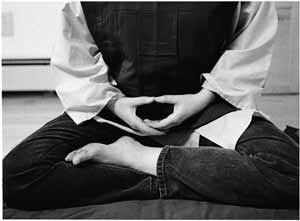
In zazen ("sitting" meditation), posture is important--and this includes the hands. After describing in detail how the hands should be positioned to form the cosmic mudra, the great Zen teacher Shunryu Suzuki says: "You should keep this universal mudra with great care, as if you were holding something very precious in your hand."
We are inundated with attachments-our feelings, insecurities, friends and family members, our stories. They all have their places in our lives, but ultimately, as Zen teaches, we have to let go of every one of these treasures. When we successfully let go of the treasures in our lives, we awaken to see the meaning behind the mystery of life, the greatest treasure of all. This is symbolized by the cosmic mudra--holding the treasure that cannot be held--"the jewel in the hand, opening endlessly."
Laying on of Hands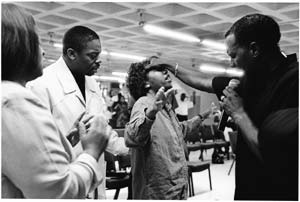
People have gathered together as religious communities for millennia because we need each other in order to understand God and ourselves. Like babies, we need to be touched--by each other and the Divine--in order to grow.
In Protestant traditions, members of the community needing special care, such as healing or counsel, or those about to enter into positions of authority and special responsibility, receive a blessing accompanied by the touch of many supporting hands. These hands are meant to be the "hands" of God.
One of the beautiful Protestant hymns, written at the turn of the last century, says:
Open my eyes, that I may see glimpses of truth you have for me; place in my hands the wonderful key that shall unlock and set me free.
Silently now, on bended knee, ready I wait your will to see; open my eyes, illumine me, Spirit divine!
-Clara H. Scott
Our Bodies Are Sanctuaries for God
Daily Honor
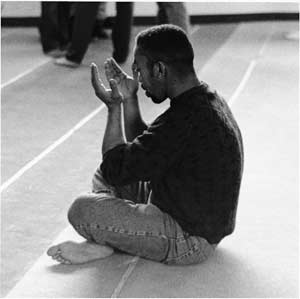
Many religious traditions practice a daily regimen of repeated prayer--but none combines the spiritual with the physical like Salat, Muslim daily prayer. According to tradition, "The Prayer" was first taught to the prophet Muhammad by angels, and it mirrors their constant adoration of God.
Salat is practiced all over the globe--five times daily the Islamic world faces Mecca and praises: "In the name of Allah, boundlessly merciful and compassionate!" The beloved Sufi poet Hafiz (14th century) sings:
I bow to God in gratitude, And I find the moon is also busy Doing the same.
The Prayer has several stages and universes of meaning: standing, bowing, prostrating, and kneeling all use the hands to recognize and praise Allah ("God" in Arabic) in humility and devotion.
A mosque is unnecessary for Salat--the inner sanctum, or the prayerful heart, is the place where the prayer begins (and on a portable prayer mat). Our bodies are the true mosques, churches, synagogues, and temples--when we use them as places for daily honor to God.