My friends and I are coming out of centering prayer. We've been sitting in silence for 25 minutes together, and now we're using the little refrain from Psalm 137, "In you alone, Jerusalem, my joy," to bring us back to this time and place.
We start with a simple monotone chant, still very inward and quiet.
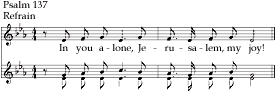
In you alone, Jerusalem, my joy.
Gradually, at our own speed, each of us becomes aware of the others around us, becomes aware that we're singing together.
Then, once our monotone chanting has established itself, we add the middle line of the chant and then the top line. Suddenly out of the monotone emerge harmony and color. It's like a passage between worlds, from the deep silence we've just experienced to the colors, the notes, the harmonies, and the people around us--just like the first day of creation. If psalmody can add intensity and grounding to a personal discipline of contemplative prayer, it can do it even more intensely in groups.
As centering prayer and Christian meditation continue to gain popularity, one of the new forms that seems to be sprouting up is the contemplative prayer "support" group. People come together, usually on a weekly basis, to meditate. They often stay around afterwards to read and reflect together, or to share their personal journeys. To frame this weekly gathering within the context of psalmody can have a very profound effect on the depth and vitality of the silence that follows. It turns meditation into contemplative worship.
In a group, we also have the wonderful (though sometimes difficult) opportunity to practice "the yoga of the choir." One of the core elements in the Christian spiritual path is its emphasis on community. There is a quiet but unshakeable insistence that the inner spiritual experience becomes infinitely more profound, more powerful, and more beautiful when it's shared "as one body."
Practically speaking, this always takes some negotiation, some bridging of the distance between pure interiority and outer sensitivity. I remember once, when I was a young music student, hearing an interviewer ask the famous pianist, Clifford Curzon, "Mr. Curzon, are you one of those pianists who plays in tempo or one of those pianists who plays expressively?" He answered, "I try to play to expressively in tempo."
I remember being in one contemplative prayer group with a woman who had a very dominant but untrained voice--as well as a deep hankering for ecstatic experience. Whenever she started chanting the psalms, she would go into a completely inward space that must have felt glorious to her, but didn't give anybody else in the room a chance to participate. It was impossible even to keep up a tempo, let alone to blend and harmonize. With a lot of support, she slowly learned how to temper her private ecstasy, opening it up so that it could be shared with the others in the group. The virtues at stake here, of course, are humility, hospitality, and sobriety. Small wonder that not only her singing, but also her prayer life soon mellowed considerably.
Learning to sing psalms together helps us to understand, as the Buddhists say, how "not to cling to our own experience." We learn to feel things very deeply but with detachment. We begin to escape from the prison of our own subjectivity. This is the beginning of true equanimity--that "still point in a turning world," as T.S. Eliot puts it--out of which our lives can flow with authenticity.
So we learn a lot about contemplative prayer simply by singing together. Listening to each other, balancing the inner and the outer, learning how to energize the psalm chanting when we get tired by refocusing our attention: all of these things have direct carryover to the meditation, with its dual demands of attention and surrender.
It has been said, "prayer is the fullness of attention." When we're completely paying attention, when we're completely present in a moment, completely listening at all levels, we're praying.
Chanting psalms together in the group opens us to these difficult but very important truths in the spiritual path, which move us from being introverted amateurs to having that kind of maturity and stability of practice out of which real grace can flow.
We start with a simple monotone chant, still very inward and quiet.
In you alone, Jerusalem, my joy.
Gradually, at our own speed, each of us becomes aware of the others around us, becomes aware that we're singing together.
Then, once our monotone chanting has established itself, we add the middle line of the chant and then the top line. Suddenly out of the monotone emerge harmony and color. It's like a passage between worlds, from the deep silence we've just experienced to the colors, the notes, the harmonies, and the people around us--just like the first day of creation. If psalmody can add intensity and grounding to a personal discipline of contemplative prayer, it can do it even more intensely in groups.
As centering prayer and Christian meditation continue to gain popularity, one of the new forms that seems to be sprouting up is the contemplative prayer "support" group. People come together, usually on a weekly basis, to meditate. They often stay around afterwards to read and reflect together, or to share their personal journeys. To frame this weekly gathering within the context of psalmody can have a very profound effect on the depth and vitality of the silence that follows. It turns meditation into contemplative worship.
In a group, we also have the wonderful (though sometimes difficult) opportunity to practice "the yoga of the choir." One of the core elements in the Christian spiritual path is its emphasis on community. There is a quiet but unshakeable insistence that the inner spiritual experience becomes infinitely more profound, more powerful, and more beautiful when it's shared "as one body."
Practically speaking, this always takes some negotiation, some bridging of the distance between pure interiority and outer sensitivity. I remember once, when I was a young music student, hearing an interviewer ask the famous pianist, Clifford Curzon, "Mr. Curzon, are you one of those pianists who plays in tempo or one of those pianists who plays expressively?" He answered, "I try to play to expressively in tempo."
I remember being in one contemplative prayer group with a woman who had a very dominant but untrained voice--as well as a deep hankering for ecstatic experience. Whenever she started chanting the psalms, she would go into a completely inward space that must have felt glorious to her, but didn't give anybody else in the room a chance to participate. It was impossible even to keep up a tempo, let alone to blend and harmonize. With a lot of support, she slowly learned how to temper her private ecstasy, opening it up so that it could be shared with the others in the group. The virtues at stake here, of course, are humility, hospitality, and sobriety. Small wonder that not only her singing, but also her prayer life soon mellowed considerably.
Learning to sing psalms together helps us to understand, as the Buddhists say, how "not to cling to our own experience." We learn to feel things very deeply but with detachment. We begin to escape from the prison of our own subjectivity. This is the beginning of true equanimity--that "still point in a turning world," as T.S. Eliot puts it--out of which our lives can flow with authenticity.
So we learn a lot about contemplative prayer simply by singing together. Listening to each other, balancing the inner and the outer, learning how to energize the psalm chanting when we get tired by refocusing our attention: all of these things have direct carryover to the meditation, with its dual demands of attention and surrender.
It has been said, "prayer is the fullness of attention." When we're completely paying attention, when we're completely present in a moment, completely listening at all levels, we're praying.
Chanting psalms together in the group opens us to these difficult but very important truths in the spiritual path, which move us from being introverted amateurs to having that kind of maturity and stability of practice out of which real grace can flow.