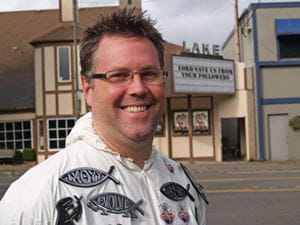
Why is the gospel of love dividing America? Director Dan Merchant set out to answer that question in the documentary "Lord Save Us From Your Followers," which earlier this year won the Beliefnet Film Award for Best Spiritual Documentary. Following a life-changing trip to Ethiopia, Merchant and his amazing suit of bumper stickers traveled across the country to find out how the culture wars were affecting people from Grauman’s Theatre to Times Square and everywhere in between. His ultimate goal, to shift people from believing that the modus operandi of Christians is not to be right but to love unconditionally.
Through exclusive interviews with Al Franken, Rick Santorum and Tony Campolo--among others; soundbites from Bono and Pastor Rick Warren; and a slew of interesting man-on-the-street meetings, Merchant leaves no stone unturned in the search for peace in the midst of the faith and culture imbroglio. In an interview that took place during the 2008 International Christian Retail Show, Merchant talked to Beliefnet about the film, how it changed his life, and his favorite bumper stickers.
When did you realize that the culture wars and this problem with Christianity is worth a book and a movie?
The defining point was following a trip to Ethiopia. Coming back from one of those unsettling look-in-the-mirror experiences in Ethiopia and comparing that against the very political, divisive kind of strident climate that Christians in America were having. There was a guy in Ethiopia that I met, a 19-year-old who was an Ethiopian Christian and he was one of many that really touched my heart and shook up my head, along with Christians from around the world and from America who were there doing, you know, the hard work, doing the good work. And this young man and I got to talking about faith. He said that we’re all children of God and that we’re in different continents and we speak different languages and our skin colors are different, but we’re still all children of God. And I was like, yeah, it feels like that should be how it is. We have way more in common than we have differences, and I really liked that.
And we were talking about our faith, and he was trying to help me understand what he believed. So he went into this story. He explained that his mother died of AIDS. And he said to me, "But she didn’t die for me. And my father died of AIDS, but he didn’t die for me. But, Jesus Christ, he died for me."
As those words left his lips, this thought ran across my brain, like, "Wow, this kid sounds like he believes this stuff," and--you know, it begged the question, "Well, what do you believe, Dan? Isn’t that what you believe? Don’t you believe God knows the number of hairs on your head?"And it’s like, well, I guess I don’t really believe that and I thought I did. And you had to see the expression on his face.
There’s just this comfort, strength and, assurance. It’s like, wow, is that what really believing it looks like? Does really believing and trusting in God mean you can sleep on a mud floor in a hut and brush your teeth in a drainage ditch with your finger and be happier than me? Is that what believing in God means? Wow. It forces you to look in the mirror. It forces you to figure out how come you don’t believe like that? Is it because I’m too comfortable in America and I don’t have to? Most of us don’t have to rely on God hourly or a minute-by-minute the way most of the world lives. But to have that kind of faith in God and that kind of reliance in God really impressed me. It really shook me up, and it forced me to look in a mirror.
That was really the start of this journey for “Lord, Save Us From Your Followers.” It’s about trying to reconcile the distance between the perception of Christ and the perception of Christians, the difference between a guy who can trust in God and be happier than I am when I have 10 times the worldly possessions. I’ve got to figure out how to reconcile that distance between how he believes and I believe.
So, it was sort of in that space that we started off on this journey. And it demands a lot from you. You’ve got to get out of your own comfort zone and you’ve got to realize that being right about everything is not where it’s at, and that actually trying to get inside of these inconvenient things Christ says, like, you know, "Love one another," "Love your enemy as yourself," that that’s a whole different kind of being right.
How do you know that how Christians are perceived isn’t actually the way they are supposed to be perceived according to the scripture?
Well, if we’re persecuted for our beliefs, so be it. And if we’re persecuted because we’re a jerk, that’s something entirely different. And I think, more often than not, that’s [the latter] actually the case. You know, I’m as guilty as anybody of sitting back on the scripture and going, "Oh, the truth divides. It's pearls before swine," you know, all these things that--if I think about it, all of those things allow me to remain motionless and pious and not go out of my way for other people.
Check your motivation. Is your motivation just to protect your castle and keep you from having to do anything difficult? Well, that ain’t what Jesus meant. He didn’t take the easy way once. Not one time do I see Jesus going, “Ah, da-da-da-da-da,” and then now it means He can go have a nap. I never saw Him take that route. He doesn’t promise us a comfortable life. He doesn’t promise us happiness. He promises fulfillment and an answer to why I’m here and, direction for our purpose.
Which denomination would you say is the biggest offender in the culture wars right now?
You know, frankly, I’m so bad at denominations. I mean, I don’t really know who believes what. I’m a filmmaker. I’m an observer of culture and of people, I’m no theologian. I don’t study churches. I go to them. I was baptized in a river. I’m a Christian who takes it seriously and tries to figure out how to live it. But, I’m not an expert in terms of all that stuff.
I would say that the way our culture works today is that, if you’re a Christian and you got a microphone and you’re talking to a lot of people, you better be sure you’re plagiarizing Jesus when your mouth opens. That’s why you’ll hear me say "Love one another" about 25 more times before this interview’s done. It’s like that one [thing] people connect with. And the reason they do is because it’s the basic truth.
You mention the Four Horsemen in the documentary. Who are they and what is their impact?
Two of the four horsemen have since passed on.
I was referring to James Dobson, Jerry Falwell were founding members of the Moral Majority. Pat Robertson and D. James Kennedy would’ve been--I think—the four I was referring to. Those are the guys who tell me that the homosexual agenda will mean the end of Western civilization. I see that for five consecutive months in this particular newsletter. On the sixth month it’s the Muslims. And I’m like, "Wait. What happened to the homosexuals?"
So, you know, everybody just has to check the motivation, Jesus talks a lot about fear. And if that’s our motivation for action, it’s wrong. Even if you say you’re supporting some biblical truth. But, if you’re reaction is essentially a fear-based reaction, then there’s supposed to be a different response. That’s what I think. Fear is this creeping virus that’ll get into everything. It gets into me and you and it gets into everybody, and it’s in our culture. And love’s the only thing that repels it.
What about the other media heads, Jon Stewart--Tony Campolo made an interesting statement about him being the Prophet of God.
I think the point that Campolo was making is that we need to be aware of how we sound. And that is a message of God. That is a biblical thing, you know, that you don’t throw words out in the air that are meaningless. You don’t throw words out in the air that are negative or that are only intended to hurt or to agitate. That’s biblical. And so, what Stewart was saying you could dig out scriptures on that. And I think that’s where Campolo was going with that. I’m not sure he meant every joke on every Daily Show. And it’s interesting, because it gets past these intellectual gatekeepers, and it provokes us to thought. It provokes a reaction. And then, we have to examine why we reacted that way. And it’s in that examination that we usually get to learn something about ourselves.
How did you feel about George Carlin’s presence in the documentary?
I cried the day George Carlin died. And I actually spent 10 or 15 minutes thinking about what kind of conversation he was having with God that day. And, you know, I don’t know if that’s biblically sound or not, but I imagine that he got to meet his Creator that day. And I don’t know what happened, and I don’t presume to know that he’s in hell or heaven. But I thought about him and I wondered. I know there’s a lot of Christian people that Carlin has offended with his view. But boy, we’ve given Carlin and Bill Maher more than enough ammunition. I don’t blame them. Those guys aren’t making up stuff. Carlin, and even Bill Maher to a certain degree, there’s truth that they’re sharing. And it might be just truth from their point of view. And maybe it’s not truth with a capital T, but boy, it sure tells us where they’re coming from.
I mean, George Carlin has this brilliant routine where he’s talking about how God needs your money. Come to church and give Him your money. Oh, he created everything in the universe. He’s the master of time, space and dimension, but He’s bad with cash. And you’re like, you know what? That’s a great lesson. It’s like we have to explain tithing in a way that doesn’t seem like we’re money grabbing. And, you know, I guess I have some questions when pastors have private jets. I guess I have some questions when they have a Rolls Royce collection.And guess what? George Carlin had some of those questions, too. And they’re valid questions.
Talk about the booth that you set up in Portland during a gay pride event to apologize on behalf of Christians.
Well, what we did in an effort to do a social experiment—to see how strong God’s grace really is, see if this truth is really as powerful as He says—we set up a confession booth at a Gay Pride event at Pride Northwest in Portland, Oregon. And in that booth I confessed my sins to the homosexual community and those of the church that I’m a part of about how we haven’t done a particularly good job in the wake of the AIDS crisis. And so, to be able to meet and connect with people, and I was in there about eight hours, I guess. I probably visited with 26-28 people. It was amazing how easy it was to connect. I was so moved and so honored by the graciousness and the kindness I was shown. I would not have been surprised to have gone in there and had my teeth kicked in by every single person in that booth. And I feel like they could’ve been justified in doing that. That’s not what happened.
I remember walking around praying as we were putting the booth up. And you know, it’s a bit of a circus, and it’s not my scene, and going, "Oh, what did I get myself into?" It wasn’t a fun experience because people were so open with their pain and people were so open with how they’d been hurt. And they were open with their heartbreak, and it shatters you.
And it’s amazing the conversation and the connection that’s possible, the relationship that’s possible if we’re willing to be open to it. The conversation is there for us with anybody, you know, about politics, about faith, about religion, about difficult issues, complicated social issues, whatever they are. If we’re willing to be open and humble and admit, I don’t have to win the argument. That’s one of the things I’ve learned, you know, making “Lord, Save Us From Your Followers.” I don’t have to win these arguments.
One of the real highlights for me, is how open the church is for a look in the mirror and to have the conversation. The thing that they grasped, which I love, is I’m not trying to rewrite the scriptures. I’m not, like, here’s the Bible according to Dan. That’s not what it is at all. And they’ve seen that. They’ve seen that I’m a follower with a broken heart trying to figure out how do we do this. How do I do this better? Differently? What about this? What about that? What do we do with the fact that Jesus says we’re supposed to love our neighbors as ourselves? Why does it look like we’re ignoring that? Is it just me, or is it you, too?
In churches, the response has been basically across the board, across racial lines, across socioeconomic lines, across denominational lines that--it’s like, “Oh, yeah, We’ve sort of forgotten some of this stuff, haven’t we? Oh, yeah. We sort of did make it about winning an election or defeating a ballot measure, didn’t we? Oh. Wait a second...”
Did you visit any black churches with this documentary and where do you see the black church fitting into the culture wars?
Well, you know, it’s interesting because there are different cultural issues that are more important from my [perspective]. You know, I’m a white guy from a cul-de-sac, in the Northwest so I’m limited in my ability to assess that. What I’ve seen is that some of these issues that white people are going crazy over just aren’t that important. While poverty certainly isn’t a racial issue, there’s some racial roots. And clearly, in the big cities there are certainly some cities where it is primarily a black issue.
We visited a group called Mission in Philadelphia. And it’s kind of like a Mormon mission, but it lasts for a year. Bart Campolo, Tony Campolo’s son, started this a few years ago. They’re based out of Chicago now. And for one year they’ll get eight or 10 kids. It’s like the “Real World” on MTV. Ten kids move into this house in north Philadelphia. But, it was the kind of neighborhood where the further into it you drive, first the sidewalks start falling apart and then, you get further in and it’s like, where’d all the cars go?
I’d never seen that. I was more depressed in Philadelphia than I was in Ethiopia. You know, sure they had XBox and cable, but they didn’t have any hope. At least the Ethiopians had hope. For whatever reason, they trust God. They have hope. Philadelphia didn’t have hope. And it was weird because I could talk about the Allen Iverson trade with these guys. I had more in common with these guys. And it was soul crushing.
We’re talking about welfare of human beings. That just has to be more important than bickering over superficial kinds of issues? Do I really want to fight about whether evolution and creationism get taught side by side in science class? There’s bigger fish to fry.
What is your favorite bumper sticker on your jumpsuit of bumper stickers?
There’s two. There’s the one that’s sort of the popular favorite that people point out all the time, which is “Get the hell out of my way. I’m late for church.”
And then one of the ones--I don’t know why I laughed so hard at it, but it was one of my personal favorites, is the one that says, “Sorry I missed church. I was home practicing witchcraft and becoming a lesbian.” I just imagine the writer of that one just going, "I’m just going to poke somebody right in the eye with this one." I laughed. Again, it was the involuntary reaction. I thought, and I laughed. And I’m still thinking about, "Why do I think that one’s so funny?" I don’t know, but that’s the one. I had such a big reaction to that.
So how do you think that we can get back to the gospel of love rather than the gospel of being right?
A lot of it starts on a person-to-person level and on a church-to-church level, which is reaching out to those around us. Take stock in your own life and who you can be helping. Is there a kid you can be babysitting after school? Just let him come over and play with your kids because his mom works. I mean, something little like that is how we get the momentum going.
It’s like we have this faith and a way that people understand what our faith truly is when we show them. And if we’re doing a whole lot more showing than telling, then that’s good. Good things are going to happen.
Who are the people you want to touch most with this film?
I didn’t make it as a film for Christians. I set out to make it as a mainstream film. It’s a balanced look at something that happens in America. And in America, seven out of 10 people or so claim to be Christians, and nine out of 10 or so claim a belief in a creator. And so, I definitely saw it as a mainstream. This is a “Super Size Me.” It’s something that will be in the art houses and all that.
One thing I did have in mind was I did design it to be able to play in a church as well as an art house. And what has surprised me is that the church is open to it. And this shows you my own stereotypes, my own lack of understanding about my church in a broader way, is that the church has been remarkably open to looking in the mirror. We’ve been screening the film all over the country, in all kinds of churches and all kinds of college campuses. I didn’t expect that. I know that college kids and people in their 20s and their 30s really, really enjoy the film.
If your movie named after a bumper sticker or your book named after a bumper sticker can serve as a conversation starter and turn people on a different kind of path where their behaviors or their actions or their heart is even in a different place, that’s powerful.
How has this documentary changed your life?
I’m sure a whole lot more aware of my own knee-jerk reactions. And I think I’m getting better. I’m slowing them down and catching myself, and really trying to understand, you know, is it fear or is it faith that’s behind a given reaction. You know, I have a better understanding that every person has “a rest of the story," that compassion is something that people shouldn’t have to earn from me, that I should give it because I’m a Christian and if I don’t understand compassion based on Christ’s life and His sacrifice, then I don’t understand my faith. I don’t care about winning arguments like I used to, and I’m a better listener. And I’m edified by most people I come across because I’m willing to try a little harder to see them, you know, to try and see them maybe how God sees them. As lame as my effort is in that area, you know, when you try, you see more. You see something different, and that just changes everything. And I’m just grateful to be in the conversation, finally.