When Beliefnet launched in 1999, the nation appeared to be in the middle of a spirituality boom. "Touched by an Angel" was the #4 show, newsmagazines put religion on their covers every chance they got, and the spirituality book market was booming. I often heard this theory to explain the boom: We were in a time of affluence; people were finding their material needs well met only to discover a feeling of emptiness, so they turned to faith.
Two years later, we were in a recession--and yet the spirituality boom continued. Clearly, we were told, the interest in spirituality resulted from Americans feeling economically insecure and needing support. Then came 9/11 and the theory changed to: Clearly, we're feeling vulnerable to attack and therefore turning to faith.
What's really fueling all this activity is a convergence of three forces:
1. The spiritual life cycle
2. The aging of the baby boomers
3. The breakdown of traditional institutional loyalties
Phenomenon #1: The Spiritual Life Cycle
Surveys indicate that spiritual interest and activity tends to follow a predictable arc, increasing as we age. This chart from Gallup tells it all:
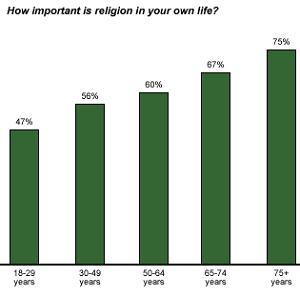
A recent Newsweek/Beliefnet poll found a similar correlation between age and an interest in spirituality. While 44% of people ages 18-39 said spirituality was "very important" in their daily lives, 63% of people aged 40-59 said so.
This is not because older folks are more traditional and old-fashioned. It's because as we age, life forces us to confront existential dilemmas.
To offer some gross caricatures....
In our 20s, we feel immortal and focused on exploration and experimentation. In our 30s, we're more likely to be searching for a soul mate and deciding on our purpose or vocation. As we create families and figure out how to raise kids, we revisit our spirituality. As we age more, we start to see more and more loved ones die--at first, our parents' generation, then our peers. We want to make sense of the losses, find strength, and connect with the other world. If we're alone, the loneliness weighs heavier; if we're happy, we discover that our joy is magnified when it is shared. As the burdens of caring for our kids and our parents grow, we need more sources of strength.
If we have no vocation, the emptiness seems vaster at 40 than at 20. What we value begins to shift. We've been burned by some of our life choices and come to treasure other more timeless virtues like honesty or authenticity than we used to. If we've been materially successful, we realize that there's more to life; if we've struggled financially, we tap spiritual wealth for strength and happiness. As we age further, we confront the fragility of life even more directly. It dawns on us that we're going to die, too, and we want to figure out how to make sense of life here and hereafter.
Are younger people spiritual too? Yes, of course. These are broad stereotypes, invariably inaccurate in the particular. But on a broad statistical level it is demonstrably true: The older you get, the more spiritual you become.
In 1970, 47% of the population was 30 or older. Today, 57% of the population is. By 2020, 60.6% will be. Stated another way, a much larger percentage of the population is in the peak "spiritual zone" than it used to be.
In a sense, the spirituality boom is an extension of the fitness boom. The same people who learned how to jog in 1975 are learning how to pray in 2005. They took care of their abs then and must attend to their souls now.
What do we know about boomers? They're used to shopping from among many choices. They're into self-help. They're both self-indulgent and tolerant. Remember these basic boomer characteristics and its easier to understand their spirituality
Phenomenon #3: The Decline of Traditional Institutions
In the past few decades we've seen a society-wide decline in many traditional institutions. Employee loyalty to corporations, and vice versa, has declined. So has affiliation with political parties, labor unions, and consumer products. Brand loyalty has eroded – whether the brand is a cereal or a church. In May 1975, 68% of Americans said they had "a great deal" or "quite a lot" of confidence in religious instiuttions. By 2002, that had fallen to 45%, though it climbed back up to 53% in 2004
In the world of faith, we've seen enormous flux and change. The mainline Protestant denominations have seen church attendance drop.
Evangelical churches have been invigorated by new forms of worship and the rise of the small-group movement.
Growing rates of interfaith and interdenominational marriage have forced people to learn more about other faiths. In all 42% of Americans have embraced a different spiritual approach from their childhood, have seen a sibling shift religious approaches, or have married someone of a different faith.
Meanwhile, more people seek personal spiritual experiences outside of, or in addition to, worship services. Thirty-nine percent report that the main reason they practice their religion is to "forge a personal relationship with God" while only 3% say it is to be part of a community. This would help explain why many people report having a regular prayer life but not attending church. Seventy-nine percent said they pray at least once a week compared to 45% who said they went to worship services during that time.
The new spiritual landscape has many new players: non-denominational mega-churches, Kabbalah centers, small-group Bible studies, retreat centers, and many other variants. Roughly 40% of Americans participate in some kind of independent support group, and two thirds of those have a religious connection--people getting together in living rooms to discuss spiritual matters.
The advantage of the days when people got most of their spiritual information from their clergy and church was the convenience of one-stop-shopping. Now, choices abound. That can be liberating--people can better match their spiritual needs to what's available--but also quite stressful. People need helpers and intermediaries.
That's why they're spending so much money on spiritual or religious information and services. Beliefnet estimates that consumers spend at least $225 billion on spiritual aids or services (not including alternative medicine) such as books, movies, CDs, collectibles, travel, magazines, and charities. The spiritual seeker has become the spiritual shopper.
The internet is one of the major new spiritual intermediaries. People use it to help explore their own faith more deeply or experiment with different approaches. In 2004, the Pew Internet Project estimated that 64% of people online had used the internet for "spiritual purposes." That's 82 million people.
But above all, Boomers have taken the same "shopping" mentality that they have applied to other aspects of life and applied it to spirituality. They study, they switch, they dive in, they dive out. They don't necessarily stay with one spiritual approach but often view their lives as meandering spiritual journeys. Some of what they're seeking is the same as what their parents and grandparents did: meaning, an eternal life, happiness, guidance for living life.
The difference is that Boomers who feel that they're faith is not providing what they need just keep on shopping.