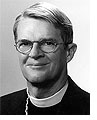
 For nearly two years, Frank Griswold, the Presiding Bishop of the Episcopal Church, has been in the vortex of his denomination's controversy over its election of an openly gay bishop. Since then, those opposed to the church's liberal stance on homosexuality have been taking steps to circumvent the bishop's authority in order to "replace" the Episcopal Church with conservative leadership.
 At a meeting last month in Ireland called by Archbishop of Canterbury Rowan Williams (head of the Worldwide Anglican Communion), the communion's top bishops, called "primates," asked the Episcopal Church to withdraw its representatives from a prominent world Anglican meeting to show their displeasure with the American actions. During the Ireland meeting, American conservative activists were seen wining and dining African and Asian primates who oppose the Episcopal Church's stance on homosexuality. Liberals accuse conservatives of plotting a coup, using the African and Asian primates.
Last week, the American church's House of Bishops met at a retreat in Texas to discuss the Ireland meeting. They issued a statement saying they will not approve any newly elected bishop--gay or straight--until the denomination's General Convention meets next year. Griswold, meanwhile, told the bishops he believes the conservative tactics are "evil."
During a phone interview last week, Griswold explained his comments, and he also said he believes that the liberal, pro-gay rights cause will in the end win. Following is an edited transcript of the interview.
In some of the Episcopal Church-related blogs you were quoted last week as singling out six Americans for having "detrimentally influenced" church proceedings. What did you say?
What I said was that there were notices put on the tables in Ireland describing "acts of oppression" within the Episcopal church that were highly inaccurate and I got up and said, "This kind of information is untrue. It's taking facts and slanting things from a particular perspective. And I said, 'In scripture Jesus tells us the devil is the father of lies, and lying is his nature.'" Therefore this kind of material is really evil. And I said my sense is-and I didn't assign it to any particular people-I feel that there is evil pressing on this meeting. And I said that any one of us can be caught in patterns of evil. Any one of us can misrepresent things to our own advantage.
I repeated it last week in Texas to the House of Bishops when I described my participation in the primates meeting. And I said there were several Americans in the hotel in Newry, including [Pittsburgh Bishop Robert William] Duncan--but I made no connection between those people and the piece of paper I was describing, and the misrepresentations on it.
Last year you talked obliquely about right-wing foundations funding the conservative cause in the church. A year later, what effect has that money had on the dispute?
The effect has been to take an internal battle in the Episcopal Church and project it onto the entire Anglican Communion. And one thing a number of the primates said to me from the global south was that they profoundly disagree with what we've done in the Episcopal Church, but that it is not their primary concern. Their primary concern is about life and death. Their primary concerns are AIDS, safe drinking water, civil war, hunger and disease. They say to me, "These are our issues, but sexuality in your country has taken over everything."
And, of course, the reason in part is because of various groups related to the Episcopal church--well-funded to be sure--who have engaged the disapproval of the primates around homosexuality in order to portray the Episcopal Church as grossly unfaithful and unbiblical, and in every way reprehensible.
But if these primates know they're being used, why are they participating?
You would have to ask them, but they're not all of one mind. Some of them very quietly let you know that they're reluctant to break ranks with the other primates from their region, but they just want me to know that they're not quite as antagonistic as some of the more public voices.
But aren't you suggesting the Episcopal Church has become a kind of "punching bag" for conservatives? Shouldn't one of these dissenting primates stand up and say, "We're not going to keep doing this."?
I do think that truth is happening in a much fuller way. I felt truth happening here in Texas, and I felt that some things were named in the primates meeting that we were reluctant to name before.
I spoke very frankly about where these pieces of paper came from, and why are these people down the road in constant communication with various of you, and whose agenda is this? Who is determining our agenda?
Have any of these primates apologized and said they're going to stop?
It will be interesting to see what happens in the light of the new statement from Texas.
What is the significance of that statement?
First of all, it represents an incredible convergence of wide-ranging opinions that have come together in a desire to find common ground. What I see in the covenant is that the "diverse center" has spoken clearly. The second point is that it is a genuine effort to meet some of the Anglican Communion's concerns, and in trying to meet those straightforwardly.
Do you think your opposition views it similarly?
At this point I have no idea where, as you put it, the"opposition" may be in regard to the covenant. I do know that people on both sides of the aisle really came together in this, and we received a very encouraging note from the Archbishop of Canterbury which communicated from his perspective that we have met some of his concerns.
The House of Bishops seemed to be extending an olive branch by saying the Episcopal Church won't consecrate any openly gay bishops, in fact any bishops, and you won't sanction any same-sex blessings, until after you make decisions at the next General Convention in 2006. At the same time, you said that you want the Developing World bishops to stay out of the Episcopal Church's affairs. Do you expect they'll comply?
I certainly trust it's taken seriously. I think that by and large the bishops in the Anglican Communion really do respect boundaries. The interventions, though highly newsworthy, have been relatively few.
In last year's interview you said the church's crisis isn't all it appears on the surface because the African and Asian primates are in difficult spots. They have to deal with the power of Islam in their countries-particularly in Africa--and so they present a public view and a private view of the American church. What is the state of play among those primates today?
When we arrived in Ireland there was a great deal of tension but as the meeting went along, there were all sorts of relationships of friendship. One Asian primate got up and said how offended he felt, not just by the Episcopal Church, but by the West and its policies toward the East--and after he finished he came up to me and said, "You know I wasn't talking about you personally. Are we still friends?" and I said "Of course we're friends." Things move on a public level, where a primate must represent the prevailing view of his province. And then there's the personal level, where friendships are very deep and understanding is very broad. We all understand that we minister in very specific contexts. We all have to deal with pressures both from the culture and within our own communites of faith.
You say you are trying to understand their situations; are they trying to understand yours?
Many of the primates are. They're really struggling to understand. I've been asked a number of questions about the homosexual reality by primates who weren't simply angry; they were trying to make sense of it from their own perspective. It's a topic they really hadn't engaged before, and I think it's important to note that in many parts of the world, open conversations about sexuality in any form simply isn't on the table. HIV/AIDS has forced it to the table in a number of places, but something as complicated as homosexuality is not something that can be engaged at this point.
How is the struggle over globalization and American foreign policy involved in this struggle?
Often the Episcopal church is wrapped into antagonism toward American foreign policy or the imposition of various elements of American culture that are seen as undermining the integrity of the culture in other parts of the world. The Episcopal Church by virtue of being an entity within the United States is seen as being part of this mix.
You preached a sermon in Belfast last month saying that Christians must be willing to take risks and "push off" into the unknown. Was the sermon a reflection of your new approach to the crisis?
In the sermon I was talking about St. Patrick and the Irish tradition of monks pushing off in small leather-covered boats and letting the waves and winds take them somewhere; they would assume where they arrived was where God wanted them to be. So I was saying that the Holy Spirit often takes us to places we don't expect, and if we don't push off we never know where the spirit might be taking us.
Are you at all sorry for the consecration of Gene Robinson?
I think the Episcopal Church prayerfully and very carefully came to a place where it could give its consent to Gene Robinson's ordination, and certainly all of us who participated in it felt that we were doing what the spirit was leading us to do. But I recognize at the same time there were those who did not feel this was of the spirit.
How do you see this debate playing out?
When I look at the history of the church, I can see all kinds of dreadful moments when something was trying to happen, and it was just too much for the system at that moment. I look at Galileo. Teachings that supposedly were heretical and contrary to what everyone "knew was true" over time shifted or reversed themselves-and our truth was enlarged.
The other thing I would say is, if I may quote Jesus in the Gospel of John: "I have many more things to say to you, but you cannot bear them now; however, when the spirit of truth comes, the spirit will take from what is mine and reveal it to you." This says to me that the truth in some way is always unfolding and being enlarged.
I find it curious that with no strain or difficulty we accept the fact that we're learning more about the world we live in; we're learning more about the human person-physiology, psychology, all of it. Why is it that we can expand our consciousness in every area other than sexuality, but when we come to sexuality everything has to be fully revealed and contained in scripture by one particular reading? You might ask why God didn't just tell us in the beginning? For some reason God didn't, and we have to grow into truth. And I think we're always growing into truth. I look at the ordination of women in the Episcopal tradition; that was a break if you looked at it in terms of the past, but if you accept truth as organic and ongoing then you can say, "This is an enlargement of our understanding of ministry rather than a hideous break with what has been."
Will the Anglican Communion stay together?
The interesting thing about the Anglican Communion is that at the end of the day the primates' desire is to remain together. No one spoke of sundering the communionCommunion is not just a juridical relationship; communion is a vast range of relationships that go from sitting down in a conference center dining room and having Irish porridge with someone whose never eaten it before through to visits, to sharing resources, to listening to one another's stories. There's a great deal of what I call a natural affection and a desire to be together. and I think we all realize we would be diminished if any part of us would be sundered.
It's interesting to hear other primates talk about tensions in their own provinces-bishops' doing rebellious things is not just in the United States. There's a great deal of sympathy for one another. Your context, what you're dealing with, may be very different, but I understand what it is to be an archbishop trying to hold things together and deal with internal forces tugging and pulling.