 |
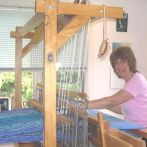
| Weaver and author Paula Chaffee Scardamalia |
In other cultures, perfection is reserved to the gods as well. The Navaho, for instance, when weaving a rug, deliberately weave a thread into the rug that looks like a mistake. That “mistake” keeps the rug from being perfect and serves as a path for Spirit to enter.
As women, if we accept our mistakes and failures as a path for Spirit to enter then we might take more risks in our work and in our lives. We could stop worrying about perfection and focus on experiencing life. As a weaver, the ideal of perfection will sabotage my choice of colors, my pattern ideas, and slow down my production if I let it. Mistakes are an inevitable part of being an artist, a mother, a woman. How we respond to mistakes makes the difference between an integrated or tattered fabric…
After I dress my loom with a new warp, before I weave the first weft, I have to weave in a waste yarn in order to evenly space the warp threads at the beginning of the fabric. Sometimes this is a fine thread to create a selvage. Sometimes if I am filling space in warp that will later be fringe, I use bias tape or even toilet paper. This filler is removed later during the finishing process.
The weaving of early adulthood, if we are lucky and have the support and guidance of family and friends, is like that filler. Given the heady experience of making our own choices about what to do after high school, who to date, what job to take, and whether or not to drink ourselves into a stupor at a party, it is not unusual to make mistakes. Some of those mistakes will be like filler at the beginning of the warp—taking up space to help the warp even out so that the weft of the weaving will go smoothly from thereon. Easily removable, yet not really part of the fabric. Some mistakes can be unwoven and rewoven.
Admitting mistakes is a challenge for all of us, requiring that we break old behaviors and ingrained responses. Unfortunately, though we may gather the courage to admit a mistake, sometimes mistakes cannot be unwoven but instead, must become part of the fabric of our lives. The ability to forgive ourselves is strongly tested. Life can change in a moment, and though we often wish for the opportunity to go back, to unweave, often we have only the choice to move forward, to keep weaving. We must fight our way through all the “if onlys,” to a place where we stand in the present moment and answer “What next?”
If we develop new skills, create new attitudes, and pick up new threads of courage and understanding, then we can integrate those mistakes into the weaving. Aspects of the pattern of the weaving may change but, with courage, we are able to integrate those mistakes into the weaving as though they were planned.
Many women experience a relationship that is not healthy for them physically, mentally, or emotionally. The mistake is not the relationship itself, which serves as an important teaching, rather the mistake arises when a woman stays in that relationship, a mistake that can have long-term consequences for not just the woman, but for her children if she has them, and for those who love her. Getting out of a relationship where strong feelings of love once lived is difficult and complicated by economic, parental, and legal concerns.
The biggest difficulty and complication, though, is our own willingness to take the blame for everything wrong in the relationship rather than valuing ourselves enough to feel entitled to change our lives for the better. If a partner betrays us, walks out on us, abuses us, then we mire ourselves in questions of what we did wrong. We try to figure out what we can do to make things better. Once out, we then berate ourselves for choosing to get involved in the first place. Instead, we need to congratulate ourselves for our courage in getting out of that relationship, for admitting the mistake and taking action to change it.
The threads of that relationship are part of the weaving of our life. Like the dark foundational threads of the warp, the threads of mistakes remain part of the fabric of our life. In that way, they remain as lesson and warning for future choices. Can we choose more wisely in the future? Will we pick up threads of love, respect, care, and wisdom to weave into our life, creating beauty once again?
Mistakes are part of being a weaver and being human. Mistakes are an opportunity for learning and growing and compassion. We need to give ourselves permission to be less than perfect—to make mistakes, and we need to give others, our friends, our husbands, our children, especially our children, permission to make mistakes as well.
Mistakes are a place for Spirit to enter.