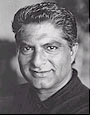
 Called "the poet-prophet of alternative medicine" by Time magazine, Deepak Chopra, M.D., is the founder and CEO of the Chopra Center for Well Being in Carlsbad, California. Dr. Chopra was born and raised in India and came to the United States in 1970 to train and then practice internal medicine and endocrinology. He has since developed his own philosophy of wellness that combines Ayurvedic healing with Western medicine and focuses on a balance between mind, body, and spirit. Dr. Chopra is the author of more than 30 books on a variety of topics ranging from herbal medicine, aging, and meditation, to quantum mechanics, golf, and the poems of Rumi. He spoke with us about his latest work, "The Book of Secrets."
I was surprised by what you wrote about spiritual seeking. You say, "Seeking is doomed because it is a chase that takes you outside yourself." But it seems that some of your biggest fans are spiritual seekers.
You know, we all go through those phases at a certain point. The seeker will realize that what they're seeking is the one who's doing the seeking.
Seeking can become stressful when you apply the same laws that you apply in the material world—hard work, exacting plans, driving ambition, and attachment to outcome. Ultimately spiritual awareness unfolds when you're flexible, when you're spontaneous, when you're detached, when you're easy on yourself and easy on others.
(Read an excerpt about spiritual seeking from Deepak Chopra's book.)
Are there practical steps that people can take to increase their awareness?
Yeah, in the Eastern traditions, those steps have been referred to as the different kinds of yoga. Yoga literally means union, so the yoga of knowledge, which is a scientific understanding of how the universe operates—the yoga of love, which is paying attention to the impulse of love, which is, after all, the impulse toward unity. The yoga of stillness or contemplation or meditation. And also, the yoga of action, the attitude you have when you perform action, when you do yoga in the spiritual worship or when you have the inner conviction that everything you do comes from God, belongs to God and that every breath of yours and every movement of yours is a divine movement of the eternal being, then those are the steps that bring you closer to the supreme intelligence that orchestrates the universe.
Your book suggests our body chemistry can tell us about our consciousness. How so?
Look at the cells and how they function, you see that each cell has higher awareness. It is doing what it does to maintain the welfare of the rest of the body. The stomach cell's not saying, why should I digest food for the heart and the brain? And the brain doesn't say, why should I regulate the activity of the stomach? So they are inseparably interdependent. They have higher awareness.
Each cell has creativity because every time there is a challenge to the body, the body has to come up with a creative solution. Each cell knows how to commune with other cells instantly, both locally and non-locally, each cell is bonded to every other cell, each cell practices what it does with maximum efficiency—it never hoards anything. Each cell obeys the laws of giving and receiving, each cell has awareness of what's happening in the body, and each cell knows the secret of immortality, because even as it dies, it passes on everything it knows to the next generation of cells.
So if you want to look at the human body as an example of consciousness, it's a direct reflection. Consciousness conceives, governs, constructs, and becomes the activity of the body. And in every human body, or for that matter, in every biological organism, there is an inner intelligence that reflects the wisdom of the universe and is, in fact, the ultimate and supreme genius.
You say that our bodies are always experiencing dying–that "Cells are constantly dying and being replaced" and then ask the rhetorical question, so what are we so afraid of? Why do you think the fear of death seems to be built into us?
The fear of death comes from limited awareness. As long as you think of your real self as the person you are, then of course you're going to be fearful of death. But what is a person? A person is a pattern of behavior, of a larger awareness. You know, the two-year-old dies before the three-year-old shows up, the three-year-old dies before the teenager shows up.
The fear of death is the fear of the unknown, and yet, the fact is, we live and breathe and move in the unknown all the time. The unknown is from this moment onwards—you're already living there. You have the pretend game that you're living in the known, but the known doesn't exist anymore, it's already gone. Everything you know is about the past. So you have to both intellectually and experientially be willing to embrace uncertainly, ambiguity, and step into the unknown. The known is a prison of past conditioning. The unknown is always a fresh field of possibilities.
Would you equate this constant evolving and recycling with reincarnation?
You can say that, but you know, there's only one "I" in the end pretending to be all these different "I"s so I really don't even believe there's such a thing as a person; there's only the infinite pretending to be a person, as a temporary pattern of behavior. So what does reincarnate is the wisps of memory and threads of desire, born of past experience.
You write that unity, as opposed to duality, is "the purpose of evolution." What do you mean?
The fact that we experience separation is really a perceptual artifact. There's only a single reality that differentiates into both mind and body and then from body and environment. So our perceptual experience of the environment is different than the body, the body is different from the mind, and the mind is different from the soul.
There are two types of ignorance that we come to in this world, one is innate ignorance, which is this perceptual artifact of separation and the other is cultural ignorance.
Just like, your DNA, for example, differentiates into the different cells of your body, your heart cells and your brain cells, and your kidney cells are different in appearance, but not different in their essence. They came from the same double strand of DNA and if I wanted to isolate the DNA in every cell of your body, even though these belong to different organs, I'd get the same information. So the appearance of the expression of the different organs in the body is different, but it's still the same essence. So, too, every observer is a differentiated aspect of a single observer and every object of perception is a differentiated expression of the same observer, because the observer and the observed, the seer and the scenery, the knower and the known are differentiated aspects of a single consciousness. The goal of all spiritual seeking is to realize that experientially and intellectually—but more importantly experientially.
Cultural ignorance is when we take these ideas of duality and then we create institutions around them—so religious and cultural and social indoctrination perpetuates the ignorance.
Do you believe humanity as a whole is evolving toward unity, toward a "New Age," a new level of consciousness on a global scale?
Yeah. I think it would need a critical mass of people to reach a certain level of awareness for humanity as a whole to be affected so I do not know when that would happen. I think the fact that we now have technology, for example, the Internet—Beliefnet, for example—to take information and knowledge and you can rapidly spread it to so many people. That could never have happened say, 2,000 years ago. But today, I personally look at the Internet as the cloning of collective consciousness, our collective soul, it could be much faster than we think it's going to be.
In another interview you said that "religion pulls us apart and spirituality brings us together in love." Do you think that someone who identifies with organized religion can benefit from your books, from this philosophy?
Religious people can only learn from this kind of philosophy if they go to the basic experience of the founder of their religion. And then they'll realize that Christ wasn't a Christian and that Buddha wasn't a Buddhist and Muhammad wasn't Muslim. These people were having the experience of unity consciousnesses and universal consciousness and they spoke of it in words. So if you're a real Christian, you should be listening to what Christ said in the Sermon on the Mount and then you are expressing the universality of spiritual consciousness.
Because if you claim that your religion is exclusive and that your God is exclusive, then how can that God manage the whole universe? We are one speck of dust in probably the junkyard of infinity and there are billions of galaxies with billions of planets and billions of solar systems. We should not diminish the magnificence of God by giving him a sexist male identity, an ethnic background, squeezing him or her into the volume of a body and the span of a lifetime and a regional geography. That's really not paying a pure respect to the magnificence of the Almighty.
You grew up in a Hindu family in India. Do you consider yourself Hindu today?
No. I'm distressed that Hindus can be as violent as anybody else, the only difference is that they're vegetarians.
Would you talk a little bit about your own spiritual practice?
I meditate two hours in the morning and about half an hour in the evening. And I go to the gym for about 1 hour which I consider to be a really spiritual practice as well. And then I have the attitude during the rest of the day that the only step I'm taking that's real is the one I'm taking at the moment, so I try not to anticipate the future or think about the past, but stay grounded in the moment. And those are the mostly, daily practices—meditations, exercise, and staying in the moment. Once every three or four months, I try to take a week of silence in the wilderness and sometimes my family will join me but sometimes I'll do it all by myself.
When I interviewed your son two years ago, he said that two of the qualities that inspired him, of yours were your curiosity and your not taking life too seriously.
[laughs] That's probably true.
Do you think these qualities can serve as spiritual tools?
I think so. I think seriousness is a mask of self-importance and self-importance in turn is a mask for self-pity. So if you're really going to pursue a spiritual way of living in the world, you must be lighthearted and carefree, have humor, be able to tolerate ambiguity and embrace uncertainty, and be forgiving of yourself and everybody else.