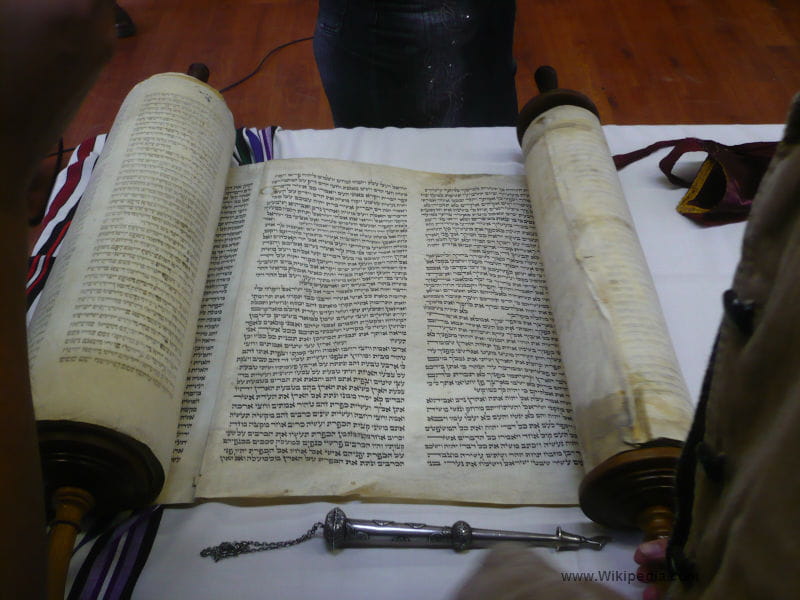
The latter refers to a not-so-secret habit that's growing in popularity, as an increasing number of people bring outside reading material with them to services. Some do this openly, even encouraged by rabbis, and some tuck a volume into a tallit bag for transport and then slide it into an open machzor [high-holiday prayerbook], much like the high school tradition of folding comic books into math texts.
These independent readers-who might pull out a book during a particular part of the service in which they lose interest-are likely to be reading serious books, trying to deepen their experience of the holidays. From my experience, it's not as though congregants are thumbing through airport novels or diet books; these special days require special books.
I've spotted interesting titles, from pocket editions of the Talmud to novels by Philip Roth. The book I've seen most often (and bring to shul myself) is the classic "Days of Awe: A Treasury of Jewish Wisdom for Reflection, Repentance and Renewal on the High Holy Days" by Israeli Nobel Laureate S. Y. Agnon (Schocken, 1995). First published in 1937 and in English in 1948, this is a companion to the prayer book, an anthology of texts, teachings, midrash, and customs following the order of the service. Agnon, a modern writer who was well-versed in Jewish texts, writes with love of the tradition, seriousness, a sense of humor and joy, and engagement. In his section on tashlich, he tells of how the Jews of Kurdistan would go to a river and jump in, rather than simply shaking the crumbs off of their clothing, so that the water would wash away all of their sins.
Rabbi Arthur Green, in a foreword to the latest edition, suggests that readers open the book and "think of Agnon as an old Jew from a world now vanished who happens to sit down next to you."
Most of the entries are less than a page long, some run onto a few pages, but the format makes for easy reading when there's much else going on, like during services. Even returning to this book every year, readers will find something new.
Another anthology of note is "Days of Awe, Days of Joy: Chasidic Insights Into the Festivals of the Month of Tishrei," compiled and adapted from the talks and writings of the rebbes of Chabad-Lubavitch (Kehot Publication Society, 1998).
From spiritual self-help to page-turners
Read more on page 2 >>
| _Related Features | |
|
|
 |
Rabbi Naomi Levy's "Talking to God: Personal Prayers for Ties of Joy, Sadness, Struggle, and Celebration" (Knopf, 2002) isn't directed toward the holidays, but readers will find comfort and inspiration in her original, personal prayers that touch on a wide range of human experience. Its compact size makes this an inconspicuous choice. She offers a prayer for daily insight:
"Open my eyes, God. Help me to perceive what I have ignored, to uncover what I have forsaken, to find what I have been searching for. Remind me that I don't have to journey far to discover something new, for miracles surround me, blessings and holiness abound. And you are near."
"Floating Takes Faith: Ancient Wisdom for a Modern World" (Behrman House, 2004) by Rabbi David Wolpe is a first collection of his brief essays that touch upon topics like God, spiritual growth, forming families and life and death. Wolpe proves himself a master of this format: His essays are tightly woven gems based in deep learning and drawing on a huge breadth of sources.
"Beginning Anew: A Woman's Companion to the High Holy Days" edited by Gail Twersky Riemer and Judith A. Kates (Touchstone, 1997) anthologizes original essays by distinguished women scholars, authors and educators, interpreting the Torah readings of the holidays. Each contributor draws deep meaning from the text, and generously shares her wisdom.
For a more straightforward introduction to the themes of the holiday, "Entering the High Holy Days: A Complete Guide to the History, Prayers, and their Themes" by Rabbi Reuven Hammer (Jewish Publication Society, 2005) demonstrates how the themes of the holiday play out in the service.
Just as you don't have to be a Conservative Jew to appreciate Hammer's style-in fact, it's intended for all Jews-you don't have to be female to enjoy "Beginning Anew" nor Chasidic to find "Days of Awe, Days of Joy" of great interest.
Another category of shul books is spiritual self-help, books that help readers with their process of teshuvah. "Improve yourself, then improve others," the sages say in the Talmud (Bava Metzia).
"60 Days: A Spiritual Guide to the High Holidays" by Rabbi Simon Jacobson (Kiyum Press, 2003) is a workbook and a reading book, with kabbalistic, biblical, and psychological insights, covering the period from the beginning of the month of Elul to the end of the month of Tishrei. Jacobson urges sincere preparation for all of the holidays and his approach is hands-on, with articles of daily inspiration, meditative quotes and practical exercises.
Each year, tens of thousands make a pilgrimage to visit the grave of the Chasidic master, Rabbi Nachman of Bratslav, in Uman, Ukraine, especially on Rosh Hashanah, and many study the teachings of this charismatic great-grandson of the Ba'al Shem Tov, born in 1772. "Crossing the Narrow Bridge: A Practical Guide to Rebbe Nachman's Teachings" by Chaim Kramer (Breslov Research Institute, 1990) is an introduction to his life work and thought, organized thematically. The author emphasizes the rebbe's teaching about seeing the good in others, judging all people favorably. Several editions of Nachman's work are available for those who might prefer to directly encounter his words, in translation.
Not so much a self-help book but more of an analytic work, Aaron Lazare's "On Apology" (Oxford, 2004) has much to offer related to teshuvah. For Lazare, professor of psychiatry at the University of Massachusetts Medical School in Worcester, the process of apology is both simple and entangled, potentially powerful and transformative.
Lazare quotes the talmudic teaching that says that God created repentance even before creating humankind: "I take this statement to mean that the sages who authored this sentiment were acutely aware of the fallibility of humankind and the need for religion's prescriptions to heal offenses. Repentance (or its secular approximation of apology), therefore, would be so important for sustaining a just and livable society that an infinite and all-powerful God would put it in place before creating mankind."
"On Repentance: The Thought and Oral Discourse of Rabbi Joseph Dov Soloveitchik" edited by Pinchas H. Peli (Jason Aronson, 1996) is a compilation of lectures given by the late preeminent Orthodox philosopher, laying out his philosophical and theological premises for teshuvah (repentance). For the Rav, as he is still known, teshuvah is not only repentance but purification.
On a more mystical note, Rabbi Adin Steinsaltz's "The Thirteen-Petalled Rose: A Discourse on the Essence of Jewish Existence and Belief" (Basic, 1985) is a remarkable synthesis of Jewish thought, and "Honey From the Rock" by Lawrence Kushner (Jewish Lights, 1999) is a first-rate introduction to the Jewish mystical tradition.
Those interested in adding a modern historical context to the holidays might particularly enjoy two fine new works of Jewish history, "American Judaism" by Jonathan Sarna (Yale, 2004) and "A History of the Jews in the Modern World" by Howard M. Sachar (Knopf, 2005).
And some people just prefer a good novel. Many works of fiction touch on the ideas of the holidays. Elie Wiesel's latest work, "The Time of the Uprooted" (Knopf, 2005) is a beautifully written work that addresses, among other themes, survival, memory and new beginnings. This season, when so many people have lost their homes, the novel is particularly timely.
Hugh Nissenson's latest novel, "Days of Awe" (Sourcebooks, 2005) is tied to these days not only by its title but by the author's exploration, both sensitive and powerful, of God, mortality and love, set in the context of Sept. 11. At the novel's center is a New York City family, unusually close and facing difficult times. The author creates an unconventional artful narrative, combining elements of mythology, poetry, email, various points of view, descriptions of the mundane details of daily life and spiritual yearnings. This is a novel with great heart.
Rabbi Debra Orenstein of Makom Ohr Shalom in Tarzana likes to recommend "Einstein's Dreams" by Alan Lightman (Warner Books, 1994), an imaginative short novel about time and memory, unfolded in vignettes.
And then there's the Book of Life. May we all be inscribed for a year of health and happiness, blessed with peace.
| _Related Features | |
|
|
|
|