Author: John Updike
Publisher: Alfred A. Knopf, 2006, 310 pgs.
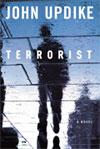 As lives inched forward following the events of 9/11, Americans entered an uncharted territory marked by a surge of interest and huge suspicion in all things Muslim, by ever-changing terror alerts from the new Department of Homeland security, and by fears that the U.S. could be incubating disaffected youngsters susceptible to becoming terrorists—without these youth knowing they’re vulnerable until it’s too late.
 Pulitzer prize-winning author John Updike’s latest novel, “Terrorist,” deftly picks up on these themes as he goes way beyond a “ripped from the headlines” treatment to create an intellectual thriller that dissects the thoughts of a young American Muslim as he becomes the willing puppet of a terrorist cell in the New York metro area.
Eighteen-year old Ahmad Ashmawy Mulloy is a disaffected young man. The son of a green-card seeking Egyptian immigrant who took off when Ahmad was three and a free-wheeling Irish-American mother who gives him intermittent attention, Ahmad is left adrift and in search of a grounding identity for himself. And so at the age of 11, Ahmed turns to his local mosque in New Prospect, N.J., trying to find some purpose to his life (and in as a futile attempt to connect with his father).
There he falls under the tutelage of Shaikh Rashid, a smart, smooth-talking Yemeni imam. Rashid begins to teach Ahmad about the Qur’an while slowly inculcating his extreme vision of an Islamic “Straight Path,” designed to protect the young man against a world awash in temptation and an American culture rife with of impurity and unsalvageable wickedness. The isolated and lonely Ahmad is the perfect sponge for this dangerous rhetoric, and Rashid sees a golden exploitive opportunity in his young student.
Under Rashid’s guidance, Ahmad forgoes college to obtain a trucking license and is steered toward becoming a driver for the Chehab family, which owns a furniture business. Ahmad forges a bond with the younger Chehab son, Charlie, a strange character whose dual passions for Americana and Islamic extremism are explained in the last pulsating chapter of the book. Ahmad is pushed along a path to becoming a shahid, or martyr, as the driver of a truck rigged with explosives ominously bound for the Lincoln Tunnel.
Updike’s paints vivid pictures that goes beyond black and white to identify each person’s color as a metaphor for his personality: Teresa, Ahmad’s mother, has freckled skin that is “unbelievably white, like a leper’s,” while his father’s color is “perfectly matte, like a cloth that’s been dipped.” Ahmad, as a result, is “dun,” a low-luster shade lighter than beige.” With his mixed-blood background, Ahmad sees his dun skin as receding into the background where only God will notice his virtues.
Ahmad is drawn to the browns. He is fascinated with classmate Joryleen Grant, a seductive girl whose “smooth body, darker than caramel but paler than chocolate” is a frustrating temptation for him. The “brown” family—in Ahmad’s eyes--seems to push past the filth and impurity to somehow become God’s children. From Ahmed’s viewpoint, white-oriented characters--the “infidels” of the world--are shameful and godless, which Updike cleverly plays upon when Ahmad unthinkingly notices that Rashid has a “waxy-white” complexion.
Only Ahmad’s high school counselor, Jack Levy, (who has a summer affair with Teresa), is absent of a colorful description, as he becomes the unlikely diversion (and hero) in Ahmad’s dangerous path when he intercepts the youth on his trip to the Lincoln Tunnel. Jack--a 63-year-old Jew worn down by his unappreciated ministrations to generations of high school youths and by a lackluster marriage to his increasingly overweight wife, Beth--is drawn to Ahmad’s reserved demeanor and alarmed by his constant quoting of the Qur’an and disdain for the whole of American life.
Indeed this one statement yields volumes about the warning signs we all must be aware of in snuffing out sparks of homegrown terrorism. Levy is the only person in Ahmed’s small circle who finds his loner status and his scornful disassociation with the larger New Prospect American Muslim community alarming. Whereas before 9/11, school violence and disaffected teenage gunmen (like killers at Columbine) preoccupied the nation, the terrorist attacks in 2001 turned the country’s attention to the possible spread of extremist Islam among American Muslims.
And by revealing Ahmad’s persona, Updike makes the important point that parents, counselors, friends, and teachers must be especially attune to teen behaviors. Although Ahmad is a well-drawn character, I do wish Updike spent more time developing the early years of his relationship with Rashid. Why did Ahmed continue to attend Rashid’s lessons when the other young boys who started with him all eventually drop out? How did Rashid capitalize on Ahmad’s identity crisis?
But the story relentlessly weaves along picking up threads from all aspects of the terrorism theme. Even the Secretary of Homeland Security has his say as he struggles with creating some sort of safety measures for a country with too many unraveled edges. A particularly vivid description of airport security cleverly explains the holes in the system:
“… a pair of nail scissors or knitting needles—while these are being spotted and confiscated, four-inch knives pass as shoe shanks seen on edge, and a petite pistol of mostly hard plastics sneaks through taped into a pewter porringer supposedly being transported, if its dark orb is challenged, as a present for a baby being baptized tomorrow in Des Moines.”
The fundamental problem with trying to preempt terrorism strikes, the Secretary explains to his assistant, is that among other things, “there’s something weird about the language—it makes [Arabs] feeble-minded, somehow. Their Internet chatter--Heaven will split asunder beneath the Western river. The light shall be admitted. --What the f—k kind of sense does that make?”
Certainly it is difficult to understand the Qur’an, even for masses of Muslims worldwide. To best interpret the Qur’an requires knowledge of when and under what circumstances different verses were revealed to the Prophet Muhammad. Updike alludes to this when he has Rashid differentiate between Meccan (early passages revealed to the Prophet Muhammad in Mecca) and Medinan (later passages revealed to the Prophet in Medina) verses. If he had spent more time on this, then readers would have received a valuable lesson on the dangerous ways the Qur’an can be misinterpreted by those with a radical viewpoint.
But “Terrorist” is a work of fiction, and not a book of Islamic scholarship. And with that in mind, Updike masterfully handles all aspects of the story, from the manipulation of Ahmad to the unlikely love triangle of Jack, Teresa, and Beth. Along the way Updike shows his depth by becoming a minor expert of the Qur’an. His transliteration of various Qur’anic passages is on the mark, and he aptly shows how radical interpretations of different verses can create a close-minded Islamic viewpoint.
Indeed, “Terrorist” cuts to the heart of American fears of homegrown terrorists. What is being preached in American mosques? What hidden agendas do some imams have? What draws some American Muslim kids toward extremism? Are some American mosques just franchises for Middle East terrorist cells? These questions have frightening answers in “Terrorist.”