Art historian Vidya Dehejia is curator of "The Sensuous and the Sacred: Chola Bronzes From South India," an exhibition devoted to temple statuary of Hindu saints at the Arthur M. Sackler Gallery of Art in Washington, D.C. She spoke with Beliefnet about the saints' connection to the gods Shiva and Vishnu, and how the saints' legacy inspires devotion today.
Which Hindu saints are represented in the exhibit?
There's a set of saints that lived between the sixth and the tenth centuries in South India. It's codified into a group of 63 saints for God Shiva and 12 for God Vishnu. The saints composed poetry in Tamil, and these poems are the sacred canon of South India. People know their verses and chant them. They were semi-deified, but elevated images of the saints are made and kept in temples. You go into a Shiva temple and see 63 stone images or painted images.
 Part of the exhibit's title is "The Sensuous and the Sacred." Most people don't think of saints as being sensuous.
Yes, that might seem to some people like a contradiction in terms. The forms are extremely beautiful, slender, and sensuous, and at the same time they're sacred.
But the way the artists, devotees, and priests thought of it was that inner spiritual beauty had to be accompanied by beauty of form. Or, looking at it another way, outer form had to reflect inner beauty. The two are inextricably combined. Part of bhakti-devotion-is contemplating the beauty of the Lord.
The Lord in this exhibit is more often the god Shiva, not Vishnu, right?
For the worshipper, Shiva is everything. There's a sort of outdated idea of a creator, preserver, and destroyer-dividing up the functions. But for a believer, Shiva does all of that.
Shiva is a paradoxical figure. He wears eccentric clothes. Sometimes he has serpents wrapped around him like a scarf or a belt, and wears a skull in his hair. The saints seem to have played with that eccentricity instead of hiding it. They played it up, almost as if they felt people listening to their poems would ask about it. With Westerners, there's a stereotype that Shiva represents pure destruction.
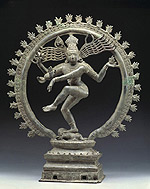
There is. The form of dancing Shiva dances the world into extinction, but that same dance continues to bring it back into creation. It's the cyclical concept of time that India has. If you're looking for logic, you say, "How can it be?"
Going back to the saints represented in the exhibit, what do believers today find most powerful about them?
Well, one of them is a child saint, Sambandar. There's something about him that people relate to enormously; he tugs at some people's heartstrings. He started singing songs when he was three. His poetry is very beautiful, but not as philosophical as some other saints'. He talks about the beauties of nature, the birds, the fishes, and the beauty of the God Shiva. He was supposed to have vanished into a radiance at the age of 16.
The other thing about these saints is that they come from all walks of life. There are a large number of Brahmin saints, but there are also untouchables and hunters and cow herders. Are there similarities between Hindu and Christian saints? Hindus tend to relate to one saint more than another and know the songs of that saint. The saints' birthdays are recorded. So it's similar to Catholic saints, except for two major differences. First, the saints in South India were family men or women. They were married. Renouncing the world was not part of being engrossed in Shiva or Vishnu. In fact, one of the saints sang that you don't need to give up everything in order to love the Lord. Look at the Lord himself: he's always got his beautiful consort Uma with him. The solitary, lone hermit path was never the style with the saints in South India. The other thing is that these saints don't intercede. Christian saints can serve as intercessors between you and God. That role is not assumed here. These Hindu saints are just wonderful examples-you admire them, you aspire to their holiness, you use their poetry and read about their lives, but there isn't that intercessory role. Another signature of a saint in the Western world is the ability to perform miracles. Does that occur with Hindu saints? Yes, most of them were supposed to have performed some miracles or other, particularly the major ones. A saint would bring someone back who had died from a snakebite. There's a story of a saint being bound and thrown into a limekiln and coming out completely unhurt. There were some persecution stories in the hagiographies. Monarchs [persecuted them]. There was a lot of rivalry at one point between the Jains, Buddhists, and Hindus.
Which Hindu saints are represented in the exhibit?
There's a set of saints that lived between the sixth and the tenth centuries in South India. It's codified into a group of 63 saints for God Shiva and 12 for God Vishnu. The saints composed poetry in Tamil, and these poems are the sacred canon of South India. People know their verses and chant them. They were semi-deified, but elevated images of the saints are made and kept in temples. You go into a Shiva temple and see 63 stone images or painted images.
Part of the exhibit's title is "The Sensuous and the Sacred." Most people don't think of saints as being sensuous.Yes, that might seem to some people like a contradiction in terms. The forms are extremely beautiful, slender, and sensuous, and at the same time they're sacred.
But the way the artists, devotees, and priests thought of it was that inner spiritual beauty had to be accompanied by beauty of form. Or, looking at it another way, outer form had to reflect inner beauty. The two are inextricably combined. Part of bhakti-devotion-is contemplating the beauty of the Lord.
The Lord in this exhibit is more often the god Shiva, not Vishnu, right?
For the worshipper, Shiva is everything. There's a sort of outdated idea of a creator, preserver, and destroyer-dividing up the functions. But for a believer, Shiva does all of that.
Shiva is a paradoxical figure. He wears eccentric clothes. Sometimes he has serpents wrapped around him like a scarf or a belt, and wears a skull in his hair. The saints seem to have played with that eccentricity instead of hiding it. They played it up, almost as if they felt people listening to their poems would ask about it. With Westerners, there's a stereotype that Shiva represents pure destruction.
There is. The form of dancing Shiva dances the world into extinction, but that same dance continues to bring it back into creation. It's the cyclical concept of time that India has. If you're looking for logic, you say, "How can it be?"
Going back to the saints represented in the exhibit, what do believers today find most powerful about them?
Well, one of them is a child saint, Sambandar. There's something about him that people relate to enormously; he tugs at some people's heartstrings. He started singing songs when he was three. His poetry is very beautiful, but not as philosophical as some other saints'. He talks about the beauties of nature, the birds, the fishes, and the beauty of the God Shiva. He was supposed to have vanished into a radiance at the age of 16.
The other thing about these saints is that they come from all walks of life. There are a large number of Brahmin saints, but there are also untouchables and hunters and cow herders. Are there similarities between Hindu and Christian saints? Hindus tend to relate to one saint more than another and know the songs of that saint. The saints' birthdays are recorded. So it's similar to Catholic saints, except for two major differences. First, the saints in South India were family men or women. They were married. Renouncing the world was not part of being engrossed in Shiva or Vishnu. In fact, one of the saints sang that you don't need to give up everything in order to love the Lord. Look at the Lord himself: he's always got his beautiful consort Uma with him. The solitary, lone hermit path was never the style with the saints in South India. The other thing is that these saints don't intercede. Christian saints can serve as intercessors between you and God. That role is not assumed here. These Hindu saints are just wonderful examples-you admire them, you aspire to their holiness, you use their poetry and read about their lives, but there isn't that intercessory role. Another signature of a saint in the Western world is the ability to perform miracles. Does that occur with Hindu saints? Yes, most of them were supposed to have performed some miracles or other, particularly the major ones. A saint would bring someone back who had died from a snakebite. There's a story of a saint being bound and thrown into a limekiln and coming out completely unhurt. There were some persecution stories in the hagiographies. Monarchs [persecuted them]. There was a lot of rivalry at one point between the Jains, Buddhists, and Hindus.
And none of them is believed to have died a normal death. They're supposed to have vanished into a wonderful radiance created by Shiva.