 |
|
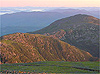
| Photo courtesy of Mt. Washington Observatory |
But first, the backstory. The Goddess in question is especially meaningful for me. As a little girl, I would sit next to my mother and listen to her recite the Lalitha Sahasranamam. Lalitha is another name for Parvati or Shakti, the consort of Shiva. The Lalitha Sahasranamam is a Sanskrit chant derived from the Brahmanda Purana, which has 1008 names of the mother Parvati, in her many avatars.
I loved hearing the rhythmic verses. Best of all, towards the end of the chant my own name would appear. It would thrill me to hear my mother say my name and look at me out of the corner of her eye to gauge my reaction. Over the years I learned the mantra, and made a habit of chanting it on Fridays, which is an auspicious day for the mother. It was my escape from daily chores, and also a sort of meditation.
The Lalitha Sahasranamam chant is supposed to generate big results--it's a "power mantra," if you will. The more you chant it, the better. Hindu devotees chant it for themselves and for their loved ones; priests in temples chant it for the well-being of temple devotees.
So why not use a chant this good to help an even bigger group? In Boston, a non-profit organization called "Soundarya Lahiri" decided to get a group of people together and collectively chant this 10 million times for the benefit of humanity. In a way, this was a response to 9/11, but more broadly it was for the good of mankind. The theory here is that if you pray for everyone's well-being and contentment, you will ultimately find your own happiness.
When I came across a flyer requesting people to join in the group chant, I was eager to attend. But where did the number come from? Why did they want to chant the mantra 10 million times?
It turned out that this organization wanted to perform a homam--an offering to a sacrificial fire where the Mother Goddess would be invoked. But before the fire stage of the yagna, there was the little matter of reciting the Lalitha Sahasranamam 10 million times in the space of 24 hours. According to custom, only then could the homam happen. As if that wasn't challenge enough, this homam could only be performed atop a mountain or in the middle of an ocean!
Luckily, tradition allows for the first stage of the yagna--chanting the name 10 million times--to be done well in advance of the second stage, the fire ceremony. Soundarya Lahiri organized the chanting event in June; a few months later came the homam on the mountain.
The energy and motivation to reach the 10 million target was overwhelming. Several people stayed for the full 24 hours, continuously chanting the Sahasranamam. I had the pleasure of chanting it about nine times, which was long enough.
Several Hindu devotees joined in from various parts of the globe, chanting via the Internet. It was amazing to watch this unity among Hindus from all over the world.
The 10 million target was achieved. Next stop: Mt. Washington.
The Saturday chosen for the homam event, which occurred a few months later, was a bright and sunny day. My husband and I got together with three other friends and headed for Mt. Washington. We left home at 6 a.m. and started winding our way up the mountain's steep, scary Auto Road around 10.
Making it up the mountain was a harrowing hour-long ride. The road was very narrow, with barely enough room for two cars one going each way. There was no barrier to prevent a car from falling off the road. Still, the Auto Road wasn't terribly crowded, and I began to wonder if anyone else would show up besides the five of us. Had we made the trip only to be disappointed?
I needn't have worried. Higher up on the mountain, I saw groups of Hindus, dressed in colorful saris and other traditional outfits, getting off the Cog railway, a narrow gauge train that brings people up the mountain. Apparently fewer people took the Auto Road (smart move!), and several of them arrived by train. To my surprise and pleasure, there were over 250 gung-ho Hindus at the site, all ready to perform the homam.
Within a few minutes of our arrival, the homam began. Besides the 10 or so people sitting around the main homam pit, other participants sat in circles of 10 to 15. Just as they'd been during the 24-hour chant, the group's positive energy vibes were amazing.
We all chanted the Lalitha Sahasranamam. As each name of the Goddess came up, participants put nuts, raisins, and other offerings into a central plate. These plates were collectively poured into the central homam fire after the 1008 names were chanted. The mother was invoked; offerings like a silk sari, the navratna or nine gems, gold, silver, and fruits were made to the sacrificial fire, and the homam concluded successfully.
The ceremony finished, we ate lunch and toured the mountaintop. A few other couples changed into jeans and took off on a hike. What better way to blend prayer with sightseeing? In fact, I learned that the same group is planning another homam that might appeal to spiritual tourists, one that will happen in the middle of the South Atlantic. Are we talking Homam Cruise or Homam on an exotic island?
After the mountaintop rite, I overheard one devotee telling another, "I hope the Mother Goddess was satisfied with our offerings." I thought to myself: a perfect day on a mountain notorious for bad weather, a group of Hindus chanting a powerful verse and completing a divine homam successfully, 250 happy, fulfilled faces-what else is this a sign of, if not a satisfied Mother Goddess?