
St. Albert the Great (1206-1280)
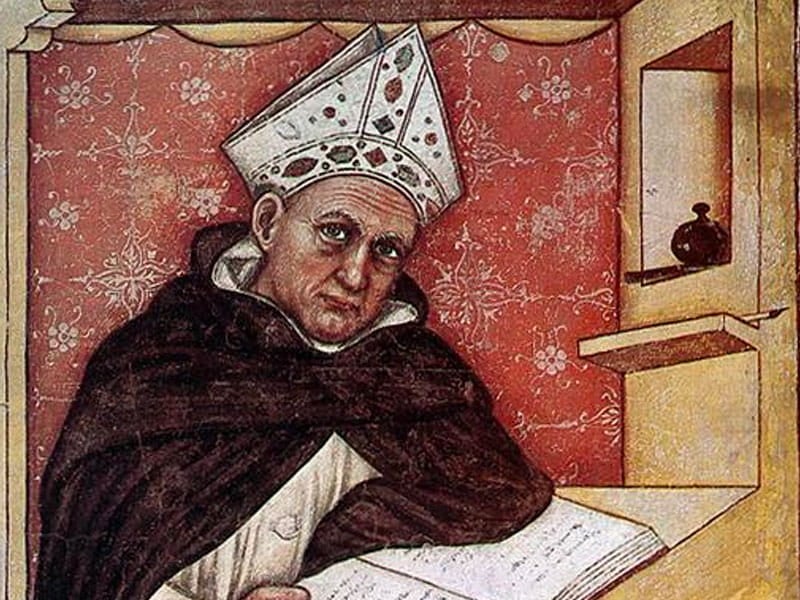
Albert the Great was a 13th-century German Dominican who influenced decisively the stance of the Church toward Aristotelian philosophy brought to Europe by the spread of Islam.
Students of philosophy know him as the master of Thomas Aquinas. Albert’s attempt to understand Aristotle’s writings established the climate in which Thomas Aquinas developed his synthesis of Greek wisdom and Christian theology. But Albert deserves recognition on his own merits as a curious, honest and diligent scholar.
He was the eldest son of a powerful and wealthy German lord of military rank. He was educated in the liberal arts. Despite fierce family opposition, he entered the Dominican novitiate.
His boundless interests prompted him to write a compendium of all knowledge: natural science, logic, rhetoric, mathematics, astronomy, ethics, economics, politics and metaphysics. His explanation of learning took 20 years to complete. "Our intention," he said, "is to make all the aforesaid parts of knowledge intelligible to the Latins."
He achieved his goal while serving as an educator at Paris and Cologne, as Dominican provincial and even as bishop of Regensburg for a time. He defended the mendicant orders and preached the Crusade in Germany and Bohemia.
Albert, a Doctor of the Church, is the patron of scientists and philosophers.
-
First Martyrs of the Church of Rome (d. 68)
-
Blessed Antonio de SantAnna Galvao (1739-1822)
-
Blessed Angeline of Marsciano (1374-1435)
-
St. Sylvester I (d. 335)
-
St. John Vianney (1786-1859)
-
Annunciation of the Lord
-
St. Cajetan (1480-1557)
-
St. Athanasius (295?-373)
-
St. Martin I (d. 655)
-
Sts. Peter and Paul (d. 64 & 67)
