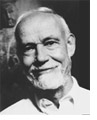
 Frail at 86, suffering from severe osteoporosis and hearing loss, Huston Smith, the nation's preeminent authority on world religions, nevertheless embarked on his recent national book tour alone. He invited his Beliefnet interviewer to sit close so he could read her lips. With a beatific smile, he introduced himself with a warm, "Hello, I'm Huston."
Smith, author of "The World's Religions," a best-seller still used in many college classrooms, has taken an experiential approach to studying world religions, training in a Zen Buddhist monastery in Japan, studying with a Sufi mystic in Iran, and spending a sabbatical in Tibet. He dug deeply into Judaism when his daughter married a Jew and converted. Time magazine has called him a "spiritual surfer." "Christianity has always been my religious meal," Smith has said. "But I'm a great believer in vitamin supplements." His latest book, "The Soul of Christianity," brings him home to his lifelong faith.
What is your favorite prayer?
Well, it shifts in different stages. But in the last two years I do have a favorite and it is the Jesus prayer. It is the one in "The Way of a Pilgrim." You know the book? And it is in J.D. Salinger's book.
Yes, Franny and Zooey.
The short version which I use is, "Oh Lord Jesus Christ, son of God, have mercy on me." And that's become a kind of a mantra to me. And especially during times of--ordeal would be too strong--but special. I'll just say special. This trip is a good example of that--it's like a mantra that I've been saying over and over again. We are in good hands. And in gratitude for that fact we should bear one another's burden.
How do you think religions differ, and what do they have in common?
Walnuts have a shell, and they have a kernel. Religions are the same. They have an essence, but then they have a protective coating. This is not the only way to put it. But it's my way. So the kernels are the same. However, the shells are different. Necessarily so, because I believe that all of the eight historically important and enduring religions are divinely revealed. But we have a diverse world and different civilizations. God has to speak to each person in their own language, in their own idioms. Take Spanish, Chinese. You can express the same thought, but to different people you have to use a different language. It's the same in religion.
Depending on the context, the time in history?
Well, let me come back to civilization. It is commonly said and known that each civilization has its own religion. Now my claim is that if we look deeper, the different civilizations were brought into being by the different revelations. I really believe that.
For example the revelation to Buddha.
And to the Hindus, and to the Jews, and to the Christians, and Native Americans. I mean we have to fiddle a little with words because they wouldn't call themselves civilization, but, say, a world or something.
So the eight that you're speaking of are .
The ones in my book ["The World's Religions"]--Hinduism, Buddhism, Confucianism, Daoism, Islam, Judaism, Christianity, and the Native American. Now there's one thing that's misleading, and that is to separate Confucianism and Daoism. Right now I'm working on a project which would speak of the East Asian religious complex. There's one religion that has three strands--Confucianism, Daoism, and East Asian Buddhism. And so if I had it to do over again, I would not have separate chapters on Confucianism and Daoism.
Who do you think Jesus was? Was he another charismatic Jewish healer? Who are these people to whom religion, to whom God is revealed?
He was God incarnate. He was Christ. He was God in human form. That would be my succinct answer.
How does he compare with Buddha or other religious figures who receive revelation?
These religions--though essentially the kernel is the same--the shell is not the same. They're not carbon copies of each other. So Buddha did not claim that he was divine. But he serves the same role in Buddhism as Christ does in Christianity, and as the Qur'an does in Islam.
Not Muhammad, but the book?
There is a saying in religious scholarship if Christ was God made flesh--in Islam, the Qur'an is Allah made book.
Do you think it matters what religion we practice?
Matters in what sense? I think it matters almost infinitely that we practice one of the authentic religions. But if you mean does it make any difference which. The answer is no, as long as each is followed with equal intensity, sincerity, dedication.
What is an authentic religion?
Read more >>
| _Related Features | |
|
|
 |
Revealed by God as proven by their impact on human history. I have studied [other religions], and I am certain they have not made impact on this earth.
Is it always a good impact in the sense of helping people live better lives?
In the sense of realizing their full potential.
In your book you seem critical of the scientific mentality.
No, wrong. I am critical of modernity giving science and technology a blank check as if it were the fountain of all truth. That is not true. And I think I may have introduced a word which has now caught on quite a bit, scientism. Science is good. It simply reports a discovery. Scientism smuggles in two untenable points. Namely, that science is, if not the only reliable, then the most reliable [way of knowing]. And second, that the stuff that science deals with, matter, is the most fundamental stuff of the universe. Those are not scientific statements. There is nothing in the way of science to prove they're true. And truth to tell, they are both wrong. So I am not against genuine science. I think scientism may come close to doing us in, but I think we're in the nick of time discovering the mistake. Our culture will be opening out to allow the religious worldview to enter.
When I think of the religious worldview, I can't help thinking of fundamentalists and evangelicals. Is that the religious worldview that you're speaking of?
I think we're polarized. We are hamstrung between an unworkable, dogmatic, uncharitable religious fundamentalism, and the liberalism, mainline churches that are losing membership disastrously. The reason being that they are accommodating too much to modern secularism.
What do you mean by accommodating to modern secularism?
To enter seminaries you have to have a university degree. The universities are secular to the core. And it's inevitable that the professors in seminary will have been--I'm going to use violent language--brainwashed by the university, which is unequivocally secular. So the secularism of the university rubs off on seminary professors. And then ministers, pastors, must in the mainline churches, most have a seminary degree. So you can just see the secularism of our culture is infiltrating. The mainline churches, they adhere to the language [of faith]. But the adherent does not have the power, the force of the unbrainwashed Christian.
Can you give me an example of what you're talking about?
Well, let me come home. My heritage is Methodist, from my missionary parents [who raised me in rural China]. When I came to this country I went to a religious college. But when I went to graduate school--one year was at University of California at Berkeley. And being a Christian Methodist, I went to Trinity Methodist Church. Seated 800, always filled, standing room only. And then I went East, had a career. Now I'm back at that same church. The church has sold the sanctuary, which is divided into I don't know how many floors and office buildings. And our congregation meets in the chapel. And we have under a hundred people on an average Sunday. And we're still losing ground. Something has gone out of the dynamic of mainline.
How do you see religion helping us in the future? And what do you hope for your own children and grandchildren.
One of my favorite quotations from the Bible is "I am neither a prophet, nor the son of a prophet." I don't know what's going to happen. But the best I can say is, if we pull out of our scary political situation, then the world is wide open in the West and we live in a Westernizing world. What happens here is going to eventually happen around the world. We live in a time when secularism is over.
Archibald MacLeish said, "An age ends when its metaphor dies." And the metaphor of modernity has been endless progress through endless technology. And that is dead.
Is there a new metaphor that includes religion or spirituality?
Oh yes, because we're religious creatures. And the new metaphor will give every ounce of our strength to compassion. And help not just our own people, but everyone.
Do you think that religious phenomena, like the virgin birth, are symbolic or literal?
Symbolic. [Just as] science can access the very small and the unimaginably large with their special language, which is mathematics and equations, we in religion need a technical language to describe sacred things. And this [language] is myth, poetry, parable. Jesus spoke to them in parables. And so everything that transpires in that infinite world of the divine must be expressed metaphorically, not literally.
So when we talk of the virgin birth, it resonates with something in us about purity, about divinity.
No, no, don't try to say it. In ordinary language it won't work. Something happened. Something happened. And I sincerely believe it really happened. And it was really vital, crucial to Christ. But don't try to psych it out in ordinary language. Go at it in terms of symbols, which stretch our understanding from the finite to the infinite.
| _Related Features | |
|
|
|
|