Perhaps the three were used to being taken aside for private conferences. But they weren't prepared for what happened next.
 |
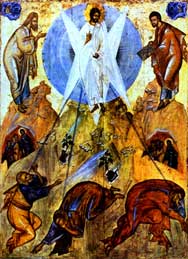 |
| The Transfiguration Of Christ Theophanes the Greek, late 14th century |
What can we make of a story like this? What did Peter and John make of it?
It seems, understandably, to have made an indelible impression. In his second letter, Peter retells the story, preceding it with this assurance: "We were eyewitnesses of his majesty" (2 Peter 1:16). John begins his intricately woven first letter with a similar eyewitness claim: "That which was from the beginning, which we have heard, which we have seen with our own eyes" (John 1:1). John continues, "This is the message we have heard from him and proclaim to you, that God is light and in him is no darkness at all."
God is light. Throughout the Scriptures, God appears repeatedly in the form of overwhelming light. A cloud covers the mountaintop when Christ's glory is revealed, just as one shook Mt. Sinai with lightning when Moses spoke with God. When Moses descended the mountain carrying the tablets of the Law, his face was shining from the presence of God: "The Israelites could not look on Moses' face, because of its brightness" (2 Corinthians 3:7). Pillars of cloud and of fire led the Israelites in the wilderness. St. Paul on the road to Damascus was overwhelmed by "a light from heaven, brighter than the sun" (Acts 26:13).
But there is something about light that most previous generations would have known, that doesn't occur to us today. We think of light as something you get with the flip of a switch. But before a hundred years ago, light always meant fire. Whether it was the flame of a candle, an oil lamp, a campfire, or the blazing noonday sun, light was always accompanied by fire.
And fire, everyone knew, must be respected. That's one of the lessons learned from earliest childhood. Fire is powerful and dangerous. It does not compromise. In any confrontation, it is the person who will be changed by fire, and not the other way round. As Hebrews 12:29 says, "Our God is a consuming fire."
Light is life: we live in light, and couldn't live without it. In some sense, we live on light. It is light-energy that plants consume in photosynthesis--an everyday miracle as mysterious as life itself. When we eat plants, or eat the animals that eat plants, we feed secondhand on light. Light is converted into life, literally, with every bite we eat.
The fire of God consumes us, and we consume it as well. His light is life. "Truly, truly, I say to you, unless you eat the flesh of the Son of Man, and drink his blood, you have no life in you" (John 6:53). What could Jesus have meant by this? In recent centuries, Western Christians have offered competing theories. Some hold that Jesus meant a memorial meal, a simple commemoration of his sacrifice.
But, in the Greek text of John's Gospel, Jesus makes a literal interpretation inescapable, by choosing the most offensive terms he can. He didn't use the ordinary word for "eat" ("phago"), but "trogo," to munch and chew as a cow chews its cud. And it wasn't even his body ("soma"), but his flesh ("sarx"). "Chew my flesh" - he couldn't have made it much more graphic. His audience got the message, and were appalled. John tells us that "many" of Jesus' disciples abandoned him because of this "hard saying." When Jesus asks the twelve whether they too will leave, Peter hardly sounds enthusiastic. But stalwart resignation speaks: "Lord, to whom else shall we go?"
On the far side of everything--the Last Supper, the campfire denial, the Resurrection, and the Pentecost outpouring--Peter tries in a letter to make sense of what happened on Mt. Tabor that day. Peter saw God's glory, and he knows it is for us. He says that God's divine power calls us "to his own glory." Through his promises we may "become partakers of the divine nature" (2 Peter 1:3-4).
"Partakers of the divine nature." The life that is in Christ will be in us. In Western Christianity, we tend to take Scriptures like this metaphorically. When St. Paul refers to life "in Christ" some 140 times, we expect he means a life that looks like Christ's. We try to imitate our Lord, and sing of following him and seeking his will. We ask "What would Jesus do?" We hope to behave ethically and fairly in this life, and after death take up citizenship in heaven.
We are made to catch fire. We are like lumps of coal, dusty and inert, and possess little to be proud of. But we have one talent: we can burn. You could say that it is our destiny to burn. He made us that way, because he intended for his blazing light to fill us. When this happens, "your whole body will be full of light" (Matthew 6:22).
Our bodies, not just our souls. Just as Jesus' body on Mt. Tabor was radiant with the glory of God, our bodies will "bear the image of the man of Heaven," St. Paul says (I Corinthians 15:49). This very same too-familiar body, that embarrasses and disappoints, that is marred by flaws and flab, will one day be "raised in glory" (1 Corinthians 15:43). As Cyril of Alexandria wrote in the fifth century, "Even though [the disciples had] heard that our flesh would rise up again, they did not know how. Now [Christ] was transfigured in his own flesh, and so gave us the example." And as John, another witness of Mt. Tabor, writes: "It does not yet appear what we shall be, but we know that when he appears we shall be like him" (I John 3:2).
It is easy to forget this. C.S. Lewis's literary demon, Screwtape, was able to get a man's mind off hair-raising spiritual realities just by showing him a shouting newsboy and a passing city bus. We are grateful for distractions because, if this is true, we will have to change our lives. If God's plan is to fill our souls and bodies with his brilliant life, we must decide whether we will cooperate. If we do, we'll have to train ourselves to "pray without ceasing" (I Thessalonians 5:17), gazing constantly on God who dwells in our hearts, "as the eyes of servants look to the hand of their master" (Psalm 123:2). We'll have to start remembering that every other human being we encounter, no matter how exasperating, is a recipient of this same divine invitation; every person we meet is called to blaze up with glory. The fear and trembling that seized Peter, James, and John on the mountain will accompany our every remembrance of God, driving out triviality and self-satisfaction. We supply the coal, God supplies the fire: "So work out your own salvation with fear and trembling, for God is at work in you" (Phillipians 2:12).
Where are we going? We're all going up Mt. Tabor. "And we all, with unveiled face, beholding the glory of the Lord, are being changed into his likeness from one degree of glory to another" (2 Corinthians 3:18).