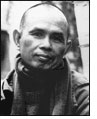
 Thich Nhat Hanh is a Zen monk, teacher, poet, peace activist, and the author of more than 100 books, including "Anger," "The Miracle of Mindfulness," and "Living Buddha, Living Christ." In his latest book, "No Death, No Fear," he invites both Buddhists and non-Buddhists alike to look deeply into the nature of life and death.
For someone who is dealing with a painful loss or a personal fear of death but knows nothing about Buddhism or meditative technique, what do you recommend as way to begin to let go of fear and grief?
I think there's a way of training ourselves in order not to become the victim of fear and grief -- that is to look deeply into ourselves and to see that we are made of non-self elements. And when we look around ourselves, we can recognize ourselves in the non-self elements, like a father looking at his children can see himself in his children, can see his continuation in his children. So he is not attached to the idea that his body is the only thing that is him. He's more than his body. He is inside of his body but he is also at the same [time] outside of his body in many elements. And if we have the habit of looking like that, we will not be the victim of our attachment to one form of manifestation, and we will be free. And that freedom makes happiness and peace possible.
Other than meditation, is there any specific practice that can help you come to this understanding?
Yes. The Buddha advised us to bear in mind that everything is impermanent, that nothing has an absolute entity that remains the same. And when we keep that insight in mind, we can see more deeply into the nature of reality, and we will not be locked in the notion that we are only this body, this life span is the only life span we have. In fact, because nothing can be by itself alone, no one can be by himself or herself alone, everyone has to inter-be with every one else. That is why, when you look outside, around you, you can see yourself. And when you look into yourself, you can see the world outside. So that is a training.
I wonder if you'd answer the question you say you like to pose to your Christian friends: "Where was Jesus before he was born?"
In the Christian tradition, people speak of the living Christ, the living Jesus. It means Jesus is not affected by birth and death. So the question can be rephrased, "Where was Jesus after he was born?" Because if you look at that manifestation of his body and you think that Jesus is only that body, you are misled -- Jesus must be much more than that body, that manifestation. So if you can answer that question, you can answer the other question.
So we should be able to see Jesus Christ even with that manifestation. And before that manifestation, we cannot say that Jesus did not exist because the nature of Jesus is the nature of no birth and no death. And birth and death cannot affect Jesus. If we look like that we have a much deeper understanding of the person, of the nature of the Lord.
Can you explain what you mean by that manifestation? What is being
manifested?
Manifestation is showing a presence -- when conditions are sufficient,
something manifests itself. And that is not a beginning, that is a
continuation also. It's like a beautiful cloud in the sky -- that is a
manifestation: before being a cloud, the cloud has been other things like water, vapor, heat and so on. So looking deeply, you can only recognize the presence of the cloud in the non-cloud elements that have been there before that manifestation of the cloud.
You say that without awareness or mindfulness we live like dead people. Can you talk about what you mean by the practice of resurrection?
Usually people have a tendency to be caught in the worries concerning the future or in the regret concerning the past. There is some kind of energy that is pushing them to run and they are not able to establish themselves in the present moment. And that prevents them from getting in touch [with] what is there in the present moment. And life is available only in the present moment. If you abandon the present moment you cannot live the moments of your daily life deeply. That is why those who are not capable of being there in the present moment, they don't really live their life -- they live like dead people, like the French writer Camus used to say.
That is why if you know the techniques of mindful breathing, mindful walking, mindful smiling, you can bring your mind back to your body and you become truly alive at every moment and that can be described as the practice of resurrection. Resurrection can be at every moment for life to be truly possible.
Is that what you're talking about when you say "When you come back to mindfulness and awareness the energy of the Holy Spirit is present in you"?
Yes, when mindfulness is there you are attentive to yourself, you are attentive to other people around you and understanding becomes possible, compassion becomes possible. And that improves the quality of your life and the lives of those around you.
If things were not impermanent, life would not be possible. Suppose you sow a seed of corn. If the seed of corn is not impermanent, it cannot sprout and become a young plant of corn and you would have no corn to eat. That is why impermanence is very important, crucial for life. That is why instead of complaining about impermanence you have to say "Long live impermanence!"
What would you say to someone, for example, whose child has just died? How should they understand what's happened?
I would say that when conditions are not sufficient, something cannot manifest itself fully. It may be waiting for a few other conditions in order to manifest. And if we keep that in mind and if we are capable of seeing that manifestation in other forms then we don't have to be the victim of despair and fear.
Suppose you are impressed with a particular cloud in the sky. When it is time for that cloud to become the rain you won't see that cloud anymore and you will cry. But if you know that the cloud has been transformed into the rain and the rain is calling you, "Darling, I am here, I'm here," if you have that kind of capacity of recognizing the continuation of that manifestation, you don't have to live in despair and grief. That is why for those who have lost someone who is close to him or to her I advise that they look deeply within and see that the one who was close is still there, somehow, and with the practice of deep looking they can recognize his or her presence very close to him or to her.
Do you ever have doubts about these truths? How do you deal with your own doubts?
Doubt in my tradition is something that is very helpful. Because of doubt you can thirst more and you will get a higher kind of proof.
Our life is a manifestation, and we can very well make that manifestation beautiful and meaningful and have a good influence on other manifestations in the now and in the future. If we know how to create the energy of love, understanding, compassion, and beauty, then we can contribute a lot to the world, influencing positively other manifestations. Because if the manifestations that happen in the present moment are beautiful and good, their continuation in the future will be also good and beautiful.
You say that people of any faith can use these teachings.
Yes.
But most Christians and others profess a faith in an embodied life after death. How can your teaching of no-death/no-self be useful to them?
There is an interesting story I would like to tell you. There is a lady who believed very strongly that if she died she would go to heaven and she would meet her husband, who died at the age of 30. And she said that when she was 70, and I asked her, "When you go to heaven, how old do you expect your husband to be -- 30 or 70? If he's 30 and then you are 70, then that's no match at all!"
So because we are attached to a specific form of manifestation, that is why we suffer. If we are free from that kind of attachment, we can easily recognize ourselves in other people, in different forms of manifestation, and then we don't have to suffer.
Is there anything more you want to add?
I think concerning the question about the presence of Jesus. In the Bible there's a story telling us that there was a disciple of Jesus walking with him but not recognizing him at all -- that is after the crucifixion. And then only when Jesus begins to break the bread do they recognize that the person that had been walking with him is their teacher.
My suggestion is that Jesus is very close, if you have the kind of eyes that is free from attachment and you can recognize him at anytime and anywhere. So the same thing is true with the person who is dear to you. You may have thought that he's no longer there, she's no longer there and you are looking for him or for her elsewhere and in the future. But if you have that kind of eye that we call a "signlessness" you'll be able to recognize him or her right in the here and the now and you will no longer be a victim of fear and grief and despair.