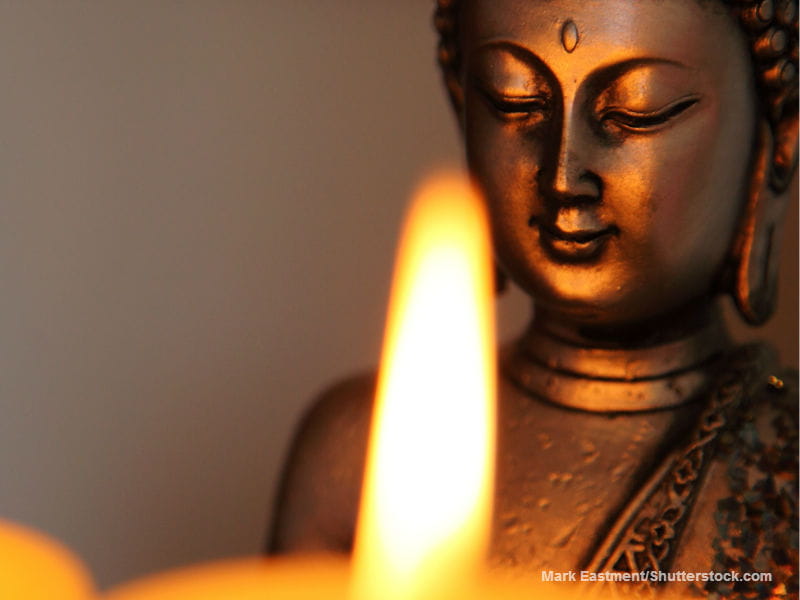
The image is seared into our collective consciousness: Buddhist monks setting themselves on fire to protest the war in Vietnam.
But as they counsel the nation not to act out of a desire for revenge, many leading Buddhist teachers are reluctantly conceding that even a religion devoted to peace recognizes that there are certain situations in which action is unavoidable.
 |
|
|
|
|
|||
|
America's Buddhist teachers are calling on the country to eschew anger, to feel compassion for both the victims and the perpetrators of the violence, and to urge politicians to find and remedy the causes that give birth to hatred, but they are also struggling to reconcile a teaching devoted to ending suffering with a terrorist threat devoted to imposing just that.
"You are entering the koan of 'Stop Harm'," observes Myotai Treace Sensei, abbot of the Zen Center of New York, referring to the insoluble meditation riddles Zen masters give their students. "'Don't do harm, but stop harm."
Zen Samurai. Dharma warriors of Tibet. Wrathful Buddhas. These represent powerful Buddhist traditions that acknowledge violence as a tool of the Dharma. Followers of these paths take a series of bodhisattva vows, voluntary oaths to relieve the suffering of all beings.
"One of those vows is that, basically, you have to kill if it will be of benefit to others," explains Nicholas Ribush, a former monk who heads the Lama Yeshe Archive. "If you don't, you are breaking your vows."
But to be justified, the teachers agree, the violence must be highly targeted and taken to prevent further violence, not to exact revenge. "When necessary, kill, but only out of wisdom and compassion," counsels John Daido Loori Roshi, Abbot of Zen Mountain Monastery. "We need to see each situation in terms of time, place and position of the individual. What's okay at one place may not be acceptable in another."

| ||
|
"Don't do harm, but stop harm." Myotai Treace Sensei,
Abbot of the Zen Center of New York |
||
|
|
Robert Thurman of Columbia University believes that the action of a commando team that "got rid" of the terrorists without hurting others could even be "heroic." "The person to do that is a bodhisattva who is very wise and skillful and will not lose his cool to hatred and anger," says America's best-known spokesman for Tibetan Buddhism.
 "I don't feel like I have any transcendental understanding, just my own fumbling through it," says Joseph Goldstein, co-founder of the Insight Meditation Society (IMS), one of the country's largest Buddhist organizations. "But it seems to me we must respond, that they present a real danger to people and so some act of protection is totally appropriate.
How to balance that without creating more violence, that's the real koan," he adds.
"I don't feel like I have any transcendental understanding, just my own fumbling through it," says Joseph Goldstein, co-founder of the Insight Meditation Society (IMS), one of the country's largest Buddhist organizations. "But it seems to me we must respond, that they present a real danger to people and so some act of protection is totally appropriate.
How to balance that without creating more violence, that's the real koan," he adds. The Dalai Lama is Buddhism's living symbol of non-violence. Yet even he has indicated that if it had been practical for the Tibetan army to stop the Chinese, he would have ordered it to do so to prevent the resulting suffering.
|
| ||
|
"When necessary, kill, but only out of wisdom and compassion." John Daido Loori Roshi,
Abbot of Zen Mountain Monastery |
||
|
|
"If one's motivation is sincere and positive but the circumstances require harsh behavior, essentially one is practicing nonviolence," the Dalai Lama said in a comment made long before the current crisis. "No matter what the case may be, I feel that a compassionate concern for the benefit of others--not simply for oneself--is the sole justification for the use of force."
Thurman, a close friend and student of the Dalai Lama, says the Tibetan leader's more recent statements have focused on non-violence to send a message. "His Holiness is setting a baseline. He's not getting into the exception about surgical violence to prevent greater violence because there are enough people talking about killing," says Thurman. "He doesn't want to give [the administration] an excuse to do their saturation bombing."
Like every teacher interviewed for this article, John Daido Loori emphasizes the need to look for alternatives to violence. He talks of Jesse Jackson's proposed mediation mission, bombing Afghanistan with food, and long-term methods of getting to the root of the suffering. But when asked whether the country should act against the terrorists, he is unequivocal: "Most certainly, but the degree of response and motivation will count very, very highly in what kind of karma we're going to create."
"My sense is the Buddha accepted that a certain amount of violence is built into the world situations," Olendzki says.
New York's Village Zendo is located just a few blocks from Ground Zero. Its abbot, Rev. Pat O'Hara Sensei, says it is not the proximity of the attack, but its nature, that has led her to conclude that, in this case, compassion requires action.
"I've considered myself to be a pacifist since the '60s, and yet we have to take care of what's in front of us. I've also been a gardener and had to get rid of pests. It's just reality," she says.
Several teachers, even those still struggling for clarity, point to the actions of the passengers on board the hijacked plane that crashed in Pennsylvania as the ultimate reflection of the terror koan.
"I think about those people with a kind of admiration," says Sharon Salzberg, Goldstein's IMS colleague. "I wonder what that extrapolates to in terms of taking life to ease suffering, but I think that it is the motivation, the conditions leading up to the act, that are so important."
Genpo Merzel Roshi, abbot of the Zen Center of Utah, flew home from Europe a few days after the bombings. He has no doubts about the wisdom of the passengers' action. "I've had martial arts training and I was prepared to do whatever was necessary to defend the aircraft I was on. There is a very small percentage of the time when we have to break the precept 'do not kill,' but if it was the right action at the time, the wisest, most intelligent action for the greater whole, then I'm prepared to do that."