|
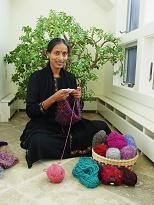
| The author, crocheting hats while chanting. |
But excuse me: While repeating the japa, I just finished making a hat.
The connection between chanting japa and making hats became clear to me when our son Mahar turned three and was ready to start preschool. Ever since the early '70s my husband Ehud had made a study of Rudolph Steiner and Steiner's Waldorf educational philosophy. He had published Steiner's biography and many books related to Waldorf education. My own research told me that Steiner's philosophy embodied the core concepts of the Bhagavad-Gita, the Vedas, ayurveda, and ancient child-centered methods of raising children. His teachings just happened to be in German or English, rather than Sanskrit.
Waldorf schools--a system of private schools based on Steiner's teachings--have sprung up all over the world. These schools cultivate children's innate sense of wonder by encouraging active, imaginative play, handwork, and a connection to the natural world. Waldorf educators avoid exposure to television, radio, the Internet, video games, violent toys, fast food, and rote learning. The teachers study the personality of each child and nourish the child's blossoming spirituality, intellect, and physique. Moreover, these schools support alternative health practices, vaccination choices, the organic food movement, and the religion and culture from which each child comes.
Because Ehud and I had followed similar philosophies to painstakingly create a Satwik (spiritually healthy) lifestyle for our son, Waldorf schools were the only way to go for our family. We were elated to find the Upper Valley Waldorf School nearby. We enrolled Mahar in their nursery in 2001. A few weeks later a letter arrived from the school asking for a donation. "Waldorf education is for those who seek," it said.
We were pleased to see that, unlike some things in life, which are available only to those who can afford them, Waldorf education was for those who seek, irrespective of whether they could afford it or not. The basic necessities of life--water, air, and food--are for everyone. A sensible education--another basic necessity--should be for all as well, not only for those who can afford it.
"But just writing a donation check is such a soulless activity," said Ehud to me one day. "We should demonstrate our good intentions with actions, too." What could I do to support our local Waldorf school and help make it affordable for all? Just as I began to ponder this question, a dear friend of ours, Mrs. Veronica Cowie, offered to teach me how to crochet. Soon I had gone on to teach myself how to crochet hats, and I had a good idea: I could make hats to further the cause. If I could find buyers for them I could put all my hat-sale money into a scholarship fund for the Waldorf school.
The bells of my inner shrine begin to ring.
Read more >>
| _Related Features | |
|
|
 |
|
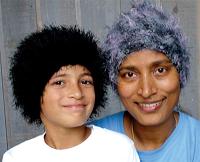
| The author and her son, displaying the finished product. |
I'm getting pretty good at selling my hats. My sales pitch goes something like this, "You may not need, want, or even like my hats, but you must buy one (or a few) because every dollar that you spend on these hats helps children receive a soul-centered and holistic education." The outcome is often pleasant. I have found that people do love to help children. The joy that comes from being able to help is very visible on the faces of these unsuspecting victims of my persuasive salesmanship.
This one-woman hat company is far from becoming a giant publicly traded corporation with a head office on Wall Street and production sweatshops in developing countries. Nevertheless, this hat making does have an undeniable commercial angle: Its purpose is to provide scholarships for children.
Yet there is another aspect to hat making that cannot be shown on any profit-and-loss spreadsheet. When I hold a skein of yarn, cast on my first stitch, and begin to create a pattern and color scheme in crochet, the bells of my inner shrine begin to ring--it's japa time. As the hat grows in my hands, stitch by stitch and row by row, my mind becomes quiet and focused, deeply engrossed in calling out to Shiva over and over again. "O benevolent Lord of creative destruction, please be kind to little children... give them good health, good education, a happy holistic start to life so that our tomorrows will hold hope and light and peace... O Shiva... Om Namah Shivaya."
As the busy mother of a six-year-old boy, with my full share of familial and social commitments, I have not been able to set aside any specific hat-making time. Consequently, any free time is hat-making time--that is, japa time; time to relish the peace and quiet that comes from sustained hand-eye coordination, from simple unhurried repetitive motion, and from nourishing the hope that every little effort to help children is worth the joy and pain it brings.
| _Related Features | |
|
|
|
|