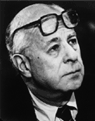
 Neo-conservative thinker and author Norman Podhoretz has written topics as diverse as politics, patriotism, and literature for decades, most famously during his 35-year tenure as editor of Commentary magazine. His most recent book, "The Prophets" (Free Press, 2002), combines literary criticism with biblical exegesis to provide new interpretations of the oft-ignored prophetic canon. He recently spoke with Beliefnet about the mission of the prophets, the failures of modern-day attempts at prophecy, and what the ancient prophets can teach us today.
Skip ahead to Podhoretz on:
What sparked your interest in the prophets?
I first studied the prophets over 50 years ago as a student in Hebrew. I fell in love with some of them. But in the last few decades, like almost everybody else in this culture, I neglected them. This is a heritage of inestimable value that has simply been lost.
A few years ago I was invited to give a lecture on the book of Isaiah. I revisited it and got hooked. I found as I went along that the prophets were not at all what I remembered and not at all what most people think they know about them. So I decided to write this book for two reasons: so that I could do what I could to rekindle interest in this great treasure that we've inherited, and to reinterpret these books in a way that seemed to me truer to the text than the standard stereotypes and the conventional interpretations. And finally, I thought that I should try to explore the question of what the prophets might still have to say to us, living in radically different circumstances. I concluded that what they had to say is centrally relevant to our situation today.
What was the primary mission of the prophets?
The primary mission was to conduct a war that had begun in the days of Abraham, roughly 4,000 years ago in 2000 B.C.E., a war against idolatry. A war to establish the truth of the great revelation, namely that there was only one god, not many gods, which is what everyone, including Abraham's own father believed. That you couldn't see him, you couldn't make a picture of him, you couldn't make a statue of him to which you would then bow down. That he was the creator of all things in heaven and earth and the one true God of all human beings.
There was a positive mission as well, which was to explain why obedience to the law of God is good, and that despite all appearances to the contrary, the life of infidelity, of idolatry, brings a curse to those who follow it. Over the course of about 1500 years, when this war against idolatry was being conducted, the children of Israel were constantly backsliding and submitting to the temptations of idolatry, which were rampant in the world around them. They were constantly forgetting what was required of them, sometimes in good conscience. They imagined that what they were doing was all right in the eyes of God, and it was to correct those errors of understanding and also spiritual regressions that the prophets were sent by God. They did this both by trying to depict the evils associated with idolatry and the glories associated with fidelity to God, including the ultimate triumph of God over the whole world, which would be brought about only when the children of Israel finally expunged all the idolatrous temptations from their own souls.
Were the prophets only talking to the Israelites?
Yes and no. They weren't just talking to Israel, but they were talking primarily to Israel. Their view is that the universal can be reached only through the particular. The children of Israel--to whom the prophet Amos said, 'You only of all nations have I known, therefore I shall visit upon you all your iniquities'--were not only privileged to be given God's law, but they also had a special responsibility, and they would be more heavily punished than other nations to whom the revelation was not granted. This is why Jews in later centuries would sometimes say, "Dear God, please choose someone else for a change."
The idea that is repeated over and over again by the prophets is that only when the children of Israel finally and fully resist the seductive temptations of paganism and idolatry and fully discharge their responsibility to be faithful to the law that had been revealed to their ancestors, only then would all the other nations recognize this truth. So they had not only a responsibility to obey the law in their own right and for their own sakes, but God had chosen them as his instrument for the conversion--the voluntary conversion, for the most part--of the other nations of the world.
Yes, in fact, as one eminent Protestant historian, John Brighton in his History of Israel, said, by the third or fourth century BCE, the war against idolatry had been won. As I point out in my book, the irony is that it was not the Jews who reaped the spoils of victory in that war; it was the new religion that was born out of the womb of the religion of ancient Israel, Christianity. When the Roman Empire, the great pagan empire, converted to monotheism, it was to Christianity, not to Judaism. So in that sense, the prophecy turned out to be both true and not true. Christians would say that they were actually foreseeing the advent of Christianity, which is one of the misconceptions that I argue against in my book--that the prophets were on the way to Christianity or were premature Christians. Most serious scholars, including Christian ones, no longer accept what used to be called the Christological interpretation of the prophets, the idea that there were foreshadowings and hints of the coming of Christ.
But most Christians still believe that the book of Isaiah foretells the coming of Christ.
Yes, most Christians do, but no serious scholars do. And the Christians who do, I think, from the point of view of serious study of what Christians call the Old Testament, are out of date. You will find scholars, many of them very pious Christians themselves, who say flatly that the Old Testament is not merely a precursor to the New Testament. It exists in its own right, and it was not a forecast of the New Testament. All the early Christians who were Jews believed that it was. But that they believed that it was and that many fundamentalist Protestants still believe it doesn't make it true.
There's a parallel development within the Roman Catholic Church, and also among many Protestants, which is the rejection of what is called supercessionism, the idea that Christianity supercedes Judaism. The Pope has said that Judaism is a religion in its own right, it is the older brother of the Church, which means that the Church, more or less officially, no longer accepts the view of St. Paul, that Judaism was no longer valid. That's a very long and complicated theological discussion I'm not really willing to enter.
You mention in your book that Jews read the prophets every Shabbat. Is the prophetic literature as important in Christianity?
No. There was a time until relatively recently when Roman Catholics were forbidden to read the Bible. That was one of the reasons that, when Martin Luther inaugurated the Reformation, one of the first things he did was to translate the bible into German, so that ordinary people could read it without the intercession of the Church. The Church of course did not believe in that -- in fact in the early days there were people who were executed for translating the Bible into the common languages. Now that's no longer true; the Church no longer discourages reading the scriptures.
Orthodox Jews also discouraged reading the scriptures nakedly. If you read them, you read them surrounded by rabbinic commentaries. Even in the synagogue, when the sections of the prophetic literature are read, as a supplement to the reading of the Pentateuch, they are also surrounded by commentaries, and usually the rabbi will deliver a sermon to interpret what the prophetic literature for that week is saying.
The fact is that compared to even fifty years ago, the level of biblical literacy in relation to the prophets has fallen catastrophically. In most Protestant countries, including this one, in the early years of the 20th century, everyone knew the bible, including illiterate people. Now if you stop the first 100 people you meet on the street and ask them to name the first five books of the bible, I'll bet that not one out of a hundred could do so, let alone tell you what's in those books. This is part of my purpose - to stimulate interest and to get people to start reading the Bible again. I focus on the prophets because, as a literary man, I feel they have an appeal, even to nonbelievers, because they were among the greatest poets who ever lived.
My favorite is Jeremiah, though I don't like his politics too much. He was an appeaser and a defeatist. But he was a very great poet, and of all the prophets, he's the most human, and the one about whom we know the most. I fell in love with him when I was a teenager, and I found that when I went back to him, I was still deeply moved.
After September 11 last year, we heard a lot about these being the End Times, and that the sins of America made us deserve the attacks. Would that be considered modern day prophecy?
I was repelled by that idea when Jerry Falwell said it. I have to admit in all honesty that it's the sort of thing the prophets were always saying to the children of Israel: you brought this on yourself by your sins and God is using these foreign powers, whether it be Assyria or Babylonia, to punish you for your sins, and they will be punished by God in their turn. But there are several differences here.
There are historians who claim with some justification that the prophets were exaggerating the sins of the people in their own time, exaggerating out of what he calls prophetic idealism, and that people were not as bad as, say, Jeremiah claimed that they were. There may be some truth in that idea.
I would apply the same idea to America, but I would put it more strongly. I don't think this is a sinful country. I think it contains many sinners, and groups of sinners, as all human communities do. But on the whole I would say that this is a virtuous country, not a sinful one as a collectivity, and that far from being attacked for our sins by the Islamic fundamentalist radicals, we are being attacked for our virtues and our freedoms, both economic and political. So the charge Falwell makes I think is mistaken with regard to the nature of this country.
And secondly, I don't think Falwell is a prophet. There's a big difference between him and the prophets who were charged by God. Whether you believe it or not, these men believed they were not speaking words of their own. Very often they were reluctant to deliver the message. That's an image that you find throughout the prophetic canon: Jeremiah, who begs to be let off the hook, for example; or Ezekiel, who has to be forced literally to chew a scroll on which the prophetic message is inscribed. They were all selfless--their entire lives were submerged into the service of God, and they were instruments of the will of God. So they believed and so they acted.
If America is a virtuous country now, what do the prophets have to tell us today?
I think what they have to say to us has to do with those elements of society which are not virtuous, which are in fact idolatrous. What the prophets meant by idolatry, I concluded after studying them very carefully, was not so much the worship of false gods, but the worship of oneself. This is what we call narcissism. D.H. Lawrence, who was no believer but who nevertheless used a lot of Christian imagery when it suited him, once said that to fall from the hands of god is to fall into the bottomless pit of self. That's very close to the prophetic ideal of idolatry--that the alternative to the worship of the one true God is worship of self.
I think that this is the great sin prevalent in America -- not what some people say is worship of money or worship of fame, success and power. The prophets did not consider worldly goods to be wicked or inferior, and I think that's one of the great signs of the realism of the prophets, which is often not noticed. They were realists, they were also incidentally very political. They dived deep and dirty into the politics of their own time--they took positions, they opposed certain other ideas and supported others, all in the name of God of course.
The besetting sin of American culture is narcissism, or the culture of narcissism, as Christopher Lash calls it, the worship of self. The prophets have a great deal to say about the meaning of such worship.
Can you give an example of narcissism in our culture?
This is where I get into trouble, where my book becomes radioactive. I believe that down deep in the feminist movement, you find precisely a worship of self. The notion that a woman's needs should take priority over the needs of her children is probably the most radical anti-biblical idea ever promulgated. I doubt there is any culture in which that idea has ever taken root that my needs are primary. That's one example.
I believe that the gay rights movement contains a very strong element of narcissism in its glorification of youth. I think, to shift the ground slightly, that you find a resurgence of this idolatry in paganism, and even in the environmental movement, with the elevation of nature above man, which is exactly the opposite of the biblical idea, which gives man dominion over nature. To go back to feminism and homosexuality, and the notion that there is no natural difference between men and women, that these differences are social constructs, this too is a repudiation of the biblical concept of the nature of life.
These are mutations of the old rebellions against the laws promulgated by God in the Bible and that are explained and ratified by the prophetic literature. To that extent, what we have in the prophetic literature and in the Hebrew bible generally, is a corrective to some of these tendencies and insight into what they really amount to, as opposed to what they represent themselves as saying in the sanitized public relations version that is peddled for political purposes.
So these social movements make the prophets still relevant?
What I'm trying to argue is that the spiritual war in which they were engaged is not over, and that different forms of the same forces that they were contending against keep cropping up, and always will, so long as human beings remain human. The prophets provide spiritual wisdom and insight that casts a very blazing light on certain aspects of our own situation today, on our spiritual condition.