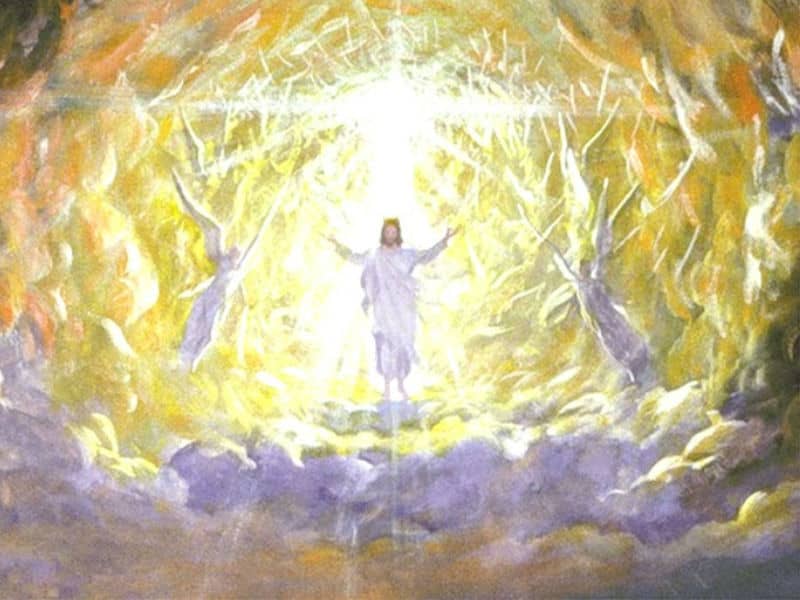
Look homeward Angel now, and melt with ruth.
And, O ye Dolphins, waft the haples youth.
--John Milton
And the child sailor
was protected by the dolphins,
who resembled little angels
hovering over the little rafter.
--from a poem about Elian Gonzalez by Miami Cuban exile Jose Manuel Carballo
Anyone who still sees the custody battle over Elian Gonzalez as a purely political squabble between Miami's Cuban exiles and Fidel Castro should visit the Domingo Padron Art Gallery in Coral Gables, an upscale suburb of Miami. There you'll find "El Nino de los Delfines"--"The Boy of the Dolphins"--a new painting by Cuban exile artist Alexis Blanco. The 30-by-24-inch oil-on-canvas work depicts Elian drifting at sea on his inner tube, surrounded by three dolphins and bathed in a shaft of light that appears to be descending directly from heaven. One of the dolphins in the painting is "pushing Elian's raft, to show that he will not return to communism," Blanco told The Miami Herald.
Blanco's arresting work renders pictorially what has already become folk wisdom among Miami Cubans since the boy--one of three survivors of a shipwreck that killed 11 other Cuban refugees, his mother included--was plucked from the sea on Thanksgiving Day: Elian's survival after two days alone on the ocean was, quite literally, a miracle. God intervened to save the child's life and bring him to freedom in the United States. At His command, a school of dolphins arrived to protect the child from sharks and nudge him gently toward shore.
So widespread is the Miami Cuban community's belief in this version of events that it is posted, quite matter-of-factly, on the official Elian Gonzalez website. "The fishermen that found Elian reported that Elian was surrounded by dolphins...who were protecting him from the shark infested waters," the site explains.
If divine intervention brought the 6-year-old to safety in the United States, it follows that he belongs here--that he should be allowed to stay with his great-aunt and great-uncle in Miami rather than be sent back to his father and grandparents in Cuba, and that any other dispensation by the U.S. government would be not only a political and legal mistake but also a kind of blasphemy. No matter that the story is almost certainly not true. The fisherman who found Elian, Donato Dalrymple, has told me and other journalists that he didn't see any dolphins protecting Elian. Nor did the Coast Guard officer who responded to Dalrymple's call for help. We are told, by Dalrymple and others, that Elian himself has recounted seeing dolphins. But he was drifting in and out of consciousness during his time on the water.
Whatever the story's literal truth, the point is that so many people believe it. Clearly, what the rest of us need to understand is both the speed with which an entire mythology has grown up around the boy's amazing survival and the power with which these stories have fed the Miami Cubans' determination to prevent Elian's repatriation--despite unfavorable legal rulings and strong indications that most of the American public is against them.
The title of Blanco's painting contains a Spanish double entendre that no Cuban viewer of the picture will fail to spot. "El nino," usually means, simply, "the boy"; but in some contexts it can mean "the Christ child." (The temperamental ocean current that periodically roils our weather got its name because it usually appears off the coast of South America around Christmas.) On a recent trip to Miami, I was amazed at how many people spoke of the preternaturally handsome Elian as "an angel" or, in the case of a supporter quoted in a recent St. Petersburg Times article, "the Cuban messiah."
Cuban Miami kindled to such symbolism almost automatically because, in part, of the lingering strength of Roman Catholicism in this community. While the Exile was established by people fleeing Cuba's political repression and economic dispossession in the early days of Castro's revolution, secular considerations were only a part of the story. Another major reason people left was because Castro intended to all but eradicate the church, religious education, and, through official atheism, faith itself.
The resonance of images of rescue at sea is also a function of Cuba's island geography--it is a place that, historically, could be entered or exited only by means of dangerous ocean voyages that often ended in tragedy. Cuba's patron saint, the Virgin of Charity, is supposed to have first made her presence known on earth by rescuing three Cuban fishermen lost at sea in a storm.
Survival at sea is also a preoccupation of the African religious tradition that traveled to Cuba aboard slave ships right up until the mid-19th century. In Santeria, Cuba's counterpart to Haitian vodun (which is often practiced by Christians as well), Yemaya is the goddess of the sea. Cubans pray to Yemaya before embarking on illegal escapes to the U.S. like the one that claimed the life of Elian's mother.
If Elian is a messiah, what sort of deliverance does he offer? On one level, he symbolizes the Miami Cubans' yearning for an end to communism in Cuba, and hence to their own exile and separation from family back home. But in a deeper sense, he promises the exiles a kind of existential vindication. The decade since the fall of the Berlin Wall has been a time of deep disappointment for the Miami Cubans; they have watched helplessly as Fidel Castro has survived the collapse of his erstwhile Soviet patron and perpetuated his harsh rule in a place they now routinely refer to as hell. More recently, U.S. policy has edged away from the uncompromising stance the exiles favor, toward a tentative rapprochement with the Castro regime.
In these circumstances, the exiles--the oldest of whom can now hardly dream of setting foot in a free Cuba someday--feel ignored and, increasingly, aggrieved. For many, this sense of helplessness poses a profound crisis of individual and collective purpose, revolving around the question of whether they did the right thing by leaving the island in the first place.
Elian seems to resolve this conundrum. By his very presence on these shores, he proves the perfidy of a Communist regime that drives children out into the dangerous waves. If only we can keep Elian here, many Miami Cubans seem to think, we will win our argument not only with Castro but also with history itself.
It's far from clear how the difficult political and legal problems presented in this case can be peacefully resolved. But no solution can work unless it recognizes and deals with the powerful spiritual forces that are driving this crisis as well. According to the Herald, Alexis Blanco's painting has been reproduced on postcards, which Miami Cubans are being urged to send to President Clinton. The postcards are emblazoned with the words "God Given Freedom."