 Every generation has its own unique ways of violating the Ten Commandments, so I suppose every generation also deserves its own Ten Commandments movie dramatizing how Moses received the two tablets of the Law. Inevitably, these also seem to reveal the ways in which the creators of those depictions fail to grasp what makes the Decalogue, as the Ten Commandments are known, important in the first place. A new ABC miniseries, "The Ten Commandments," airing April 10 and 11, is no exception. Similarly, a recently released 50th-anniversary DVD of Cecil B. DeMille's 1956 classic--complete with a six-part documentary about the making of the film--serves as a good reminder that the same is true for that iconic movie.
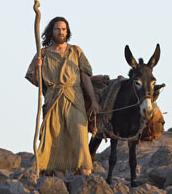
 The man who plays Moses, Scottish actor Dougray Scott, certainly will not stick in anybody's memory, though he does an adequate rendition of the "Oh I'm in so much pain duet to personal moral sensitivity" wince that James Caviezel (as Jesus) made more affecting use of in Mel Gibson's "The Passion of the Christ." But in "The Passion," The Wince was appropriate, since the crucifixion of Jesus, in Christian thinking, is quite understandably regarded as the ultimate tragedy. The Moses narrative as told in the Bible's book of Exodus, by contrast, is supposed to be an upper, not a downer. After all, Moses, with the help of spectacular miracles, is leading the Israelites from slavery to freedom.
Yet Scott looks as if he's feeling miserable throughout the proceedings. Even after the Hebrew slaves have fled Egyptian bondage, crossed the miraculously split Red Sea, and seen the water pour back down upon their murderous Egyptian pursuers, Moses remains Mr. Mopey. As the Israelites sing, dance, and play tambourines, rejoicing in freedom just as they do in the Bible, Moses's sister, Miriam (Susan Lynch), comes to him by the seashore and tells him, "Everyone is celebrating!" But Moses is inconsolable about the death of all those innocent Egyptian soldiers.
He never cheers up, leaving the viewer with an unrelentingly negative impression of Moses's accomplishments. The mobs of liberated Hebrew slaves are ugly and angry even by the standards of Hollywood-depicted mobs. Of course, because this is a historical drama set in the ancient Near East, everyone speaks in a British accent, according to universally observed entertainment-industry convention. So the ugly Jewish mobs communicate in unpleasant, vaguely Cockney accents, which raises the question of why Pharaoh wasn't delighted to get them out of his country to begin with.
The negative tone extends to the enforcement of the Law, the same Law that Moses is leading his fellow Israelites into the wilderness to receive. When a pair of adulterers are caught and executed, Moses again gives The Wince. This doesn't happen in the Bible story, but the episode calls into doubt whether it is a blessing or a curse the Jews receive when they get the Ten Commandments--after all, even their leader Moses is disturbed by some of the Law's implications.
According to the plain text of the Bible itself, however, the reason God called the Israelites to stand at the foot of Mount Sinai and hear His voice reciting, "I am the Lord your God," and so on, was very simple. The day before the revelation of the Decalogue at Sinai, God told Moses what He had in mind: "Behold! I come to you in the thickness of the cloud, so that the people will hear as I speak to you, and they will also believe in you forever" (Exodus 19:9). In other words, the purpose of the whole exercise was to impress on the Jews that God spoke to Moses, literally, "face to face, as a man would speak with his fellow" (Exodus 33:11). It was a necessary preliminary to all that followed, namely his revealing to Moses all the other commandments that form the eternal Sinai covenant. The Ten Commandments serve the purpose of lending credibility to the other 603.
The DeMille "Ten Commandments" also gets this wrong. Only Moses hears the voice. To make matters worse, Charlton Heston, playing Moses, personally supplies the voice of God, underlining the mistaken impression that somehow when Moses heard God, he wasn't necessarily hearing a separate entity from himself but rather a voice from his own heart. As the DVD's accompanying documentary makes clear in an interview with Heston, that's how the star himself understood it.
The 1956 "Ten Commandments" is a far more memorable and colorful movie than ABC's drab update, with vivid performances (Heston, Yul Brynner as the Egyptian pharaoh Ramses, Edward G. Robinson as the cowardly-villainous Jewish overseer Dathan), and an enjoyably campy screenplay, including Anne Baxter's classic line, "Oh Moses, Moses, you stubborn, splendid, adorable fool!"
DeMille's version also has a definite point of view, not altogether untrue to the Bible's, through which the film demonstrates passionate conviction. It is, after all, a product of the Cold War, and DeMille clearly was taking aim at Soviet Communism, for which Pharaoh's Egypt stands in. Before the main action of the movie begins on the DVD, the director himself steps from between curtains onto a theatrical stage and introduces the film as encompassing the theme of freedom versus tyranny. He leaves no doubt that he sees this as the whole point of his exercise. "There is no freedom without the Law," Heston's Moses declares at one point, and clearly he means it, too.
ABC's "Ten Commandments" demonstrates no particular conviction in anything other than the possibility that this miniseries can capitalize on the Christian audience for "The Passion" by giving them the Commandments in place of the Christ. Certainly there is no passionate attachment to the Ten Commandments themselves, which come across not as a supreme gift to humanity but merely as a primitive stage in humanity's evolution toward higher enlightenment. From the evidence of the miniseries, on the day Moses stood at Sinai, that enlightenment was still a long way off. In this way, the production perfectly represents the dominant culture of our times, which regards itself as superior in wisdom to all generations that have gone before.