
As a card-carrying Mormon, do I want to become a regular watcher of HBO’s new series "Big Love," which focuses on a polygamous family? As with many questions I have related to Church matters, the answer is complicated.
To be clear from the outset, "Big Love"--which premieres Sunday after "The Sopranos"--is not about Mormons. Rather, it is about members of a splinter group that still practices polygamy while retaining aspects of Mormon practices and culture. HBO’s press release includes this prominent disclaimer, which also airs at the end of the show's first episode: "According to a joint report issued by the Utah and Arizona Attorney General’s Offices, July 2005, 'approximately 20,000 to 40,000 or more people currently practice polygamy in the United States.’ The Mormon Church officially banned the practice of polygamy in 1890."
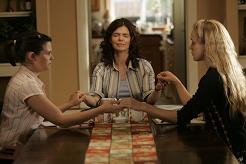
Besides the obvious polygamy aspect, there are several clues that this is really not about Mormons. Fashion is a tip-off, from Margene’s (Wife #3) short skirts and spaghetti-strap dresses to Nicki’s (Wife #2) long skirts and braided hair. Nicki looks like someone not far removed from the fictional “Juniper Creek” polygamist cult compound--probably based on the real polygamist enclave, Colorado City, Ariz.--where she (and husband Bill) grew up. Tripplehorn's Barb (Wife #1) is more on the mark: Many Salt Lake City Mormon women go for her sort of “modest but modern” look these days. She can and does “pass” as Mormon.
The terminology that the characters toss around provides tip-offs that the actors themselves are not Latter-day Saint insiders. Barb refers to the phenomenon of Family Home Evening, a common Mormon happening, but she accents the second word, “home,” rather than giving a slight oomph to "evening," as in real Mormonspeak. Perhaps more tellingly, the creepy cult leader Roman, played by Harry Dean Stanton with amazing menace, mispronounces Palmyra, the name of the upstate New York town where Joseph Smith’s first vision took place--and therefore a word with which every Mormon or splinter-group member would be very familiar. So the writers have it correct; maybe the cast needs just a little more fine-tuning from the accent coach.
For the most part, though, the show nails the Mormon rubric. Henrickson household conversations abound with common Mormon phrases such as “for time and all eternity” or “CTR” (the acronym used to remind Latter-day Saint youth to “Choose the Right”), and exclamations like “Oh my heck” and “Dumbhead” are about as strong as the language gets. Tina Majorino’s (Napolean Dynomite) character--a perky mainstream Mormon friend of the oldest Henrickson daughter--rattles off mentions of “Relief Society" and "Young Women’s" knowing that everyone in her life--if not her non-Mormon TV viewers--will catch her references to these common Mormon groups.
Mormons can probably laugh louder that most viewers at Bill wolfing down green jello after a fast, seeing Nicki’s mother’s Lladro collection, or hearing that teenage Benji’s high school baseball team is the Cumorah Cougars. (Cumorah is the place where Joseph Smith found the Book of Mormon.) These are great inside jokes that show real homework.
As "Big Love" portrays, splinter groups like those the characters belong to often share some nomenclature, some history, and some theology with the Mormon Church. Much of the counsel the characters offer concerning how to discern revelation, how to seek guidance, and even how to build unity sound like the real deal to me. Shots of the Salt Lake Temple spires appear in nearly every driving scene. A replica of the Salt Lake Temple appears on the desk of the cult patriarch and “Prophet.” That gives me the willies.
What is "Big Love’s" intent? The show features the disclaimer insisting that the Henricksons are not Mormon, but all the overlaps muddle that concession. Who can parse out these distinctions without an insider’s framework? "Big Love" makes a Big Mishmash of all things Mormon and faux-Mormon. Perhaps non-Mormon audience members will perceive the Church even more than they already do as a weirdo, cultish, control-hungry sect. It would be sad if "Big Love’s" success obscures the fact that the real Church of Jesus Christ of Latter-day Saints provides a sacred, saving, and satisfying Christian message to millions of people around the globe.
As a convert to the Mormon Church, I have no heritage of or fondness for polygamy (except for the fact that it eventually produced my husband, a fifth- generation descendant from polygamist marriages back in the day). Polygamy had a significant shaping effect on the culture of the Church in the 19th-century--for good or ill. Watching these characters deal with the frictions inherent in “living the principle,” as polygamy was known, helps me understand the challenges my children’s Mormon ancestors faced long ago. The system required women to develop strength, independence, willingness to sacrifice, and top-notch organizational skills. These are fine qualities, though I’m happy to develop them through means other than polygamy.
Bill Henrickson’s children seem to have loving relationships with their dad, but what about those circumstances in which men took double-digit numbers of wives and had triple-digit numbers of children? Wife #2, Nicki, shows the effects of this sort of inevitable neglect. Will "Big Love’s" spotlight on contemporary polygamy--its domestication of this forbidden practice--mask real concerns, which Barb understands, about the exploitation of girls and women, and the financial and emotional abandonment of children in these societies?
Another red flag makes itself apparent in the very first scenes of the first episode: explicit sexual content. Mormons who never see R movies will not want to see this. Those who sometimes do may also find scenes in the first two episodes off-putting and gratuitous. I watched five episodes and was pleased to see that in some later installments of the show, there is more emphasis on character development and much less on sex scenes. I wish the whole series was like the later episodes I saw, in which we get the message without the explicit visuals.
The effect of "Big Love" on the Church's image--especially for people unfamiliar with Mormon culture's nuances--and the show’s graphic sexual content are serious problems. Those realities alone will and perhaps should keep Mormons away. In an odd way, the choice to watch this series may require the same kind of thought that went into deciding whether to see “The Passion of the Christ”: Do its problems outweigh its benefits?
But if you can get past those significant stumbling blocks, "Big Love" is an example of intricate, well-paced, finely acted storytelling. The three wives, in particular, are superb characters for the gifted actors who play them. Production values are high and the writing is clever, suspenseful, compelling, and at times profound. (And what a pleasure not to have to put up with swearing all the time!) With a delicate balance of wit and wisdom, "Big Love" wrestles with relationships and the deep human questions of commitment, unity, forgiveness, patience, and--of course--love, as well as the darker qualities of greed, jealousy, revenge, and manipulation. This is not a raunchy soap opera with a prurient twist. As Bill Henrickson would tell you, you have your agency. There is no coercion. You’ll have to choose for yourself.

