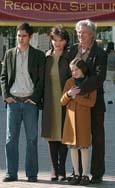
 Sometimes a movie can be important for its inaccuracies. Take "Bee Season," for example. The story takes place in Oakland, Calif., and ricochets off the foibles of the members of the Naumann family: Eliza, a grade school girl with a gift for spelling; Aaron, her older brother, who is a spiritual seeker; their mother who, it turns out, is basically bonkers; and their father, who is a religion professor and failed Kabbalist (Jewish mystic). It is a beautifully photographed but unsatisfying rendition of Myla Goldberg's beautifully written but unsatisfying novel of the same name. Despite its disappointments, however, "Bee Season" inadvertently offers some highly instructive insights into the state of religion--and, specifically, Kabbalah--in America today. Permit me three examples.
Its most insidious mistake comes from Professor Saul Naumann, played by Richard Gere, when he tells his daughter Eliza that "a mystic can talk with God and have God listen." This should come as a big surprise to anyone who has ever offered a prayer, because it means that he or she is now a de facto mystic. (And you thought that communicating with God in and of itself, in any form, made you religious!) Sorry, professor, you get that one wrong on the exam. Mysticism, unlike religion in general, is not about communicating with God; it is about dissolving yourself into the divine All and becoming one with God.
Far more fascinating, however, is the damning implication here that, if the only way to commune with God is to be a mystic, then mysticism therefore must be the only bona fide form of religion. Therefore, all other non-mystical forms of religion are really just condemning their practitioners to spinning their (prayer) wheels. In other words: According to the movie's error, we realize that in America today, perhaps the only way to be truly religious is to be a mystic.
A second instructive error concerns Jewish kids becoming Hare Krishnas. Seeking love, we suspect, more than spirituality, Aaron eventually dons the saffron robe that made the Hare Krishnas an icon--and flashpoint--of the 1970s and '80s. (Although Aaron's defection, in the movie unlike the book, does require a blonde knock-out as bait.) But given the absence of any expression of Judaism whatsoever in the Naumann home--no candles, no religious books, no blessings, no melodies, no prayer--it is at least encouraging that the kid has enough good sense to try to find something religious somewhere else. (In the novel, Saul Naumann, is a cantor which, we suspect, might have been an easier reach for Gere but also a box office albatross). There's only one problem: Though the Hare Krishnas are still around, Jewish kids aren't running off to join them in large numbers these days, nor are Hare Krishnas aggressively pursuing converts like they once were. Thirty years ago it was different. Then, virtually everyone in the Jewish community knew of a kid who went off and became a Hare Krishna, joined an ashram, took up Zen Buddhism, or pledged their allegiance to something else Eastern or even more esoteric.
Why does Aaron's heresy, even in Oakland, seem so dated? The instructive answer is that nowadays a young Jew on a spiritual search need look no farther than--of all places--the local synagogue. Today, Judaism's own mystical tradition, Kabbalah, is not only out of the closet, you can learn about it in People Magazine. Everyone, it seems, is eager to know and observe some recondite tradition. (Haven't you heard? Organized religion is boring, secular and irrelevant.) And, while "Bee Season" tries to employ this new mystical paradigm, its Kabbalah seems tacked onto the plot with little authentic substance.
This may be another inadvertent insight: Kabbalah is in. And why is it all the rage? Contemporary Judaism, now finally beginning to recover theologically from the Holocaust, has begun to re-encounter its own mystic heritage. And now that it's accessible again, Hollywood has found it. To be sure--as throughout so much of Jewish history--charlatans, mountebanks, and quacks still abound. Yet, with even modest persistence, anyone can learn a lot about real Kabbalah, and, if you are also willing to commit yourself to a traditional Jewish lifestyle, you can even practice it, too.
Abracadabra, and the world's created--in Hebrew
Read more >>
| _Related Features | |
|
|
 |
But for Judaism and Kabbalah, reality is both in and of Hebrew letters--not English ones. The way you say "I create" in Aramaic (a cognate of Hebrew and the language of both the Talmud and the Zohar) is avara. The way you say "I speak" is davara. And the way you say "I create as I speak" is avara k'davara--Abracadabra. Words make reality. According to the Hebrew Bible, that is how God commences creation: God said, "Let there be.."--"And there was..."
Joseph Dan, the Israeli historian of Jewish mysticism, notes an important difference between the Hebrew Bible and the New Testament. Unlike Christianity's sacred text, which (with the exception of six Aramaic words spoken by Jesus) is the story of Jesus translated into Greek, the Hebrew Bible purports to be the original and literal statements, words, and letters spoken by God. To understand these word and letter-rubrics and know how to rearrange them in their intended order is to be able to perform miracles, resurrect the dead, know the very secrets of creation.
Don't get me wrong. English is my mother tongue and a very beautiful language. But the letters of our alphabet are only graphic signs for making sounds. In Hebrew, on the other hand, letters are beings with existences independent of ink and paper. Hebrew letters are the literal instruments of divine creation. And to understand them is to understand the secrets of being itself.
It is hardly surprising then that Kabbalists devoted such sustained attention to the letters of the l'shon kodesh, the holy language. The 13th-century Spanish Kabbalist Abraham Abulafia even developed ecstatic alphabetic meditations and permutations. These are the subject of Prof. Naumann's doctoral thesis and form the basis of the spelling-bee methods he teaches his daughter. But to make this leap and believe that Abulafia's teachings can help someone ace English spelling bees--much less proffer direct access to the divine--is simply uninformed. Kabbalah is not about spelling, and it is not about English. But here too there is an insight into our current spiritual state of affairs. Does this error in the film perhaps betray a yearning to unearth something sacred in our otherwise secular society?The 18th-century Hasidic master Rabbi Yaakov Yosef of Polnoye offered the following parable:
Once some travelers got lost and decided to go to sleep until someone came along who knew the right way. Someone gave them bad directions and sent them to a place of wild beasts and robbers. Then someone else came along and showed them the right path. It's the same way with the letters of the words of sacred text. They have come to this world as travelers but have lost their way and fallen asleep. When someone comes along however and studies the Torah holy intent, such a one leads the letters back to the right path so they can cleave to their root.
Trying to return the letters to their supernal source, just like any loss of ego boundaries, can be psychologically destabilizing, but for most of us it does seem worth the risk. I do not doubt that over the ages some mystical seekers have indeed slipped over the edge, and I have personally known a few people who have had bad, drug-induced trips. But I have never heard of anyone having a seizure from trying to get too close to God, as Eliza does in the movie. Perhaps, though, that's what the young heroine of "Bee Season" intuits when she symbolically renounces such intimacy with the divine in a conspicuously non-mystical attempt to heal her dysfunctional family.
| _Related Features | |
|
|
|
|