- Faith: Atheist
- Career: Public Figure
- Birthday: November 19, 1933
- Date of Death: January 23, 2021
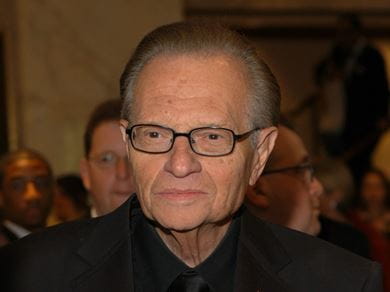
Larry King was a celebrated American television and radio broadcaster, author, and media personality. He began his career in the 1950s and 1960s as a radio interviewer for WMBM in Miami, quickly earning a reputation for his natural, conversational style. In 1978, he rose to national fame as host of The Larry King Show, a late-night, coast-to-coast call-in program on the Mutual Broadcasting System. From 1985 to 2010, King became a household name as the host of Larry King Live on CNN, where he interviewed world leaders, celebrities, and everyday people. Later, he continued his work online with Larry King Now (2012–2020) on Hulu, Ora TV, and RT America, as well as Politicking with Larry King (2013–2020), a weekly political talk show on the same platforms. Over his storied career, King conducted more than 50,000 interviews, leaving behind one of the most influential legacies in broadcast journalism.
Born Lawrence Harvey Zeiger on November 19, 1933, in Brooklyn, New York, King was the son of Jewish immigrants from Eastern Europe. His father, Aaron, worked in a restaurant and later in a defense plant; his mother, Jennie, was a garment worker. The family lived modestly, and when Larry was nine, his father died suddenly of a heart attack. The loss plunged the household into economic hardship and left a lasting mark on the boy who would grow into broadcasting’s most recognizable interviewer. He finished at Lafayette High School in Brooklyn, but college was out of reach; he needed to work to help support his mother. Even as a kid, however, he was captivated by radio. He would mimic play-by-play at baseball games by rolling up a scorecard into a makeshift microphone and calling the action under his breath. That fascination became a compass pointing toward his future.
In his early twenties, King was told that Miami offered opportunity for ambitious newcomers. He took the advice, hopped a bus south, and talked his way into an entry-level job at a small station. On May 1, 1957, when another announcer abruptly left, King was thrown on the air. Just before his first shift, a manager suggested that “Zeiger” sounded too ethnic for radio and urged him to pick a simpler on-air name. Spotting an advertisement for a local business with “King” in it, he chose “Larry King,” a moniker he would later adopt legally. The name stuck—and so did he.
In Miami he became a versatile radio presence: spinning records, reading news and sports, and—most importantly—hosting interviews. His style was already evident: unpretentious, curious, and conversational. King soon branched into local television and newspaper work, including a stint as a sports commentator and columnist. The ascent wasn’t without turbulence. In 1971 he was arrested following a dispute with a former business associate; though the charges were eventually dropped, the episode cost him jobs and temporarily derailed his momentum. He rebuilt with the determination that would define his career, returning to broadcasting and gradually regaining his audience.
King’s national emergence began on January 30, 1978, when he debuted “The Larry King Show” on the Mutual Broadcasting System. The program’s structure was simple and addictive: an hour-long interview with a guest, followed by two hours of listener calls, and a final hour of “Open Phone America,” where anyone could talk to Larry about anything. Night after night, his warm greeting—“Hello, you’re on the air”—invited callers into an intimate national conversation. What began with a few dozen affiliate stations blossomed into hundreds as the show became a late-night institution. King’s genius wasn’t bombast or confrontation; it was curiosity. He asked the obvious question others were too proud to ask, and then waited. Guests noticed his respect. Callers sensed he cared. The show made him one of the country’s best-known voices long before most Americans had seen his face.
In 1985, CNN hired King to host a nightly interview program. “Larry King Live” quickly became appointment television and, over twenty-five years, one of the longest-running prime-time shows on cable news with a single host in a single time slot. The guest list was dazzling: U.S. presidents from Ford to Obama, world leaders from Mikhail Gorbachev to Yasser Arafat and King Hussein, cultural icons from Frank Sinatra and Marlon Brando to Oprah Winfrey and Lady Gaga. King’s approach remained consistent. He did minimal pre-interview preparation compared to contemporaries, preferring to approach a conversation like a curious viewer might—surprised, open, and unafraid of basic questions. Critics occasionally wished he would press harder; fans appreciated how much his guests revealed when they weren’t on the defensive. Ratings rewarded the formula.
Beyond the nightly program, King wrote a breezy, item-style column for years, made cameos in films and television shows as himself, and lent his distinctive voice to animated features. He weathered the shifting tides of cable news while keeping his brand of talk intact: short questions, long answers, and an almost old-fashioned civility. When he stepped back from the CNN show in 2010 after roughly 6,000 episodes, he had become an American media landmark—someone people recognized less for a single scoop than for a consistent presence that made big news feel intimate and understandable.
Retirement from CNN didn’t mean unplugging the microphone. King co-founded a digital production company, Ora TV, and launched web-based interview series including “Larry King Now” and “Politicking with Larry King.” He embraced streaming platforms and on-demand viewing with the same curiosity that once drew him to late-night radio. The format remained familiar—two people in conversation—but the distribution was new, bringing King’s interviews to younger audiences and global viewers who had discovered him through clips and social media shares. Even late in life, he was still most at ease where he’d always been: seated across from someone interesting, asking what he hoped were the right questions.
King’s own health became part of his public story. He survived a major heart attack in 1987 and later underwent quintuple bypass surgery, experiences that led him to found a cardiac charity to help patients who couldn’t afford life-saving care. Over the years he confronted additional medical challenges, including diabetes and later strokes, and he spoke candidly about them, using his platform to encourage screenings and heart-healthy living. The openness that characterized his interviews extended to his personal life; when asked how he coped, he consistently credited excellent doctors, access to good care, and a stubborn will to keep working.
Larry King’s personal life drew public fascination, not least because of his many trips down the aisle. He was married eight times to seven women, a résumé he discussed with characteristic humor and candor. His first marriage, to his teenage sweetheart Freda Miller, was annulled. He later married and divorced Mickey Sutphin and, twice, Alene Akins—the second time with Alene producing their daughter, Chaia, and the couple also raising her son Andy. He wed Sharon Lepore in the late 1970s, divorced, and later married Julie Alexander. In 1997 he married singer and television host Shawn Southwick (later known as Shawn King), with whom he had two sons, Chance and Cannon. Along the way, he also fathered Larry King Jr. with Annette Kaye, whom he did not meet until his son was an adult.
Counting biological and adopted children, King was the father of five: Larry Jr.; Andy; Chaia; Chance; and Cannon. In 2020 he suffered the devastating loss of Andy and Chaia within weeks of each other—Andy from a heart attack and Chaia after a battle with lung cancer. He spoke publicly about the grief, praising their lives and the bonds they shared. Those who knew him best often described him as an affectionate, involved dad who delighted in his children’s pursuits and, even amid demanding schedules, made time for ballgames, school events, and shared meals. King was also an avid sports fan—an unwavering supporter of the Dodgers from their Brooklyn days to Los Angeles—frequently seen behind home plate or commenting on baseball with the same enthusiasm he brought to interviews.
As with many public figures whose professional lives overfill the calendar, King’s marriages sometimes foundered under pressure, and he admitted he wasn’t always easy to live with. Still, he maintained cordial relationships with several ex-spouses, emphasized the importance of family, and kept close ties with his sons as he aged. His later years, even as he continued to work, were anchored by fatherhood and the satisfaction of watching Chance and Cannon come of age.
In his final years, King continued to tape interviews, appear on panels, and offer commentary on the media landscape he had helped shape. He was candid about health setbacks and honest about aging, but he never lost the itch to ask questions. Larry King died on January 23, 2021, in Los Angeles, at the age of 87. Tributes poured in from across the world: politicians who had sparred on his set, entertainers who had broken news from his chair, fellow journalists who learned from his rhythms, and viewers who felt they knew him because, for so many nights, he’d been a companion in their living rooms.
Larry King's Religious Beliefs
King’s religious background and beliefs formed a distinct thread in his life. Raised in a Jewish home by immigrant parents, he learned Hebrew as a boy and was steeped in the cultural rhythms of Jewish Brooklyn. Over time, however, he moved away from religious belief, describing himself first as agnostic and later as an atheist. He remained proudly Jewish in cultural identity and heritage—open about his background, publicly supportive of Jewish causes and the state of Israel—and he often spoke with rabbis, priests, pastors, and imams on the air with genuine interest. Yet he did not profess belief in God or an afterlife. The distinction mattered to him: he could celebrate the culture and community he came from while honestly acknowledging that faith, for him, was not a matter of belief.
Back to the Celebrity Faith Database